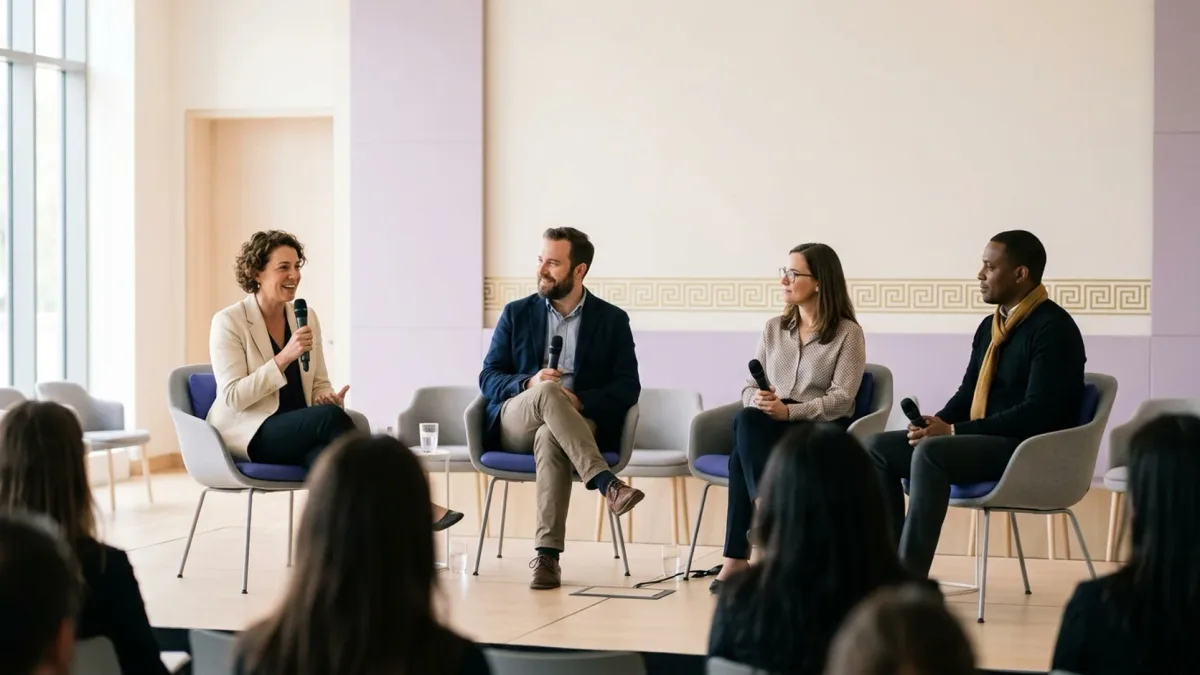
Most panel advice is a list of twenty things: prepare, don't ramble, don't check your phone, research your co-panelists. It's all true and it skips the two things that actually decide how a panel goes for you.
The first is arithmetic. A panel gives you far less speaking time than you think, in far smaller pieces, and almost nobody works out how many pieces before they sit down. The second is that the standard advice assumes a moderator who runs the room well. Plenty don't — and every article on airtime balance is written for the moderator, not for the panelist sitting there having said nothing for fifteen minutes.
This guide covers both, plus the answer shape that fits the time you actually have. It's a specific sub-skill inside the broader practice loop in how to improve public speaking, and it leans on the same delivery fundamentals — it just applies them to a format where you're seated, sharing a microphone, and speaking in ninety-second bursts.
Here's the sequence:
- Ask the moderator for the format, the questions, and the running order.
- Work out how many answers your panel actually gives you.
- Pick three key messages, not ten.
- Write a two-sentence self-introduction and learn it cold.
- Build each answer as headline, example, implication, stop.
- Learn the physical signals that get you called on.
- Decide in advance how you'll handle a question you can't answer.
- Manage your listening face — it's most of your stage time.
This guide is about speaking on a panel at a conference or event. If you're the one being interviewed by several people at once, that's a panel interview and a different problem — start with how to prepare for an interview instead.
How much will you actually get to speak?
Work this out before anything else, because it sets every other decision.
Take a standard 45-minute panel with a moderator and four panelists. Roughly five minutes goes to the moderator's introduction, framing and housekeeping. Another ten goes to audience questions at the end. That leaves about thirty minutes of moderated discussion split four ways — about seven and a half minutes each.
Seven and a half minutes is the entire budget. What changes is how many pieces you get it in:
Ninety seconds is the number most experienced panel organisers land on, and it's what Powerful Panels advises panelists as an upper bound for a single response. The chart shows why: at ninety seconds you get five distinct moments in front of the room. At three minutes you get two, which means four of the moderator's questions go by with your best material unused.
At a normal spoken pace of around 130 words a minute, ninety seconds is roughly 195 words — about three tight paragraphs. That's a useful thing to know when you're preparing, because it's a length you can actually draft and time. The same word-budget arithmetic runs through how to write a speech, and it works the same way here.
The planning consequence is the part people skip. Five answers means three key messages, not ten. Pick the three things you want the room to remember, and accept that whichever question comes, you're steering toward one of the three.
How do you prepare for a panel discussion?
Preparation for a panel is a different job from preparing a talk. You're not writing something; you're loading a small set of things you can reach for in any order.
Ask the moderator five questions, in writing, at least a week out. How long is the session and how much of it is audience Q&A? Will there be self-introductions, and how long? What questions are you planning to ask, and in what order? Who else is on it? Am I here as the technical voice, the practitioner, the sceptic? That last one matters more than the rest — the moderator usually has a mental casting for each panelist, and knowing yours tells you which answers are yours to take.
Research the other panelists, and specifically look for where you disagree. Not to pick a fight. A panel where four people agree is a boring panel, and the moderator knows it. If you can identify in advance the one point where your experience genuinely differs from someone else's, you have the most valuable thing on any panel: a position only you can take.
Draft your three key messages as sentences, not topics. "Pricing" is a topic. "Most teams discover their pricing was wrong about eighteen months too late" is a message. The second one you can say out loud under pressure; the first one you have to invent an answer around while the room watches.
Bring examples, not arguments. For each message, have one concrete thing that happened — a number, a project, a moment. The examples are what get remembered and quoted, and they're also what protects you when nerves make abstractions hard to assemble. Keeping them specific is the same discipline as explaining complex ideas simply: one anchor beats three qualifiers.
Write your self-introduction and learn it cold. Two sentences, about fifteen seconds: who you are, and the specific thing that makes your view on this topic worth hearing. Not your résumé. "I'm Dana, I run support at Northwind — about four hundred conversations a week come through my team, so I see the failure modes before anyone else does." The introduction is the first thing that happens, it's the moment you're most nervous, and it's the one part of a panel you can fully script.
How to speak on a panel: the four-beat answer
Every guide says keep your answers short. Almost none say what goes in the short answer, which is why "be concise" so rarely survives contact with a live microphone.
Use four beats:
- Headline — one sentence that answers the question directly. If the room heard only this, it should still be an answer.
- Example — one specific thing that happened. A number, a customer, a time it went wrong.
- Implication — what it means for the people listening. One sentence.
- Stop. Deliberately. Hand it back.
That's the whole shape, and at a normal pace it lands between sixty and ninety seconds without you watching a clock.
The fourth beat is the one people fail. Most over-long panel answers aren't long because the speaker had too much to say — they're long because the speaker didn't know how to end, so they added a qualification, then a second example, then a summary of the qualification. If you find yourself doing this, the fix is a fixed landing phrase you always use: "…so that's the bit I'd watch." Then silence. A stop that feels slightly abrupt to you sounds decisive from the third row. If trailing off is a pattern for you generally, how to stop rambling when you talk deals with the underlying habit.
Two modifications for the panel format specifically:
Tag on instead of starting fresh. Open by connecting to what the last person said — "Building on that, the thing I'd add is…" or "We actually found the opposite…". It turns four sequential mini-speeches into a conversation, which is the thing audiences say they want and rarely get. It also buys you a beat to think.
Don't answer if it's already been answered. Saying "I'd agree with everything Marcus just said, and I'd only add one thing" and then adding one thing is stronger than three minutes of paraphrase. Passing is allowed, and it buys credit you can spend on the next question.
Before the panel starts, decide the order of your three messages and roughly which question type each one attaches to. Then when the moderator asks something you didn't anticipate, you're not inventing an answer — you're choosing which of three prepared things is closest and building the bridge.
What if the moderator never calls on you?
This is the common failure and it's strangely absent from the advice. Search for panel airtime and everything you'll find is written for the moderator: balance the panelists, ask the quiet one directly, notice who hasn't spoken. That's correct — Powerful Panels puts airtime balance squarely on the moderator — and it's no help at all if you're the one who's been silent for fifteen minutes.
Getting in is a physical skill, not a verbal one. In order of subtlety:
- Sit forward. Most panelists sit back into the chair. Coming forward six inches, forearms on knees, is visible to the moderator in peripheral vision and reads to the audience as interest rather than interruption.
- Catch the moderator's eye at the end of someone's sentence, not in the middle. Moderators are scanning for the next turn exactly then. This is where eye contact when public speaking does concrete work for you rather than being a general virtue.
- Lift the microphone. Not to your mouth — just off your lap to chest height. It's the clearest non-verbal "I have something" available on a panel and it's nearly invisible to the audience.
- Take the handoff verbally. When the current speaker finishes, "Can I add one thing to that?" directed at the moderator, not the room. Short, deferential, almost always granted.
- Use the audience Q&A. If the moderated section has been lopsided, the final ten minutes are your recovery window. Answer the first question that's remotely yours.
If you get three minutes with two minutes left in the session, use it. Don't try to deliver all three prepared messages at speed — pick the one that hasn't been covered, give it the full four beats, and let the others go. One clear thing is worth more than three rushed ones, and the rushed version is what makes people remember you as the panelist who talked fast at the end.
What do you do when you can't answer the question?
Decide this in advance, because the live improvisation is always worse.
The wrong move is bluffing, and panels punish it faster than most formats — there are three people beside you who know the subject and can see the bluff, and it's usually being recorded. The right move is two sentences: name the limit, then hand it somewhere useful. "I haven't seen that in our context — Priya's the one who's actually run it at that scale." You've been honest, you've been generous to a co-panelist who will return the favour, and you've moved the session along in about six seconds.
You can also redirect to the nearest thing you do know: "I can't speak to the regulatory side, but the operational version of that question comes up constantly, and there…". That's not evasion as long as you've named the swap out loud first.
And if your mind goes completely blank — which happens more on panels than on stage, because you can't rehearse the questions — the repair is the same as anywhere: buy a beat honestly rather than filling it with noise. Repeating the question back slowly is the standard move and it works. What to do when your mind goes blank covers the rest.
What do you do while the other panelists are talking?
Roughly eighty percent of your time on a panel is spent not speaking, in a chair, in front of the room. That's the part most preparation ignores entirely.
Turn toward whoever is speaking. Not a full swivel — angle your torso and your eyes. It reads as engagement to the audience and, usefully, it stops you performing a listening face at the crowd, which never looks like listening.
Take a note when someone says something you want to respond to. It gives your hands something to do, it makes the tag-on easy when your turn comes, and it signals to the audience that the panel is a conversation rather than four people waiting to talk.
Assume the camera is on you. Sighing, checking a phone, scanning the room, jiggling a leg — all of it is visible and all of it is what gets clipped. The seated-posture details here matter more than they do standing up, and body language for public speaking has a section on exactly what changes when you sit down.
Keep the microphone off your mouth between turns. A handheld held at chin height while you're not speaking picks up your breathing and every quiet agreement noise you make. Rest it on your knee and bring it up as you start. If you're on a shared mic passed down the row, take it, speak, and pass it back rather than holding it hostage while you think.
How do you stand out on a panel without dominating it?
The panelist people remember is almost never the one who spoke most. Airtime and impact come apart on a panel more than in any other speaking format.
What actually gets remembered: a number nobody else had, a position that disagreed with the room, a story with a real person in it, and one sentence phrased well enough to repeat. All four fit inside ninety seconds. None require extra time.
What gets remembered badly: the person who answered every question, the person who used a panel slot as a product pitch, and the person who was still finishing their point while the moderator was trying to close the session.
There's a quieter version of standing out that works especially well if you're not naturally the loudest person in a group: be the one who makes the panel better. Reference other panelists by name, ask one of them a genuine question, credit an answer that was good. Moderators notice it immediately and reward it with more turns, and audiences read it as confidence rather than deference. That's the same dynamic that runs through how to speak up in meetings — the contribution that moves the discussion along carries more weight than the longest one.
How do you practise for a panel?
You can't rehearse a panel the way you rehearse a talk, because you don't control the prompts. What you can rehearse is the unit: one question, one four-beat answer, ninety seconds.
Write down the ten questions you think are most likely — the moderator's list if you got it, plus the obvious ones. Then answer them out loud, one at a time, on a timer, without writing the answer first. The aim isn't a script. It's to find out which of your three messages is hard to say cleanly under time pressure, because that's the one that will fall apart live.
Do a few of them seated, with something mic-shaped in one hand. Delivery changes when you sit — breath support drops, gestures shrink, and volume goes with them — and the first time you notice that shouldn't be on the stage. Getting feedback on how you're actually landing, rather than how it felt, is the whole point of a practice loop; an AI speech coach is one way to get it for the ninety-second format without organising four friends and a moderator.
Key takeaways
- A 45-minute panel with four panelists gives you about 7.5 minutes total — roughly five answers at ninety seconds each. Prepare three key messages, not a talk.
- Build each answer in four beats: headline, one specific example, one implication, stop. The stop is the beat most people skip.
- Ask the moderator for the format, the questions and your casting a week out; research where you genuinely disagree with a co-panelist.
- Learn a fifteen-second self-introduction cold — it's the most nervous moment and the only fully scriptable one.
- If the moderator forgets you, get in physically: sit forward, catch their eye at the end of a sentence, lift the mic to chest height, then ask.
- When you can't answer, name the limit and hand it to someone who can. Bluffing on a panel is visible to the three experts sitting next to you.
- Eighty percent of your panel time is listening on camera — turn toward the speaker, take notes, keep the mic off your mouth.
Frequently asked questions
How long should a panel answer be?
About ninety seconds — roughly 195 words at a normal speaking pace, or three tight paragraphs. On a 45-minute panel with four panelists you have about seven and a half minutes of airtime in total, so ninety-second answers give you around five turns while three-minute answers give you two. Ninety seconds is also the upper bound most panel organisers recommend.
How do you prepare for a panel discussion?
Ask the moderator a week out for the session length, the Q&A split, the questions and their order, and what role you're cast in. Research the other panelists specifically to find where your experience differs from theirs. Then draft three key messages as full sentences, attach one concrete example to each, and learn a two-sentence self-introduction cold.
How do you stand out on a panel without dominating it?
Standing out on a panel is about density, not airtime. A number nobody else had, a position that disagrees with the room, a story with a real person in it, or one sentence phrased well enough to repeat — all four fit inside ninety seconds. Referencing other panelists by name and asking one of them a genuine question also earns you more turns from the moderator.
What do you do if the moderator never calls on you?
Getting in is physical before it's verbal. Sit forward, catch the moderator's eye at the end of someone's sentence rather than mid-sentence, and lift your microphone off your lap to chest height — the clearest non-verbal signal available on a panel. If that fails, wait for the current speaker to finish and ask the moderator directly: "Can I add one thing to that?" Audience Q&A is your recovery window.
What should you do while the other panelists are talking?
Turn your torso and eyes toward whoever is speaking, and take a note when you hear something you want to respond to — it gives your hands a job and makes your next answer easy to connect. Assume you're on camera the whole time: sighing, phone-checking and leg-jiggling are all visible and all clippable. Keep a handheld mic off your mouth between turns.
What do you say when you don't know the answer on a panel?
Name the limit and hand the question somewhere useful: "I haven't seen that in our context — Priya has actually run it at that scale." Two sentences, six seconds, and the session moves on. Bluffing is a bad bet on a panel specifically, because three people who know the subject are sitting next to you and it's usually being recorded.
Conclusion
A panel rewards preparation of a very specific kind: three messages, one example each, a ninety-second shape you can land on any question, and a plan for getting in when nobody hands you the floor. Time a few of your answers out loud before the day — the gap between what you meant to say in ninety seconds and what you actually fit into it is the whole difference between a panelist people quote and one they can't quite remember.