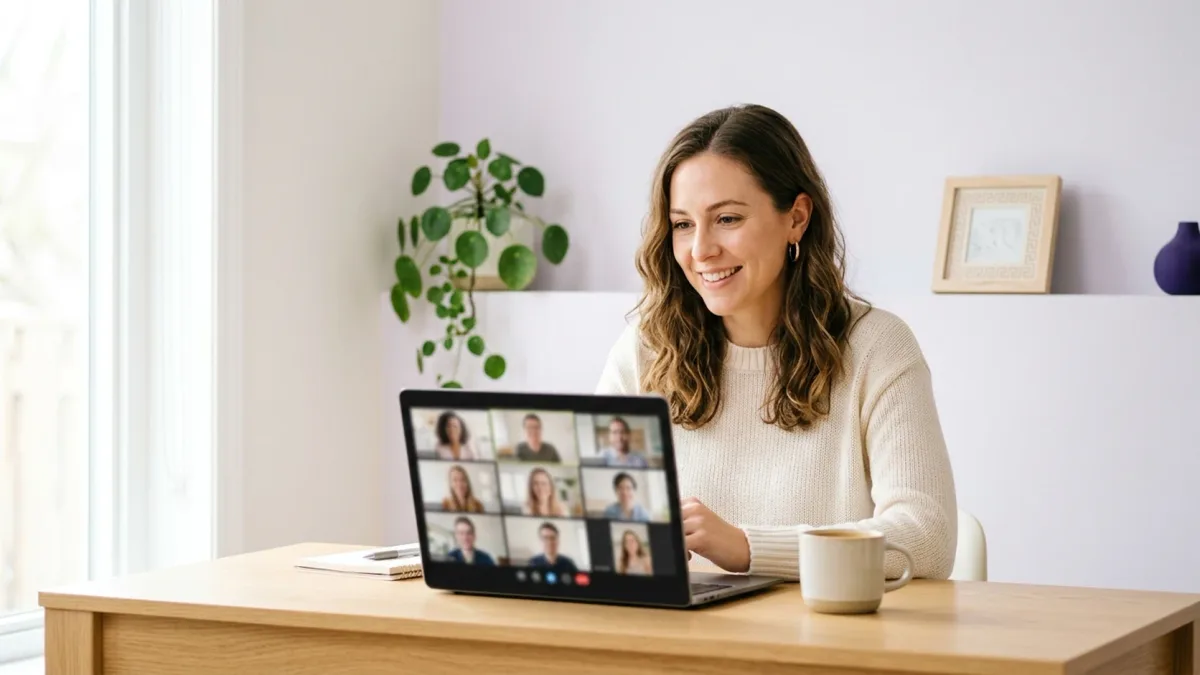
You can be completely at ease presenting to a room and still feel your stomach drop the moment a Zoom call connects. That is not a contradiction. In-person confidence and on-screen confidence draw on different skills, because a video call adds three things a live room never had: a mirror of your own face, a camera that is never quite where anyone's eyes are, and silence with no clear signal for whose turn it is.
This guide is the companion to our guide to speaking with confidence, which covers the general habits — pace, pauses, rehearsal — that make you sound composed anywhere. Here we go narrower: the handful of things that are specific to the on-screen medium, and genuinely make video calls harder than talking to the same person across a table.
Why video calls feel harder than talking in person
Video calls are not just "talking, but through a screen" — they carry a specific kind of nonverbal overload that in-person conversation does not. Stanford researchers built a validated Zoom Exhaustion & Fatigue scale after finding that sustained close-up eye gaze, constant self-view, reduced mobility, and higher cognitive load from reading nonverbal cues through a small window compound into a distinct kind of tiredness (Stanford Report, 2021).
One factor the researchers isolated by name is "mirror anxiety" — the self-consciousness that comes from watching a live video of your own face while you are supposed to be listening to someone else. In the same research, women were 2.5 times more likely to report significant video call exhaustion, with mirror anxiety identified as a meaningful driver of that gap (Stanford Report, 2021).
None of that is a personality flaw. It is a predictable response to being shown a live mirror during a task that requires your attention to be somewhere else entirely. Once you know mirror anxiety is a named, measured effect and not a sign you are bad at video calls, the fix stops being "relax" and starts being "change what you are looking at."
Separately, a 2024 UK workplace survey by Face For Business found that 62% of employees had avoided a work call in the past year because of anxiety about being on camera — this is common enough that it is worth treating as a specific skill to build, not a quirk to hide.
Where to actually look (it is not the camera, exactly)
Most advice says "look at the camera lens," and it is close, but not quite right. A 2025 eye-tracking study found viewers rate remote eye contact as most natural when the speaker looks about 2 degrees below the camera lens, not directly into it — looking straight at the lens reads as slightly too intense on playback (Gao et al., Journal of Vision, 2025).
In practice: put a small sticky dot just under your webcam, at roughly where the top of your monitor meets the lens, and aim your gaze there instead of at the gallery of faces below it. It takes a few calls to feel automatic, because your instinct is to look at whoever is talking — but that instinct is exactly what makes you look disengaged to everyone else on the call.
The stakes are higher than they feel. A 2024 study simulating online job interviews found that candidates whose gaze drifted down toward the screen instead of the camera received significantly lower evaluation scores than candidates who looked at the lens, even though both groups gave the identical prepared answer (Scientific Reports, 2024). The words were the same; only the gaze changed the outcome.
Resize your video window and drag it directly under your webcam before an important call. The physical distance between your eyes and the lens is what breaks the illusion of eye contact — closing that gap is the single cheapest fix available.
Turn off your own mirror
If mirror anxiety is a named, measured driver of video call stress, the most direct fix is to stop looking in the mirror. Every major platform lets you hide your own self-view while keeping your camera on for everyone else — right-click your own tile in Zoom, or use the three-dot menu in Teams and Meet, and select "hide self-view."
This feels wrong the first time you try it — like turning off a smoke detector. In practice, it removes the one input that has nothing to do with the conversation and everything to do with self-monitoring. You cannot fully listen to a colleague and evaluate your own face at the same time; the mirror is competing for the same attention the conversation needs.
If you are the type who wants a small amount of reassurance that your framing is fine, minimize the self-view window to the smallest size the platform allows instead of hiding it outright, and check it once at the start of the call rather than continuously.
How to speak up without an obvious turn-taking cue
A conference table gives you posture shifts, a lean forward, an intake of breath — the small physical cues that signal "I am about to talk" before anyone says a word. Video strips almost all of that out. What is left is a flat grid of faces and a mute button, and the fear of talking over someone is usually what keeps people silent when they actually have something to say.
The fix is a verbal substitute for the physical cue you have lost. Say a person's name before your point — "Sam, quick add to that" — instead of just starting to talk, because a name functions as the lean-forward you can no longer see. If the platform has a raised-hand feature, use it for anything longer than a quick add; it gives the host an explicit signal instead of relying on a gap in the audio that may never come.
Waiting for a natural pause on video is a losing strategy, because pauses are rarer and shorter than they are in person — everyone else is waiting for the same gap. Naming who you are responding to and stating your point in one sentence, the same point-first habit from how to improve speaking skills, gets you into the conversation faster than waiting for permission that video rarely offers.
Presenting on a screen-share without losing your presence
The moment you start screen-sharing, your video tile usually shrinks to a small corner box or disappears entirely — and with it goes most of your presence as a person the audience is listening to. This is the point where confident speakers start sounding flat, because they are now performing to a slide instead of a room.
Two habits fix most of this. First, narrate transitions out loud before you move the cursor — "next, let's look at the Q3 numbers" — so the audience is oriented by your voice, not by watching a mouse move. Second, periodically stop sharing or shrink the shared window to bring your face back to full size for a key point; reserving your full video presence for the two or three moments that matter most makes those moments land harder than droning through slides with a tiny face in the corner the whole time.
If you are running a full session rather than a quick screen-share, how to give a virtual presentation covers the rest of it — the pre-call tech rehearsal, an opening built for a distracted room, and what to say when the connection drops mid-sentence.
Reading slides verbatim is a bigger problem on screen-share than in person, because the audience's eyes are already on the text — your voice needs to be adding something the slide does not say, or there is no reason for them to keep listening to you instead of just reading.
A two-minute routine before you join
Nerves before a video call are often worse than nerves before an in-person meeting for a simple reason: there is no walk to the room, no small talk in the hallway, no transition time. One click and you are on camera. Building a short transition back in solves most of the "instant panic" feeling.
Before joining anything that makes you nervous: close every other window so you are not tempted to multitask through your own anxiety, take three slow breaths with a longer exhale than inhale, and say your opening line out loud once — not in your head — so your voice has already made the sound before the call needs it. Then check your framing once, hide your self-view, and join a minute early instead of at the exact start time, so you are not still adjusting your camera while other people are already talking.
None of this replaces the underlying habits from how to speak with confidence — pace, pauses, finishing your sentences. Video call confidence is what happens when you add the screen-specific fixes on top of those habits, not instead of them.
Key takeaways
- Video call anxiety has specific, named triggers — mirror anxiety, gaze mismatch, and lost turn-taking cues — that general confidence advice does not target directly.
- Look about 2 degrees below your camera lens, not straight at it or at the gallery of faces, for the most natural-reading eye contact.
- Hide or shrink your self-view. You cannot fully listen and monitor your own face at the same time, and mirror anxiety is a measured driver of video call exhaustion.
- Say a person's name before you speak up — it replaces the physical lean-forward cue that video removes.
- On screen-share, narrate transitions out loud and bring your face back to full size for the moments that matter most.
Frequently asked questions
Why do I feel more anxious on video calls than in person?
Video calls add triggers that in-person conversation does not have: a live view of your own face (mirror anxiety), a camera that never quite matches eye contact, and no physical cues for whose turn it is to speak. Stanford researchers found these nonverbal factors combine into a measurable kind of exhaustion distinct from general social anxiety (Stanford Report, 2021).
Should I look at the camera or the screen during a video call?
Look just below the camera lens rather than directly at it or at the faces on your screen. A 2025 eye-tracking study found viewers perceive the most natural eye contact when a speaker's gaze sits about 2 degrees below the lens, and gaze that drifts toward the screen instead of the camera is rated as noticeably less engaged (Gao et al., Journal of Vision, 2025).
Does turning off self-view actually help with video call nerves?
Yes. Watching a live video of your own face competes for the same attention the conversation needs, and researchers have identified this "mirror anxiety" as a specific driver of video call exhaustion, especially pronounced for women (Stanford Report, 2021). Every major platform lets you hide your own tile while keeping your camera on for others.
How do I jump into a video call conversation without talking over someone?
Say the person's name before your point — "Sam, quick add to that" — instead of waiting for a natural pause, since video strips out the physical cues, like leaning forward, that normally signal you are about to speak. Waiting for silence on video is unreliable because everyone else is waiting for the same gap.
Why do I sound flat when I'm screen-sharing on a call?
Screen-sharing usually shrinks or hides your video tile, so the audience stops seeing you as a person and starts watching a static slide. Narrate what you are doing out loud before you move the cursor, and periodically bring your full video back for the points that matter most, instead of staying shrunk in the corner for the whole presentation.
Conclusion
Video-call nerves have their own specific triggers — mirror anxiety, gaze mismatch, lost turn-taking cues — so they need their own specific fixes, not generic confidence advice. Hide your self-view, look just below the lens, and say a name before you speak. Small mechanical changes, rehearsed once or twice, do more than any pep talk.