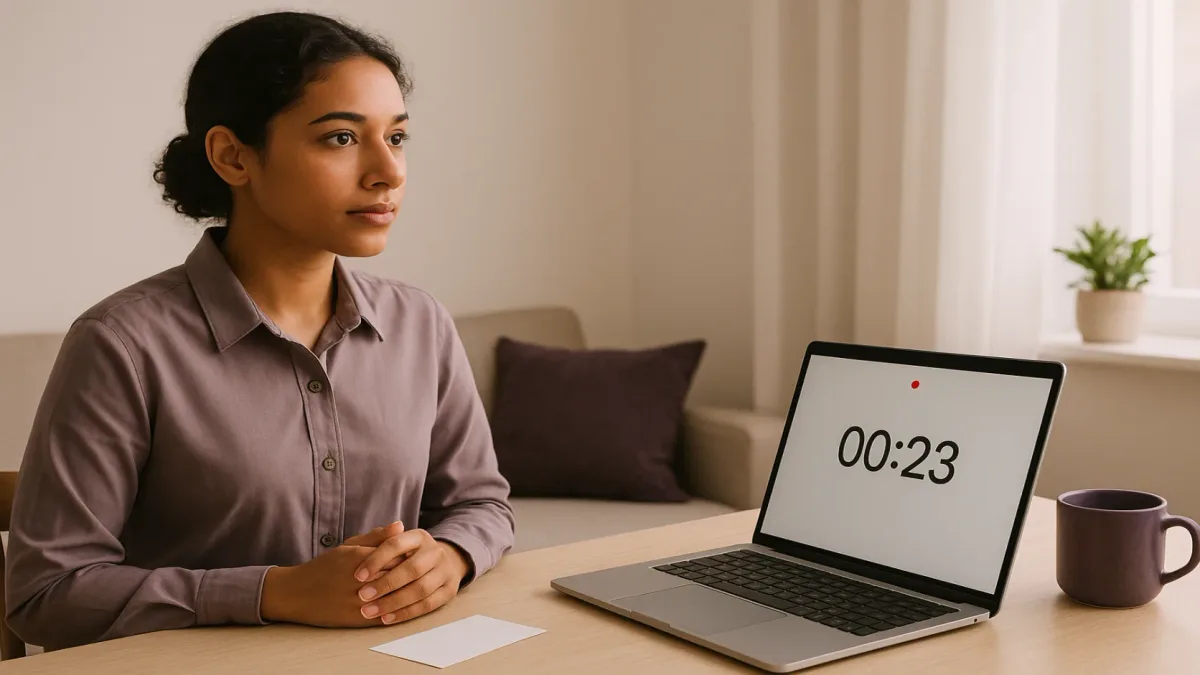
The email says something like "You've been invited to complete a video interview" and gives you a link and a deadline. No interviewer, no time slot. Just you, a webcam, a question on screen and a countdown. HireVue, Spark Hire, Willo, Modern Hire and the recording step inside many applicant tracking systems all work this way, and for many graduate schemes and high-volume roles it's now the first real screen.
Most advice treats this as a normal interview with the other person taken out: dress well, test your Wi-Fi, look at the camera. That's all true, and it misses the point. Taking the listener out changes how people talk. Without nods, a "mm-hm", or a follow-up question, people don't know when they're done. They run long, circle back, and add a second ending to an answer that already worked. A small body of research from I/O psychology has now measured those effects directly, and it gives far more concrete advice than "be yourself."
This guide sits under our guide to speaking with confidence and next to our mock interview practice guide, which covers tools. Here the focus is narrower: the delivery problem that is unique to answering a camera.
- Learn the format before you start: number of questions, think time, answer limit, retakes.
- Understand why it feels harder: there is no listener to tell you how you're doing.
- Know what gets scored: mostly your words, not your face.
- Plan your length: aim for about two-thirds of the time limit.
- Finish on purpose: one landing line, then stop recording.
- Use think time for a skeleton, not a script.
- Tell one specific story from your best moment, not a "usually" answer.
- Talk to the lens, not the screen.
- Rehearse on a timer and watch it back before the real thing.
What is a one-way video interview?
A one-way video interview, also called an asynchronous video interview (AVI) or recorded video interview, is a screening step where you record answers to preset questions on your own schedule, before a deadline. The employer watches the recordings later, sometimes with automated scoring. Nobody is live on the call at any point.
The mechanics vary by employer, because each one configures its own settings. The pattern is usually:
- Three to eight questions, shown one at a time. You can't see the next question until you've answered the current one.
- Think time before each answer, commonly around 30 seconds, set by the employer per question (Hirevire help centre, How thinking time and retakes work).
- An answer limit per question, usually somewhere between one and three minutes, with a visible countdown.
- Retakes, if any, are set by the employer. Some allow one or two, some allow none, and practice questions can usually be repeated as often as you like.
- A deadline window, often three to seven days from the invitation.
Every platform shows you the settings before the first real question: how many questions, the think time, the answer limit, and whether retakes are allowed. Write those four numbers down. Everything else in this guide depends on them, especially the answer limit.
The format exists because it's cheap to scale. A recruiter can watch fifty two-minute answers in the time it would take to schedule five phone screens. That matters for you, because it tells you how you're being watched: quickly, one after another, often at 1.25x speed, next to dozens of other candidates answering the exact same question. Clear structure and a clean ending stand out in that setting far more than polish does.
Why do one-way video interviews feel harder than a real interview?
They feel harder because the listener's feedback is gone, and that feedback was doing more work than you realised. In a 2025 University of Neuchâtel study of 160 people completing a mock one-way interview, 38.7% said they had trouble completing an interview with a computer rather than with a person (Orji, How asynchronous video interview design features influence interviewees' experience, behavior, and interview outcomes, PhD thesis, University of Neuchâtel, 2025).
In a normal conversation the listener is constantly steering you without saying anything. A nod tells you a point landed. A slight frown tells you to give an example. A shift in the chair tells you to wrap up. Researchers call these signals backchannels, and speakers lean on them far more than they realise. Remove them and you're speaking into silence, with only a countdown for company.
Researchers at Ulm University measured what happens to performance when interviews move on-screen. In a 2021 study of 114 mock interviews, half face-to-face and half by videoconference, the same quality of answers was rated more negatively on video. Candidates on video made less eye contact, used fewer impression-management tactics such as pointing out their strengths, and reported a weaker sense of social presence (Basch et al., It takes more than a good camera, Journal of Business and Psychology 36(5), 2021). That was a live video call, where someone could still react. A recorded interview removes even that.
That's the reframe that makes the rest of this guide work. A one-way interview isn't hard because you're bad on camera. It's hard because three jobs the listener used to do are now yours: telling you you're on track, telling you to give an example, and telling you you're done. Every technique below replaces one of those missing signals with something you decide in advance.
What does HireVue actually score?
Mostly your words. HireVue removed facial analysis from its assessments in March 2020, and said publicly in January 2021 that advances in natural language processing had made language far more predictive, so visual analysis "no longer significantly added value" (SHRM, HireVue Discontinues Facial Analysis Screening, 2021).
Two things follow from that. First, a lot of anxious advice online is out of date. You don't need to hold a fixed smile or worry that a frown in the middle of a sentence is costing you points with an algorithm. Second, what you say and how clearly it's organised matters most, whether a model or a recruiter is the one watching. Many employers don't use automated scoring at all; a person watches the clips and rates them against a guide.
That doesn't mean appearance is irrelevant to human viewers. In a separate 2024 study, the same Ulm-linked research group found that the background behind an applicant can bias how they're evaluated (Basch et al., How different backgrounds in video interviews can bias evaluations of applicants, International Journal of Selection and Assessment, 2024). A plain wall, even light from the front and a camera at eye level remove a variable you don't want in play. Do that once, then put your attention back on the answers.
How long should a one-way video interview answer be?
Long enough to tell a complete story, and not one sentence longer. In a 2025 experiment, 185 people answered four interview questions with a one-, three- or five-minute limit. Coders rated answers highest for clarity and relevance in the three-minute condition, where people spoke for about 127 seconds on average (Orji & Bangerter, Tick tock, tick tock, time's up!, International Journal of Selection and Assessment, in press 2025).
The detail in that study is more useful than the headline. With one minute, people used about 92% of the time (roughly 55 seconds) and answers were rated least relevant: there wasn't room to finish. With five minutes, people spoke for about 136 seconds on average, only 46% of the limit, and ratings fell back down. More time didn't produce more content; it produced looser content. Within each condition, people who spoke longer generally did better, but once speaking time was held equal, a longer limit was linked to lower performance and higher anxiety. A big empty countdown is a pressure of its own.
You can't choose your time limit, but you can choose your target. Here's a rule of thumb that follows from the data. It's our reading of the study, not a number the authors prescribe:
| Answer limit | Plan to speak for | Why |
|---|---|---|
| 1 minute | 45–55 seconds | The limit is tight. Cut the setup, lead with the result. |
| 2 minutes | 75–100 seconds | Room for one full story with a short setup. |
| 3 minutes | 90–130 seconds | Where answers were rated best. Don't stretch to fill it. |
| 5 minutes | 2–2.5 minutes | Treat it like a three-minute limit. The extra time is a trap. |
If you finish a strong answer at 1:40 of a 3:00 limit, that isn't a failure to use the time. That's the answer working.
Why should you stop talking as soon as you've finished?
Because a second ending makes the first one worse. In a Neuchâtel study of 114 people answering three past-behaviour questions, about 80% kept talking after they'd already wrapped up at least once, and a third did it on every question. Raters scored the first, complete answer higher for performance and persuasiveness than the full answer including the add-on (Orji, PhD thesis, University of Neuchâtel, 2025).
The researchers call these extended responses. They show up in a recognisable way: the candidate says something like "so that's how I handled it," the timer still shows 50 seconds, and they start again. "And I think what I really learned from that was..." The add-ons had more pauses, as people worked out what else to say in real time, and they drifted from the concrete story into opinions and values. Extended responding was more common in people high in emotionality, which fits the idea that it's partly a way of coping with silence: if nobody tells you you're done, you keep going in case you're not.
In a live interview, the interviewer would cut in at that point with the next question. In a recorded interview, nobody rescues you. So build the ending in advance:
- Write one landing line per story. It should state the result and connect it to the role in a single sentence. "We shipped two days early, and that's the kind of deadline pressure I'd expect in this job."
- Say it, pause for a beat, and press stop. Most platforms let you end a recording before the timer runs out. Use that button. Unused time isn't scored against you; rambling is.
- Don't add a summary of what you just said. If the story was clear, the summary is noise. If it wasn't, the summary won't fix it.
If you know you tend to keep going in normal conversation too, our guide on how to stop rambling when you talk covers the habit in more depth.
How should you use the think time?
Use it to build a skeleton, not to write a script. A 2021 study found that giving candidates preparation time in an asynchronous interview improved their ratings, and the benefit ran through active response preparation, meaning people used the time to plan what to say, not just to calm down (Basch et al., A good thing takes time, International Journal of Selection and Assessment 29(3–4), 2021).
The evidence is not all one-way. In a 2025 follow-up with 274 people, unlimited preparation time made no difference to performance compared with just enough time to read the question, about 12 to 27 seconds (Orji, PhD thesis, 2025). Read together, the two studies point to the same practical conclusion: what you do with the seconds matters more than how many you get. Thirty seconds spent on a plan beats three minutes spent worrying.
Here's a 30-second routine that fits the standard think time:
- Seconds 0–5: name the skill. What is this question really testing? Handling conflict, owning a mistake, prioritising, influencing without authority.
- Seconds 5–15: pick one moment. One specific occasion, with a date you could put on it. Not a type of situation that happens a lot.
- Seconds 15–25: write three words. One for the situation, one for what you did, one for the result. Not sentences. Three words fit on a sticky note in your eye line.
- Seconds 25–30: say your first sentence in your head. The first sentence should answer the question directly. Once that's out, the story carries you.
If you've used the STAR method before, this is STAR compressed to fit a timer; our guide to answering behavioral interview questions walks through the full version with examples.
Tell one specific story, not a "usually" answer
The strongest answers describe one particular occasion; the weakest describe what you generally do. Interview researchers call the second kind a pseudo-story: a summary of repeated situations with no clear time frame. In the 2025 Neuchâtel study, simply rewording questions to ask about a time you performed at your best raised interview performance and made people more likely to tell an actual story (Orji, PhD thesis, 2025).
You can't reword the employer's question, but you can reword it for yourself during think time. When the screen says "Tell me about a time you handled multiple competing deadlines," ask yourself silently: when was I best at this? That small switch pushes your memory toward a single peak episode instead of a blended average.
Here's the difference on the same question.
The pseudo-story (common, weaker):
"I'm someone who's really organised, so when I have lots of deadlines I usually make a list and prioritise based on urgency. I try to communicate with my team so everyone knows what's going on, and I'm good at staying calm under pressure. I think time management is one of my strengths."
Nothing in that answer is false, and nothing in it is checkable. A viewer watching forty of these can't tell yours from anyone else's.
The specific story (stronger):
"The clearest example is the week before our spring product launch last March. I was covering the support rota for a colleague on leave, and the launch FAQs were due the same Friday. I told my manager on Monday that both couldn't be done well, proposed that I hand two rota shifts to a teammate in exchange for covering hers the following week, and blocked my mornings for the FAQs. We published them two days early, and support tickets in launch week were about a third lower than the previous launch. That's the kind of trade-off I'd expect to make here, where launches and support overlap."
Count what changed: a date, a named conflict, a decision you made, who you told, and a result with a number. Then a landing line, and stop. It runs about 50 seconds spoken at a normal pace, which leaves room to slow down and still finish well inside a two-minute limit.
If the question is an opener such as "tell me about yourself," the same rule applies in a different shape: a present-past-future arc, not a career history. Our guide to answering "tell me about yourself" has the full structure.
How do you talk to a camera when no one is there?
Look at the lens, raise your energy a notch above normal conversation, and talk to one imagined person. The Ulm videoconference study found candidates on video made less eye contact and felt less social presence, and that this helped explain why identical answers were rated lower than face-to-face (Basch et al., Journal of Business and Psychology, 2021).
On a recorded interview, the screen is the enemy of eye contact. Your own face is right there, plus a countdown, and your eyes will drift to both. Some practical fixes:
- Put the camera at eye level. A laptop flat on a desk films up your nose and makes you look down into the lens. Stack it on books until the lens is level with your eyes.
- Move the question window up, near the camera, if the platform lets you, so reading doesn't pull your gaze down.
- Stick your three-word note just under the lens, not on the desk. Glancing at it then looks like a natural pause instead of reading.
- Hide or cover the self-view if you can. Watching yourself while you talk splits your attention; the effect is the same one that makes video calls tiring, which our guide on how to be confident on video calls covers.
- Picture one specific friendly person behind the lens: a supportive former manager, a mentor. You'll naturally warm up your tone and pace for a person in a way you won't for a black dot.
Energy is the other adjustment. A camera flattens you. Volume, facial movement and vocal variety that feel slightly too much in your room tend to read as normal on playback. Don't perform. Just speak as you would to someone sitting across a large table rather than right next to you. If your voice tends to go flat when you're nervous, how to stop sounding monotone has drills for exactly that.
Smiling at the start of each answer is fine and helps you sound warm, but you don't need to hold a smile. HireVue dropped facial analysis in 2020, and human reviewers care much more about whether your answer was clear and specific.
How do you prepare for a HireVue interview?
Rehearse the exact conditions: a timer, a camera, no listener, and one take. The research on think time found that what helped was active preparation: planning what to say, not just having more time (Basch et al., International Journal of Selection and Assessment, 2021). The same applies before the interview. Practising answers in your head doesn't build the skill the format tests, which is finishing a clear answer out loud, on time, to nobody.
A three-session plan that fits most deadline windows:
Session 1 (day one, 40 minutes): build the story bank. Pull six to eight specific stories from your last few years, each tied to a skill: a conflict, a mistake, a deadline, persuading someone, learning fast, leading without a title. For each, write the three-word skeleton and one landing line. Match them against the job description's requirements, and against the common questions below.
Session 2 (day two, 30 minutes): record against a timer. Pick eight likely questions. Give yourself 30 seconds of think time, then record one take of each with the answer limit you were given. No restarts. Then watch all eight back and score each on three things only:
- Did I answer the question in the first sentence?
- Was it one specific story, or a "usually" answer?
- Did I stop after the landing line, or keep going?
Most people find the third one is where they lose the most. Re-record only the answers that failed a check.
Session 3 (the day of, 15 minutes): warm up, then go. Do two practice questions out loud, including the platform's own practice question if it has one, because that's where you check your lighting, sound and eye line. Then start the real interview while you're warm, not an hour later.
If you'd rather not set up the camera and timer yourself, an AI interview-practice tool can ask the questions, time you and flag filler words and pacing; our mock interview practice guide compares the options. And if nerves are the main problem rather than structure, start with how to calm interview nerves.
Should you use retakes?
If retakes are allowed, use them only for a concrete fault: you answered the wrong question, lost your thread, or got interrupted. Don't re-record because you didn't like your face or said "um" twice. Second takes are often stiffer than first takes because you're now reciting, and you may burn your last retake on a minor point and then need it for a real problem on a later question. Some platforms show the reviewer only your final take; others may record the number of attempts. Either way, a natural first take with a clean ending usually beats a polished third.
Common one-way video interview questions and what they test
Most one-way interviews draw on the same small set of questions, because the employer has to write them once for everyone. Knowing what each one is really testing lets you choose the right story in 30 seconds instead of searching for one.
| Question | What it tests | Story to reach for |
|---|---|---|
| Tell me about yourself. | Can you summarise yourself clearly, and is it relevant? | Present role, one proof point, why this job next. |
| Why do you want this role / this company? | Have you done any research, and is your motivation specific? | One concrete thing about the role that connects to something you've done. |
| Tell me about a time you worked in a team that disagreed. | Collaboration under friction. | A real disagreement, what you did, how it resolved. |
| Describe a time you made a mistake. | Ownership and learning. | A genuine mistake, your fix, what you changed afterwards. |
| Tell me about a time you had to meet a tight deadline. | Prioritisation and judgement. | One week, a trade-off you chose, the result. |
| What's your greatest weakness? | Self-awareness without self-sabotage. | A real, non-fatal weakness and the system you use to manage it. |
| Describe a time you persuaded someone. | Influence and communication. | Who, what they believed, what changed their mind. |
| Where do you see yourself in five years? | Fit and commitment. | A direction that this role genuinely moves you toward. |
For the role-motivation question, see our guide to answering "why are you interested in this position?"; for the weakness question, how to answer "what is your greatest weakness?" covers which weaknesses are safe to name.
One-way video interview mistakes to avoid
Most of what costs people in a recorded interview isn't the content of their stories. It's how they handle the format. These are the ones that come up most:
- Reading a script. Your eyes move side to side, your voice flattens, and viewers notice within seconds. Script only the first sentence and the landing line.
- Filling the whole time limit. As the time-limit study showed, longer limits without more substance lower ratings. Finish and stop.
- The second ending. "So yeah, that's... and I guess the other thing is..." is the most common pattern, and the most avoidable.
- Opening with context instead of an answer. "So, I've worked in a few different roles, and in my second job..." makes the viewer wait. Answer first, then explain.
- Filler at the start of every answer. Starting each recording with "um, so" is a habit you can break in one practice session; how to stop using filler words explains how. A one-second silent pause before you start reads as composed, not slow.
- Recording at the last minute. If the deadline is Friday, don't start at 11 pm Thursday. Tired delivery is obvious on camera, and technical problems need time to fix.
Key takeaways
- A one-way video interview is a recorded screen with preset questions, short think time, a time limit per answer and employer-set retakes.
- It feels harder because the listener's feedback is gone. In one 2025 study, 38.7% of candidates struggled with answering a computer instead of a person.
- HireVue dropped facial analysis in 2020; your words and structure matter most.
- In a 2025 experiment, answers were rated clearest and most relevant under a three-minute limit, at around 127 seconds of speaking. Aim for about two-thirds of the limit.
- About 80% of candidates kept talking after finishing, and the add-ons lowered ratings. Script a landing line and press stop.
- Use think time to pick one specific story from your best moment and build a three-word skeleton.
Frequently asked questions
What are the best HireVue interview tips?
Treat it as a structure test more than an appearance test. HireVue removed facial analysis in 2020 and relies on language, and human reviewers rate clarity and relevance. So open each answer with a direct one-sentence answer, tell one specific story with a result, end on a prepared landing line, and stop recording. Set the camera at eye level, hide your self-view, and practise on a timer at least once before the real thing.
How do you prepare for a HireVue interview?
Build a bank of six to eight specific stories, each with a three-word skeleton and a landing line. Then record yourself answering eight likely questions with 30 seconds of think time and the real time limit, one take each, and watch them back. Check three things: did you answer in the first sentence, was it one specific story, and did you stop after the landing line. Use the platform's practice question to test lighting and sound on the day.
How long should a one-way video interview answer be?
Plan for roughly two-thirds of the time limit. In a 2025 study of 185 people, answers were rated clearest and most relevant under a three-minute limit, where people spoke for about 127 seconds on average. Under a five-minute limit, people spoke only slightly longer and ratings dropped. For a one-minute limit, aim for 45 to 55 seconds; for two minutes, 75 to 100 seconds; for three minutes, 90 to 130 seconds.
What is an asynchronous video interview?
An asynchronous video interview is the research term for a one-way video interview: you and the employer aren't online at the same time. You record answers to preset questions whenever you choose before a deadline, and the employer reviews them later. Platforms include HireVue, Spark Hire and Willo, and many applicant tracking systems have a recording step built in. Some employers add automated scoring; many simply have recruiters watch the clips.
Are recorded video interviews scored by AI?
Sometimes, but less than people fear, and not on your face. HireVue stopped using facial analysis in 2020 after its own research found that language was far more predictive. Some employers use language-based scoring; many have a person watch every recording against a rating guide. Either way, a clear, specific, well-structured answer is what scores well, so put your preparation into stories and structure rather than expressions.
Can you use notes in a one-way video interview?
Usually yes, unless the instructions say otherwise, but keep them tiny. A sticky note with three words per story, placed just under the camera, lets you glance without breaking eye line. Full sentences or a script on screen make your eyes track side to side and your voice flatten, and reviewers notice quickly. Script only your first sentence and your landing line, and speak the rest from the skeleton.
Conclusion
A one-way video interview takes away the listener, and with it the cues that tell you when you're on track and when you're done. The fix is to make those decisions before the timer starts: one specific story, a first sentence that answers the question, a landing line, and the discipline to press stop with time on the clock. Before your deadline, record yourself answering three questions on a timer, and watch only the last ten seconds of each. That's where you'll find out whether you're stopping or starting again.