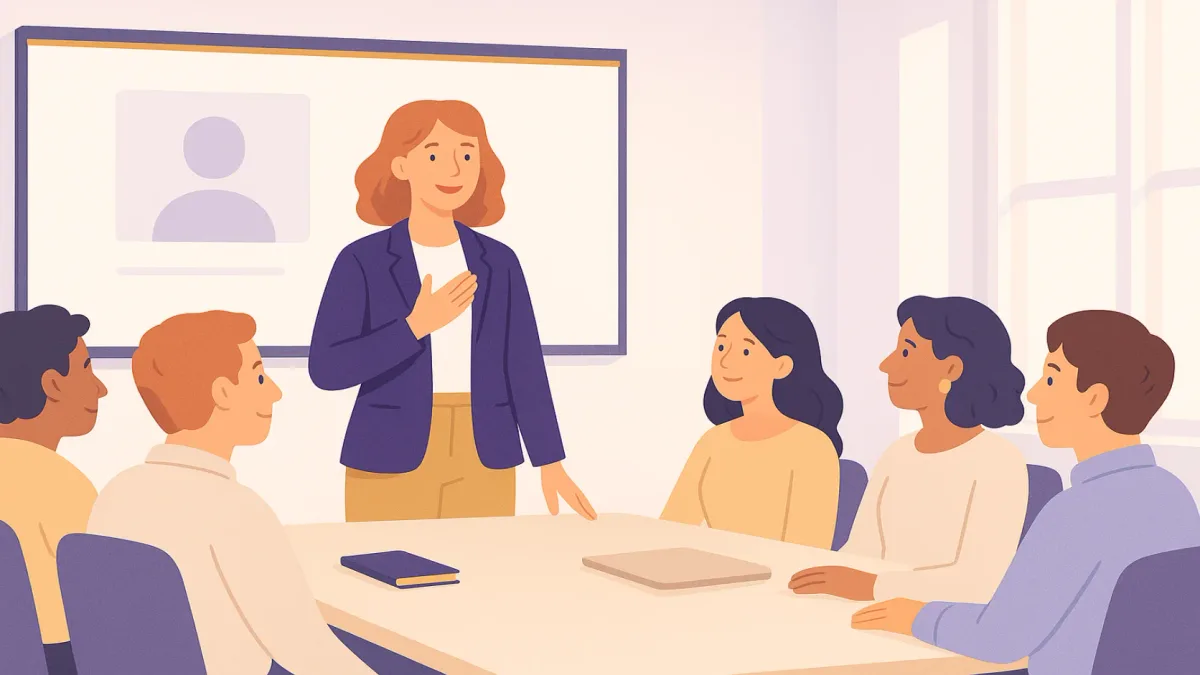
Most people introduce themselves in a presentation the way they fill in a form. Name, job title, company, how long they have been there, a thank-you to the organiser, a thank-you to the audience for coming, and then, finally, the first slide. It takes forty-five seconds, it tells the room nothing it could not have read on the agenda, and it spends the one moment when attention is guaranteed on the least interesting thing you will say all day.
The fix is not to skip the introduction. The room does need to know who is talking and why that person is worth twenty minutes. The fix is to shrink it to the only parts that do any work, put it in the right place, and say it in a form people can actually retain. This guide gives you that form: a fifteen-second structure, twelve scripts for the situations people actually face, a separate template for the speech that is about you, and the research on why the order matters more than the wording.
It sits one level below how to start a presentation, which covers the whole opening: the pause, the hook, the stakes, the roadmap. This guide is about the fifteen seconds inside that opening where you become a person with a name.
The sequence, in order:
- Open with the hook, not your name. The introduction comes second.
- Say your name slowly, once, with a pause after it.
- Give one credential that is relevant to this topic, not your job title.
- Attach one piece of proof: a number, a project, a length of time.
- Bridge into the first point with a single sentence.
- Put the same credential on the first content slide, in one line, so it survives being forgotten.
- Rehearse the fifteen seconds verbatim and record one take.
- Check the recording for three things: the name was audible, the credential was specific, nothing in it was an apology.
If the whole talk is about you, an icebreaker, a first-day introduction, a class assignment to present yourself, jump to the section on the self-introduction speech. The fifteen-second version is for when you are introducing yourself on the way to something else.
Where does the self-introduction go, and how long should it be?
Second, and short. The introduction belongs after the hook and before the roadmap, and it should run ten to twenty seconds, which at an ordinary speaking pace of roughly 150 words a minute is twenty-five to fifty words. Anything longer is a biography, and biographies belong on a slide people can read while you set up.
The reason it goes second rather than first is attention. People form their first impression of a speaker almost instantly; trait judgments made after a tenth of a second of exposure correlate almost perfectly with judgments made with unlimited time (Willis and Todorov, Psychological Science, 2006). Whatever you say first is said to a room that is still deciding what kind of thing you are. Spend that on something that matters to them, a hook that names their problem, and then introduce yourself to a room that is already listening.
The reason it goes before the roadmap, rather than at the end, is credibility. This is the part competitor guides consistently get wrong, so it is worth being precise about. A meta-analysis of experiments on the timing of source identification found that telling an audience who the speaker is before the message, rather than after it, produced large differences in how persuasive the message was, with an average effect size of 0.75 (O'Keefe, Central States Speech Journal, 1987). The specific finding is that the advantage a credible source has over a non-credible one shrinks when the identification comes late. A credential delivered after the argument is a footnote; delivered before it, it changes how every subsequent sentence is heard.
So the order inside the opening is: hook, then who you are, then where you are going. Not name first, because nobody is listening yet. Not name last, because by then the argument has already been judged without it.
What should a self-introduction in a presentation actually contain?
Four things, in a fixed order, and nothing else: your name, a relevance credential, one piece of proof, and a bridge. Here is what each one is for, and what it is not.
Your name, said slowly, once. Two seconds. Say it more slowly than feels natural and pause after it, because it is the one word in the whole introduction the room has never heard before and cannot infer from context. If you have a name people tend to get wrong, this is the moment to say it the way you want it said; nobody will ask later.
A relevance credential. Six seconds. This is the single fact about you that gives you the right to talk about this topic to this room, and it is almost never your job title. "I'm the Head of Operations" tells the audience your rank. "I've run this migration twice, at two companies" tells them why to believe you about migrations. Titles are claims; relevance credentials are evidence. If your title happens to be the credential, use it, but check that it is doing the work rather than just being there.
One piece of proof. Five seconds. A number, a duration, or a named thing: "about four hundred support conversations a week come through my team", "the last eighteen months", "the Northwind rollout". Proof turns the credential from an assertion into a fact the audience can picture. It also does something you would not expect: it makes the credential more memorable than your name. People who were told a man's occupation remembered it far better than people who were told the same word as his surname, even though it was the same word, a finding usually called the Baker/baker paradox (McWeeny, Young, Hay and Ellis, British Journal of Psychology, 1987). The room will forget "Dana". It will remember "runs support, sees four hundred conversations a week". So the proof is the part worth getting right.
A bridge. Two seconds. One sentence that turns the introduction back toward the audience: "which is why I want to show you what we found." Without it, the introduction ends in a small silence and the next slide has to restart the talk.
That is the whole thing. No thanks to the organiser, which belongs at the end if anywhere. No "I'm really excited to be here", which the room will judge by your delivery, not your announcement. No hobby, unless the hobby is the credential.
How to introduce yourself in a presentation: the fifteen-second formula
Fill this in before you write a single slide, because the credential you choose will tell you what the talk is allowed to claim.
I'm [name]. I [relevance credential: the specific thing you do or did that bears on this topic], so [proof: a number, a duration, or a named project], which is why [bridge: what you are about to show them].
Three worked versions, so you can hear the pattern rather than the template:
- "I'm Priya. I've spent the last year interviewing the customers who left us, forty-one of them so far, which is why I think our churn story is wrong."
- "I'm Marcus. I was the on-call engineer the night this system went down, twice, so what follows is what I wish someone had told me beforehand."
- "I'm Sam. I teach this module to first-years, about ninety students a term, and the same three misunderstandings come up every single time. Here they are."
Notice what none of them contain: a job title, a company history, a thank-you, or the word "passionate". Notice what all of them do: they end pointing at the audience's problem, not at the speaker.
The credential test: cover your name and read the rest aloud. If a stranger could not guess the topic of your talk from your introduction alone, the credential is not relevant enough. "I've been at the company nine years" fails the test. "I've run nine of these budget cycles" passes it.
Twelve scripts for introducing yourself, by situation
The formula holds in every room, but the weighting changes. In some rooms the name is redundant; in others the proof has to be bigger because the audience has no reason to trust you. Each script below is the fifteen-second version, with a note on what to change.
1. An internal update, where most of the room knows you. Skip the name. The credential becomes the reason you are the one presenting this, which is usually not obvious even to people who know you. "For anyone who hasn't worked with me on this: I've owned the onboarding funnel since March, so I've seen every number I'm about to show you move week by week."
2. A conference talk, where nobody knows you. Full formula, and make the proof larger than feels modest, because the room has no other way to calibrate you. "I'm Lena Ortiz. I lead data platform at a mid-size fintech, and over the last two years we've moved about three hundred pipelines off the system I'm about to criticise. So this is a post-mortem, not a prediction." If the host has already read your bio, see script nine.
3. A class or student presentation. The formal framing is usually required, so compress it to one sentence and spend the credential on the work, not the student number. "I'm Jordan, and this is my presentation on the Treaty of Westphalia. I read the three main accounts and they disagree on one point, which is what I want to focus on." If the class already knows you, drop the name; the rubric rarely requires it, and it costs you three seconds of attention. For the longer assignment where you are the subject, see the self-introduction speech below.
4. A webinar or video call, with your name on screen. Your name is already written under your face, so saying it reads as not knowing where you are. Go straight to the credential, slower than you would in a room, because video strips about a third of your energy. "Hi everyone. Quick context on why it's me talking: I ran the pilot we're reviewing, in both regions, so I can speak to what actually happened, not just the deck." The habits that make this land, where to look, what to do with your hands, are covered in how to be confident on video calls.
5. A sales or pitch meeting. The credential should be the proof that you solve the buyer's specific problem, and the bridge should be a question that makes them talk. "I'm Ravi, I work with ops teams at logistics firms about your size, twelve of them this year, and the thing they all said in the first meeting was that the problem wasn't the software, it was the hand-offs. Is that true here?"
6. An interview presentation, where the panel asked you to present. The panel has your CV, so a credential they already know is wasted. Use the credential that is not on the CV: what you did to prepare this. "Thanks for the brief. I spent the weekend with your last two annual reports and your public roadmap, and I've built this around the gap I found between them." That signals how you would work, which is what the presentation is actually assessing. The answer to the inevitable follow-up, "tell us about yourself", is a different task with its own structure, covered in how to answer "tell me about yourself".
7. A panel discussion. The moderator will ask for introductions in turn, and it is the most nervous and most scriptable moment of the whole session. Two sentences, learned cold: who you are, and the specific thing that makes your view on this topic worth hearing. The full preparation sequence is in how to speak on a panel; the introduction script is the same fifteen seconds as everywhere else.
8. A first day, new team, or all-hands introduction. Here the room wants two things from you: what you will be doing, and one handle to start a conversation with. "I'm Aisha, I'm joining as the second designer on the payments team. I spent the last four years at a bank doing the part of this nobody likes, the compliance screens, so if you have one of those on your roadmap, come and find me." One humanising detail is fine here, in the bridge, where it gives people a way to approach you. It is still not a hobby list.
9. When the host has just read your bio. Do not repeat it, and do not thank them for it at length. Acknowledge it in half a sentence and spend the fifteen seconds on the one thing the bio could not say: why this talk, today. "Thanks, Chris. The bio leaves out the relevant part, which is that I got this wrong in production before I got it right, and that is the version I'm going to tell."
10. When everyone in the room already knows you. Then the name and the credential are both redundant, and the only question worth answering is why you, on this topic, now. One sentence. "You all know me as the person who says no to new tooling, so it should tell you something that I'm the one proposing this."
11. Round-robin introductions, going around the table. This is the one format where the formula needs a change, and the reason is a memory effect described in the next section. Keep your introduction to one sentence, say the credential rather than the title, and plan to repeat the credential the first time you speak in the actual discussion, because the people sitting either side of you will not have retained it.
12. A formal or academic setting, or English as a second language. When a formal register is expected, a thesis defence, a regulatory briefing, a ceremony, use neutral phrasing that will not sound stiff: "Good morning. My name is [name], I am [role] at [institution], and I have spent the last [duration] working on [topic]." Then the bridge. Clarity beats flourish here; the audience is listening for whether you can be understood, and slowing the name down matters more than any vocabulary choice.
Why do people forget your introduction, and what do you do about it?
Because they are not listening to it, and the reason is more specific than nerves. In any format where people introduce themselves in turn, the person who is about to speak is rehearsing, not listening. Experiments in which participants each read a word aloud in turn found that the words spoken in the roughly nine seconds before a person's own turn were recalled markedly worse than the rest, an effect now called the next-in-line effect (Brenner, Journal of Verbal Learning and Verbal Behavior, 1973; summarised at Wikipedia). The person speaking just before you is the one you remember least.
Apply that to a table of eight going round in turn. Whatever you say, the person after you did not encode it, and the person before you was recovering from their own turn. Your introduction reached about five people. In a conference room, the effect is milder, because the audience is not waiting for a turn, but the audience is still doing something else for the first few seconds: deciding what they think of you, finding a seat, closing a laptop.
Three things follow from this, and all of them are cheap.
Put the credential on a slide as well as in your mouth. One line under the title of your first content slide: "Dana Reyes, Support lead, Northwind. ~400 customer conversations a week." Not a bio slide at the start, which people read instead of listening to you; a single line on a slide they will be looking at anyway, so the credential survives being missed. The slide question is covered more fully below.
Say the credential again, once, later. Not the name, the credential. The natural place is the first time you make a claim that depends on it: "and I say that having run this twice." It lands as evidence the second time, not as repetition, because it is attached to a point.
In round-robin formats, be short and plan the repeat. One sentence when it is your turn, then say the relevant thing again the first time you contribute to the actual discussion. The two people either side of you are hearing it for the first time.
What should the About Me slide show?
As little as possible, and usually not where you think. The About Me slide that opens a deck, with a photo, a bulleted career history and three logos, is the written form of the forty-five-second biography, and it fails for the same reason: it asks the room to read about you before you have given them a reason to care. People read slides faster than you can talk, so the moment it appears, the audience is ahead of you and bored.
The rule is the same as for the spoken version: one line, placed where it does work.
- For most talks, no About Me slide at all. Put one line of credential under the title on the first content slide, and move on.
- For a conference talk where the organiser wants a bio slide, put it last. It is the slide people photograph when they want to follow up, which only happens after you have said something worth following up.
- For a student or formal presentation where it is required, make it a title slide, not a biography. Your name, the course or institution, the title of the work. Nothing you would have to read aloud.
- If there is a photo, it should be of the work, not of you. A screenshot of the system, the chart that started the project, the room you ran the pilot in. The audience already knows what you look like. They do not yet know what you did.
The one exception is a pitch or sales setting where the credential is the team, in which case a single slide of faces with one line each is the proof, and belongs where the proof goes: right after the hook, as the introduction itself. Even then, you talk over it in fifteen seconds; you do not read it.
What mistakes make an introduction fall flat?
The failures are consistent, and most of them come from treating the introduction as a courtesy rather than as the first evidence the room gets about you.
Reciting the résumé. Three roles, two companies, one degree. The audience cannot use any of it, and the time it takes is time in which the hook goes cold. Pick the one credential that bears on this topic and leave the rest for a slide at the end.
Apologising in the first sentence. "I'll try to keep this short", "I'm not really a presenter", "bear with me, the slides are a bit rough." Each one tells the room to lower its expectations, and rooms oblige. The research on the spotlight effect found that people consistently overestimate how much others notice their appearance and their performance (Gilovich, Medvec and Savitsky, Journal of Personality and Social Psychology, 2000). The nervousness you are apologising for is, most of the time, invisible until you name it.
The fun fact. Competitor guides love this one: open with a quirky detail to seem relatable. In a room that has no other information about you, the fun fact becomes the information. If you want a humanising detail, put it in the bridge, where it gives people a reason to approach you afterwards, and make sure the credential came first.
"I'm passionate about". The audience will decide whether you are passionate from the next twenty minutes. Announcing it costs four seconds and adds nothing they will believe.
Reading the About Me slide aloud. If the slide says it, you do not. If you say it, the slide does not need to. Pick one.
Thanking everyone. The organiser, the previous speaker, the audience for coming, the venue. A single "thank you" to a host who introduced you is enough, and even that goes after your first sentence, not before it. Longer thanks belong at the end, if anywhere.
Mumbling the name. It is the one word nobody can infer, and it is the word most people rush, because it feels self-indulgent to dwell on it. Slow it down. If your name tends to be mispronounced, this is your one free chance to say it the right way; how to enunciate better covers the mechanics if the sounds themselves keep getting swallowed.
Running past twenty seconds. The introduction is not the talk. If it is longer than about 5% of your slot, you are warming up, and the audience knows it.
How do you introduce yourself in a speech when the speech is about you?
Sometimes the introduction is the whole assignment: an icebreaker at a speaking club, a first-day introduction to a cohort, a class task to present yourself, a two-minute "who I am" at a team offsite. This is the self-introduction speech, and it needs a different structure, because there is no topic for the credential to point at. You are the topic.
The mistake is to make it chronological. Born here, studied there, worked at these places, now here. It is a résumé read aloud, and it fails for the same reason the forty-five-second introduction fails: nothing in it is a reason to listen. The structure that works is one thread, three beats, and a question the audience can answer about you by the end.
The 90-second template:
- A thread, not a timeline. Open with the one thing that connects what you have done: a question you keep coming back to, a kind of problem you keep choosing, a thing you are known for. One sentence. "Every job I've had has turned out to be about getting two teams that don't talk to each other to talk."
- Three beats that prove the thread. Three short episodes, each with a concrete detail, in any order that suits the thread rather than the calendar. Fifteen to twenty seconds each. This is the storytelling structure at miniature scale: a situation, a thing you did, what it showed.
- What you are here for. One sentence on what you want from this room, this course, this team. It gives the audience something to do with what they have just heard.
- The handle. A closing line people can use to start a conversation with you afterwards. This is where the humanising detail finally earns its place.
A worked example, about 170 words, which is roughly seventy seconds spoken:
I'm Noor. Every job I've had has turned out to be about getting two teams that don't talk to each other to talk. The first time, I didn't know that was the job: I was a junior analyst and I noticed that finance and sales were using two different numbers for the same quarter, and nobody had said so out loud. Saying so out loud became what I did. The second time was at a hospital trust, where the problem was the same and the stakes were higher, and I learned that the fix is never a better spreadsheet, it is a standing meeting with the right two people in it. The third time was last year, when I was the one who had stopped talking to another team, and someone had to do it to me. So that's what I'm here for: I'd like to find the two teams in this organisation that most need a standing meeting. And if you're on one of them, I'll buy the coffee.
Notice that there are three stories and no dates, that the thread is stated once at the start and once at the end, and that the only personal detail is a joke that doubles as an invitation. Notice also the length. Ninety seconds is the ceiling for a self-introduction speech in most settings; a two-minute slot is better filled at ninety seconds with a pause than at two minutes without one.
Do not open a self-introduction speech with a fun fact, a quote, or a rhetorical question about the audience. Those are hooks for talks about something else. When the talk is about you, the hook is the thread.
How do you deliver the introduction when you're nervous?
By treating it as the one part of the talk you fully script, and by rehearsing it in a way that gives you a number rather than a feeling.
The introduction is where nerves peak. It is the first time you hear your own voice in the room, the first eye contact, the first discovery of whether the microphone works. That is an argument for scripting it word for word, which is advice this site gives for almost nothing else. Fifteen seconds of verbatim text is small enough to hold under adrenaline, and having it means the first thing the room hears from you is something you have said twenty times before. By the time you reach the bridge, you have found your voice and the rest of the talk can be spoken from a spine rather than a script.
Three things to drill, in order:
The name, slowed. Say it at about two-thirds of your natural pace, with a full pause after it. Adrenaline will speed it back up to normal. If you say it at normal pace in rehearsal, on the day it will be a blur. The same logic applies to the whole opening, and how to stop talking too fast explains why the first thirty seconds are where pace most often runs away.
The credential, specific. Rehearse the version with the number in it, not the version with "a lot of". "About four hundred a week" is both more credible and easier to say than "a huge number", because it has a shape.
The breath before the first word. One slow exhale, then the pause, then the hook, then the introduction. The pause is the part most people skip when nervous, and it is the part that makes everything after it sound deliberate. If your voice tends to waver in that first sentence, the breathing fix in how to stop your voice from shaking is the one to practise.
Then record one take. Fifteen seconds is short enough that you can record it on a phone, listen back immediately, and check three things: the name was audible and unhurried, the credential was specific enough that a stranger could guess the topic, and nothing in it was an apology. If any of the three fails, change the words, not your personality, and record again. Two or three takes is usually enough. An AI speech coach that listens back to the recording and flags pace and filler does the same check without you having to hear your own voice more than once; the best public speaking apps all handle a fifteen-second clip.
The thing to remember is that the room is not grading your introduction. It is deciding, in the background and mostly without noticing, whether the person talking is worth the next twenty minutes. Fifteen seconds of name, relevance, proof and bridge answers that question before they have finished asking it.
Key takeaways
- Hook first, introduction second. Nobody is listening during your first sentence; spend it on their problem, then introduce yourself to a room that is already paying attention.
- Fifteen seconds, four parts. Name, a credential relevant to this topic, one piece of proof, and a bridge into the first point. Twenty-five to fifty words.
- Credential before claim. A meta-analysis found identifying the source before the message rather than after produced an average effect size of 0.75 on persuasion (O'Keefe, 1987). Late credentials are footnotes.
- The proof is the memorable part. People retain "runs support, four hundred conversations a week" far better than they retain a name. Make the proof concrete and let the name go.
- In round-robin introductions, the people either side of you will not retain it. The next-in-line effect (Brenner, 1973). Keep it to one sentence and repeat the credential the first time you speak properly.
- No About Me slide at the start. One line of credential on the first content slide; a bio slide, if required, goes last.
- Script the fifteen seconds verbatim and record one take. Check the name was unhurried, the credential was specific, and nothing was an apology.
Frequently asked questions
How do you introduce yourself in a speech?
The same way as in a presentation: after the hook, in about fifteen seconds, with your name, one credential relevant to the speech's topic, one piece of proof and a bridge into the first point. The exception is when the speech is about you, an icebreaker or a class assignment, in which case use the self-introduction speech structure above: one thread, three short episodes that prove it, what you are here for, and a closing line people can use to approach you. Keep that version to ninety seconds.
How do you introduce yourself in a presentation as a student?
Compress the required formalities into one sentence, then spend the credential on the work rather than on yourself. "I'm Jordan, and this is my presentation on the Treaty of Westphalia. I read the three main accounts and they disagree on one point, which is what I want to focus on." If your classmates already know you, drop the name and go straight to the work; the marking rubric rarely requires a self-introduction, and the three seconds are better spent on the hook. If the assignment is to present yourself, use the ninety-second self-introduction speech template instead.
What is a good self-introduction speech example?
A good self-introduction speech has one thread rather than a timeline. The worked example in this guide opens "Every job I've had has turned out to be about getting two teams that don't talk to each other to talk", proves it with three short episodes that each contain a concrete detail, says what the speaker wants from the room, and closes with a line people can use to start a conversation. It runs about 170 words, which is roughly seventy seconds spoken, with no dates and no job titles.
How do you introduce yourself before a presentation if someone has already introduced you?
Do not repeat the bio and do not thank the host at length. Acknowledge the introduction in half a sentence, then spend your fifteen seconds on the one thing the bio could not say: why this talk, today. "Thanks, Chris. The bio leaves out the relevant part, which is that I got this wrong in production before I got it right, and that is the version I'm going to tell." That adds information rather than restating it, and it moves the room from the host's framing to yours.
What should an about me slide include in a presentation?
One line, and usually not at the start. For most talks, skip the About Me slide and put a single line of credential under the title of your first content slide: name, role, and the proof point. If a bio slide is required, put it last, where people photograph it to follow up. If there is a photo, make it a photo of the work rather than of you. A bulleted career history at the start asks the room to read about you before you have given them a reason to care, and they read faster than you talk.
How long should a self-introduction be in a presentation?
Ten to twenty seconds, or twenty-five to fifty words at a normal speaking pace. A useful ceiling is 5% of your total slot: for a ten-minute talk, that is thirty seconds including the hook. If the whole speech is about you, an icebreaker or a first-day introduction, ninety seconds is the ceiling, and a two-minute slot is better filled at ninety seconds with a pause than at two minutes without one.
Should you say your name first in a presentation?
No. Open with the hook, a sentence that names the audience's problem, then say your name. First impressions form within a fraction of a second of seeing a speaker, so your first sentence is heard by a room that is still deciding what kind of thing you are; spend it on something that matters to them. The name comes second, said slowly, with a pause after it, because it is the one word in the introduction nobody can infer from context.
Conclusion
An introduction is not a courtesy; it is the first evidence the room gets about whether to believe you, and the research says its timing changes how everything after it is heard. Shrink it to fifteen seconds of name, relevant credential, proof and bridge, put it after the hook, and let the proof carry the memory your name will not. Then write your fifteen seconds down, say them out loud, record one take, and listen for the three things that matter.