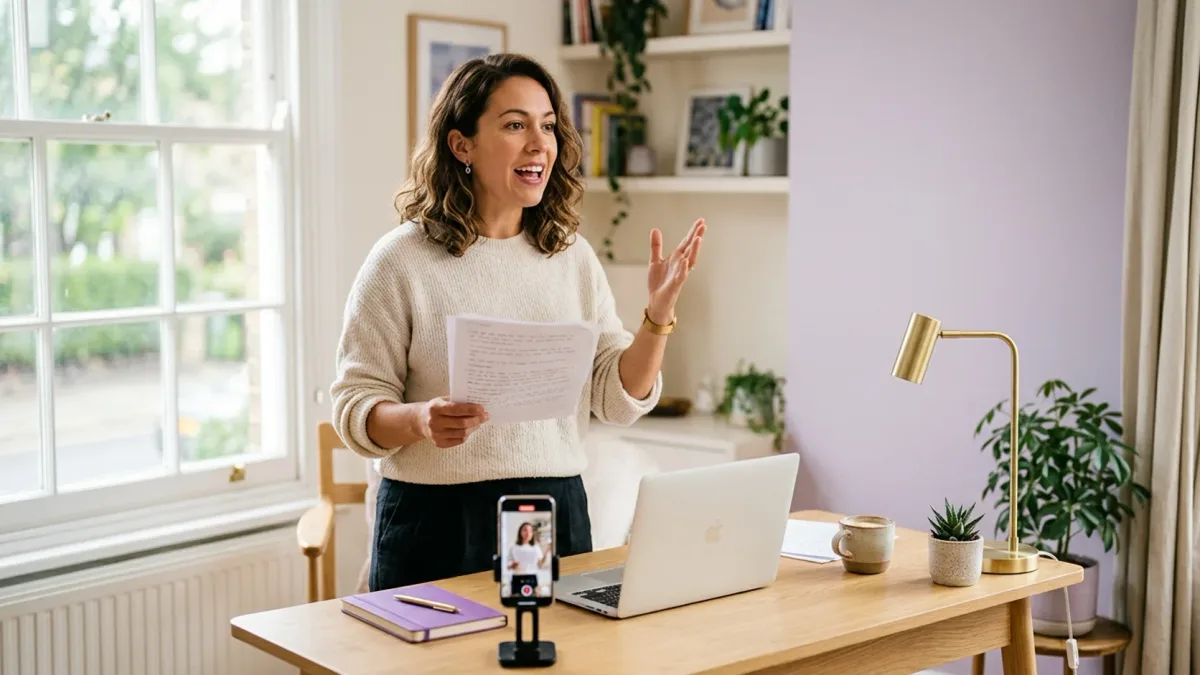
Most speech-writing advice is essay advice wearing a hat. It tells you to know your audience, hook them early, and end with impact — all true, all things you already suspected, and none of it explains why the draft you were happy with on Sunday collapses when you stand up and say it on Monday.
The reason is mechanical. Writing and speaking produce different sentences. Typed at a keyboard, you build long, nested, comma-spliced constructions that a reader can re-read at their own pace. A listener gets one pass, in real time, at whatever speed you happen to be going. A speech is not a document that gets read aloud — it is a spoken performance that happens to have been written down first, and the drafting method has to reflect that.
Here is the order this guide works through:
- Name the one sentence you want the room repeating afterwards, before you write anything else.
- Set your length budget — minutes, then words, then words per section.
- Outline three points that earn that one sentence, each stated in a single plain line.
- Draft it out loud, speaking and transcribing rather than typing.
- Write the opening last but rehearse it first, and make it a moment rather than a topic.
- Write a close that returns to the opening, not one that summarises the middle.
- Run the rewrite-for-the-ear pass over the whole draft — sentence length, subject-verb distance, pronouns, numbers.
- Decide what is scripted and what is bullets, then time a full read at real speaking pace.
Why is writing a speech different from writing an essay?
Because your reader can go back and your listener cannot. That single constraint drives every other rule in this guide.
An essay reader who loses the thread scrolls up. A listener who loses the thread is simply gone — and worse, they are gone silently, so you get no signal until the Q&A is strange. Everything that makes written prose efficient works against you here: subordinate clauses, pronouns that refer three sentences back, precise numbers, parenthetical qualifications, long noun phrases.
There is a second difference that matters more than it sounds. An essay is finished when it is correct. A speech is finished when it is sayable — when you can get through it at a natural pace without running out of breath, tripping over a construction, or hearing yourself sound like a document. That is a physical test, not an editorial one, and you cannot run it silently at a desk.
The useful mental model: you are not writing a speech. You are writing a transcript of a talk you have not given yet. Everything below is in service of making that transcript match what your mouth would actually do.
How long should a speech be, and how many words is that?
Start from time, not from pages. You are almost always given minutes — five at a wedding, ten at a conference, three for a toast — and the word count follows from your speaking rate.
The reference point is well established: conversational English runs around 150 words per minute.
Write to 130, not 150. The gap is deliberate and it is where most over-running speeches die. A prepared speech delivered well is slower than conversation: you pause between points, you let a number land, you wait out a laugh, and you take breaths you never notice in a chat. Drafting at 130 words per minute builds that room in. Drafting at 150 produces a script you can only finish by rushing — and talking too fast is the most common delivery fault there is.
| Speech length | Words at ~130 wpm | Opening | Body | Close |
|---|---|---|---|---|
| 2 minutes (a toast) | ~260 | ~40 | ~180 (one point) | ~40 |
| 3 minutes | ~390 | ~55 | ~275 (two points) | ~60 |
| 5 minutes | ~650 | ~85 | ~480 (three points, ~160 each) | ~85 |
| 10 minutes | ~1,300 | ~150 | ~1,000 (three points, ~330 each) | ~150 |
| 20 minutes | ~2,600 | ~250 | ~2,100 (three to five points) | ~250 |
Two rules hold across every row. The opening and close together take 10–15% of the total — they feel like they should be longer and they should not be. And the number of points stays at three for anything under ten minutes, no matter how much you know. A five-minute speech with five points is not a thorough speech; it is a list nobody will remember.
How do you write a speech outline?
Before any sentence gets drafted, the whole speech should fit on one index card. That card is the outline, and it has four lines on it.
- The one sentence. What do you want someone to say to a colleague the next morning when asked what you talked about? Write that sentence in plain words. If you cannot, you do not have a speech yet — you have a subject.
- Point one. A single plain line.
- Point two. A single plain line.
- Point three. A single plain line.
Then apply one test to each of the three: does it earn the one sentence, or does it merely relate to it? Most weak speeches are three things loosely orbiting a topic rather than three things building an argument. Anything that only relates gets cut, however much you like it.
Order the three deliberately. The strongest point goes first if you need to establish credibility with a sceptical room, and last if you are building to a call to action with a friendly one. The weakest goes in the middle either way — that is the position the room remembers least, which is exactly what you want for your weakest material.
Each point wants the same internal shape: claim, evidence, so-what. State it, back it with one concrete thing (a number, a story, a demonstration — one, not three), then say explicitly what it means for the people in front of you. The so-what is the line people skip, and it is the line that makes a point land rather than merely register. If your evidence is a story, storytelling in public speaking covers the spine that keeps it from wandering; if it is a technical idea, how to explain complex ideas simply covers how to make it survive contact with a non-expert room.
How to write a speech by saying it out loud
This is the step that separates a speech that sounds like you from one that sounds like a report being read. Do not type the first draft. Speak it.
Open a voice recorder or any dictation app, look at your four-line outline, and talk through the whole thing as if someone were in the room. Do not stop to fix anything. Ramble where you ramble. When you are done, transcribe it — phone dictation does this automatically, and the transcript is your actual first draft.
It will look rough. That is the point: it is rough in exactly the places your delivery is rough, which a typed draft would have hidden from you until you were standing up. What you get in exchange is enormous. The sentence lengths are already sayable. The rhythm is yours. The words are ones you can actually pronounce under pressure — nobody spontaneously says "leverage" or "utilise" out loud, but plenty of people type them. And the explanations that came out fluently are the ones you genuinely understand; the ones that came out as mush are the ones you have not thought through yet, which is information you want on day one rather than the night before.
Then edit the transcript rather than replacing it. Cut the false starts, tighten the rambles, promote the sentence you accidentally said well into the position it deserves. Speak-and-edit three or four times and you converge on something that is simultaneously drafted and half-rehearsed — which is why this method folds neatly into the practice loop in how to improve public speaking rather than sitting in front of it.
If speaking to an empty room feels impossible, record yourself explaining the speech to one specific person you know — "so the thing I want to tell them is…". The transcript comes out warmer and more direct than either typing or formal dictation, and warm and direct is what you were going to spend three rewrites trying to add anyway.
What does the rewrite-for-the-ear pass actually change?
Once you have a draft, run one pass whose only job is to make it sayable. Four mechanical checks, in this order:
- Sentence length. Anything over about 25 words gets split. Vary what is left — a run of uniformly short sentences is as hard to listen to as a run of long ones, because the rhythm stops carrying meaning.
- Subject-verb distance. Put the subject and its verb next to each other. A listener holds an unresolved subject in working memory, and every word you put between the two is a word of tax.
- Pronouns. Replace most of them with the actual noun. "It" is free to write and expensive to hear, because your listener has to look backwards to resolve it and loses the sentence you are currently saying.
- Numbers. Round them, and give each one a comparison. "Forty-one point seven per cent" is unhearable. "More than four in ten — so, this row of the room" is not.
Here is the pass on one real sentence. Before, typed for the eye:
Although the onboarding improvements we shipped in Q3, which were originally scoped as a fix for the activation drop-off that support had been flagging since May, delivered a 41.7% reduction in first-week churn, they have not yet been extended to the enterprise tier.
After, rewritten for the ear:
In May, support started flagging the same complaint: new users were dropping off in week one. We shipped a fix in Q3. First-week churn fell by more than four in ten. Enterprise customers still do not have it.
Same facts, same length, roughly. But the second version is four sentences instead of one, every subject sits next to its verb, the pronoun "they" is gone, the number is rounded and comparable, and the chronology runs forwards instead of being reassembled out of a subordinate clause. Read both out loud once and the difference is not subtle.
Do this pass with your mouth, not your eyes. Silent reading smooths over exactly the constructions that trip you — you will not find the sentence that runs out of breath until you actually run out of breath in it.
How do you write the opening?
Write it last, and rehearse it first. Openings written before the body tend to describe a speech you have not settled on yet, which is where "Today I'd like to talk about…" comes from.
The rule that does most of the work: open with the moment, not the topic. A topic sentence tells the room what category the next ten minutes belong to. A moment puts them inside it and earns the topic sentence for free.
- Topic: "Today I want to talk about how our onboarding is failing new users."
- Moment: "Last Tuesday, a new hire spent forty minutes stuck on a form our onboarding never mentions."
Both introduce the same speech. Only one makes anyone look up. Whatever you choose — a scene, a number that does not sound possible, a question the room is already privately asking — the test is that it should be impossible to deliver while the audience is still checking their phones. A full treatment of the openers that work in a formal setting is in how to start a presentation.
Two things not to put in an opening: an apology of any kind ("I'm not really a speaker", "I only got this on Friday"), and a preview of your own structure in a speech under ten minutes. In a long conference talk, signposting helps. In a five-minute speech it spends your most valuable eighty-five words describing the speech instead of giving it.
How do you write the close?
Return to the opening. That is the whole technique, and it beats every summary-based ending.
If you opened with the new hire stuck on a form, close with what changes for that person once the fix ships. If you opened with a number, close with what the number becomes. The callback does two things a "so, in conclusion" cannot: it tells the room unmistakably that you are finished — which is why people stop stranding themselves in the awkward "…yeah, that's it" — and it leaves them holding the one image you most want them to keep, rather than a recap of everything you said.
Then stop. The most common drafting error in a close is writing past the ending: landing the callback, and then adding a thank-you paragraph, an acknowledgements list, and a final qualification that quietly undoes the point. Write the last line, read what comes after it, and delete it. How to end a presentation covers the closing moves in more depth, including where a call to action goes when you have one.
What should you script word for word, and what should stay bullets?
A full script is a trap and a full improvisation is a different trap. The mix that works for almost everyone:
- Script word for word: the opening, the close, any number you quote, and the one sentence you most want repeated. These are the moments where improvising costs you most, and they are short enough to know cold.
- Keep as bullets: everything in between. One line per point, plus a keyword for the evidence under it. This keeps you assembling sentences live, which sounds like a person talking rather than a person reciting.
- Write out but do not memorise: any explanation you find genuinely hard. Drafting it precisely forces the thinking; delivering it from a bullet keeps it alive. The precision survives even when the wording does not.
The reason to hold the middle loosely is recoverability. A memorised middle has one path through it, so losing your place means losing the thread entirely — see what to do when your mind goes blank for the recovery. A bulleted middle has many paths, so a stumble costs you a sentence instead of a minute. How to memorize a speech covers how to lock the scripted parts down without turning the whole thing rigid.
How do you write a speech for a specific occasion?
The structure above holds everywhere. What changes is the weighting and the tone.
| Occasion | What changes | Length |
|---|---|---|
| Wedding or best man speech | One story, told properly, beats five anecdotes. Warmth over jokes; land on the couple, not on you. | 3–5 min |
| Eulogy | Specifics, not adjectives. One small habit of theirs says more than a paragraph of praise. Write in a breath pause after the hardest line. | 3–7 min |
| Work update or all-hands | Conclusion first, then the reasoning. Executives want the answer before the method. | 3–10 min |
| Conference talk | One idea, three points, a demo or story per point. Cut your second-favourite idea entirely. | 20–40 min |
| Graduation or award acceptance | Thank specifically and briefly, then give them one usable thing. Gratitude lists are the format's main failure mode. | 2–5 min |
| School or class assignment | Follow the brief's structure literally, then make the opening a moment. Most classmates will open with the topic. | 3–5 min |
Two notes that apply to the emotional ones. Write the hardest sentence of a eulogy or a wedding speech down word for word even though you will not need the rest scripted — it is the sentence your voice is most likely to go on, and having it in front of you means you only have to read, not compose. And rehearse those out loud more, not less; the first time you say a sentence about someone you love should not be into a microphone. How to stop your voice from shaking covers what to do when it happens anyway.
How do you know the draft is finished?
Not when it reads well. Run these four tests, all of them out loud:
- Time a full run at real pace. Not a fast read — the pace you will actually use, with the pauses. If it runs long, cut a point rather than trimming words evenly across all three; evenly trimmed speeches lose their evidence first and turn into assertions.
- Say it without looking, and see what survives. Whatever you remember without the page is the speech. Whatever vanishes was probably decoration.
- Check you can breathe it. Mark where you actually inhale. If any sentence has no natural breath in it, it is too long, no matter how it scores on the page. Deliberate pauses are part of the draft, not an accident of delivery — how to use pauses when speaking covers where to put them.
- Read the one sentence to someone and ask what they think it is about. If their answer is not your one sentence, the problem is the outline, not the wording, and no amount of polishing the prose will fix it.
Only after those four does the draft become a delivery problem, which is where how to give a presentation picks up.
Key takeaways
- Write for one listening pass, not for a reader who can scroll back.
- Budget ~130 words per minute, not 150 — a delivered speech is slower than conversation.
- Keep the opening and close to 10–15% of the total, and hold to three points under ten minutes.
- Get the whole speech onto one index card — one sentence plus three lines — before drafting.
- Draft by speaking and transcribing, then edit the transcript. Do not type the first draft.
- Run a rewrite-for-the-ear pass: split long sentences, close subject-verb gaps, kill pronouns, round numbers.
- Open with a moment rather than a topic, and close by returning to that moment.
- Script the opening, close and numbers; keep the middle as bullets so a stumble costs a sentence, not a minute.
- The draft is finished when you can time it, breathe it, and someone else can repeat your one sentence back.
Frequently asked questions
How many words is a 5 minute speech?
About 650 words, if you write to a delivered pace of roughly 130 words per minute. Calculators that use the conversational average of 150 wpm will tell you 750, and that is the number that makes people over-run: a prepared speech is slower than conversation because you pause between points, let numbers land, and take breaths you never notice in a chat. Draft 650 and time a real run. If it comes in at four and a half minutes you have room; if it comes in at six you were reading, not speaking.
How long should a speech be?
As long as you were given and no longer — running over is the fastest way to lose a room's goodwill. Within that, match the number of points to the time: one point for a two-minute toast, two for three minutes, three for five to twenty minutes. Beyond about twenty minutes attention drops sharply regardless of quality, so anything longer needs a change of format — questions, a demo, a second voice — rather than more speech.
How do you write a speech outline?
Four lines on one index card: the single sentence you want the room repeating tomorrow, then three points that earn it. Test each point by asking whether it earns that sentence or merely relates to it, and cut the ones that only relate. Give each point the same internal shape — claim, one piece of concrete evidence, and an explicit so-what. If the whole speech will not fit on the card, it is not outlined yet.
What should you include in a speech?
One controlling idea, three points that support it, one concrete piece of evidence per point, an opening that puts the room inside a moment, and a close that returns to it. What to leave out matters just as much: opening apologies, a structural preview in anything under ten minutes, more than one piece of evidence per point, and any sentence that comes after your actual last line.
Should you write a speech word for word or from bullet points?
Both, in different places. Script the opening, the close, any number you quote, and the one sentence you most want remembered — those are short and they are where improvising costs the most. Keep the middle as bullets so you are assembling sentences live, which sounds like a person talking instead of a person reciting, and so a stumble costs you one sentence rather than the thread.
What are the best speech writing tips for a beginner?
Say it before you type it. Almost every beginner problem — sentences too long to breathe, words you would never use out loud, a draft that feels stiff in the mouth — comes from writing for the eye and then reading the result aloud. Record yourself talking through your outline, transcribe it, and edit that. The second tip is to cut to three points, because over-stuffing is the other universal beginner fault.
How long does it take to write a speech?
For a five-minute speech, budget about two hours of writing spread over two or three sittings, plus rehearsal. The outline takes twenty minutes, the spoken draft and transcript about thirty, and the rewrite-for-the-ear pass another thirty — but the gaps between sittings do real work, because the weak point you could not see on Tuesday is obvious on Wednesday. Writing it in one sitting the night before is possible and almost always shows.
Conclusion
A speech is not a document you read out — it is a transcript of a talk you have not given yet, and the fastest way to write one is to give it badly first and edit what comes out. Set the word budget, get it onto one index card, then put the keyboard away and start talking. The draft you speak into existence is already half-rehearsed, which is the only kind worth having.