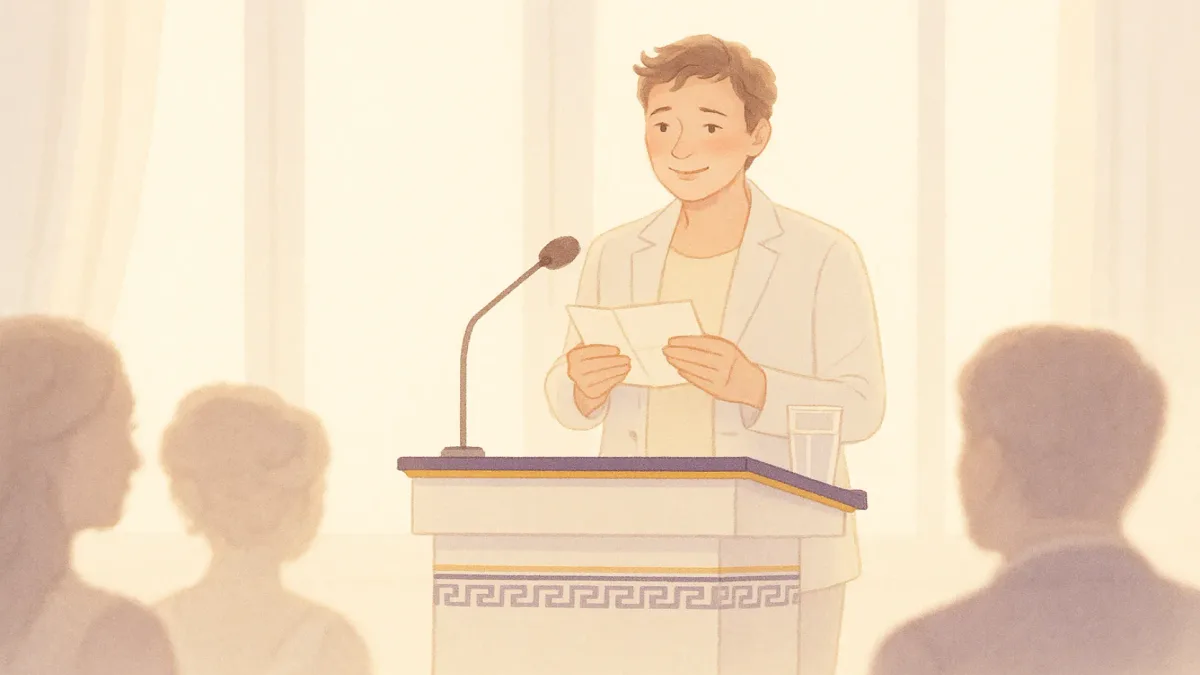
You have read the speech a dozen times at the kitchen table without a flicker. Then you stand up, say the first line to a room full of faces, and your throat closes on a sentence that was fine an hour ago. Your voice goes thin, your eyes sting, and some part of you starts bargaining with the rest: just get through this paragraph. For a eulogy, a wedding toast, a retirement send-off, or the personal story you decided to put into a work talk, this is the fear that sits above all the usual nerves. It is not that you will forget your words. It is that you will not be able to say them.
Most advice on this subject is a list of tricks: press your tongue to the roof of your mouth, pinch the bridge of your nose, look up, drink water, breathe. Some of those help a little and this guide will tell you which and why. But the tricks miss the two facts that actually decide whether you get through. First, the instinct to hold it in is the strategy that the research says fails. Second, the sentence that gets you is not a mystery; it can be found in advance, rewritten, and worn down by repetition until it no longer lands. This guide covers both, then gives you a recovery script for the moment the lump arrives anyway and the evidence on what audiences make of tears, which is kinder than you expect.
It sits beneath how to speak with confidence, which covers the general habits that keep you steady in front of a room, and alongside how to stop your voice from shaking, which handles the adrenaline tremor that often arrives first. This one is narrower. It is about the moment the feeling, not the fear, takes your voice.
Here is the sequence:
- Understand why saying it aloud to people hits harder than reading it alone, and why clenching against the feeling backfires.
- Map the trigger lines in your draft, usually the first naming, the direct address, the small sensory detail, and the last line.
- Rewrite those lines to report rather than relive, and write them out word for word so you can read instead of compose.
- Say the hard lines out loud, many times, across several days, until two runs in a row come out flat. That is habituation, and it is the real technique.
- Rehearse the conditions, not just the words: standing, with the card, to a listener, at the pace you will use.
- Prepare a ten-second recovery for the lump: stop, eyes down, long exhale, swallow, one bridging line, next written sentence.
- Decide now that you will not apologise and will not speed up if your eyes fill. Tears cost you nothing. The stall is the only risk.
- Record your rehearsals, note where the catches happen, and watch the count fall before the day.
A word on the goal. Not crying is the search term, but the real aim is finishing well, and finishing well includes the possibility of a wet-eyed pause. Thousands of people have given a eulogy with a crack in their voice and it was the best thing anyone said that day. What you are trying to prevent is not the feeling showing. It is the stall: the thirty seconds where you cannot continue and do not know how to get back. Everything below is built to prevent the stall.
Why do you cry when you give a speech but not when you read it alone?
The sentence is the same. What changes is that you are now saying it, out loud, to the people it is about or the people who share the loss. Speech is a social act, and emotional tears are a social signal; Ad Vingerhoets of Tilburg University, who has studied adult crying for three decades, describes tears as a message about helplessness and need that other people respond to (The Psychologist, British Psychological Society). Reading at the kitchen table sends that signal to nobody. Standing up and saying "she was my best friend" to her mother sends it to exactly the person it was built for, and the body knows the difference.
There is a second reason, and it is more useful because you can act on it. The lines that get you are nearly always the specific ones. Not "he was a generous man" but "he kept a jar of coins by the door for the parking meter so none of us would ever get a ticket." Specific sensory detail is what makes a eulogy good and it is also what makes it dangerous, because a concrete image re-creates the person rather than describing them. You do not cry at the adjective. You cry at the jar of coins. Which means the trigger lines can be found before the day, and the section on rewriting them shows how.
And a third: you are not just sad, you are sad in front of people, with a fear of crying stacked on top. That second layer is what tightens your throat before the feeling has even arrived. Which brings us to the thing almost every guide gets backwards.
Why does "holding it in" make it worse?
Because suppressing an emotion is expensive, and it does not reduce the emotion. In a 1998 study at Stanford, James Gross showed 120 people a disgusting film and told some of them to think about it in a way that would keep them from feeling anything (reappraisal), told others to behave so that nobody watching could tell what they felt (suppression), and let the rest simply watch. Both regulation groups showed less on their faces. But only reappraisal reduced what people actually felt. Suppression left the feeling untouched and raised sympathetic nervous system activation, the fight-or-flight arousal that makes your heart pound and your hands cold (Gross, Journal of Personality and Social Psychology, 1998). An earlier study by Gross and Robert Levenson with 85 participants found the same thing: told to hide what they felt, people showed less, felt no less, and their bodies worked harder (Gross and Levenson, 1993).
Source: Gross, JPSP, 1998
That is the laboratory version of the thing you already know from experience: the harder you clench against tears, the more your whole body shakes, and the feeling is still there when you unclench. Now add the mechanics of the lump. When you are upset, your autonomic nervous system opens the glottis, the gap between your vocal cords, to let more air through. When you then swallow or hold your breath to force the sob back, you are asking the muscles around the glottis to close it at the same moment other muscles are holding it open. The tug-of-war is the lump, the feeling that you have swallowed a golf ball (BBC Science Focus). The lump, in other words, is partly made by the holding. The harder you hold, the bigger it gets, and your voice has to squeeze through the middle of it.
So the strategies that work are the ones Gross would call antecedent-focused. They act before the feeling peaks: changing the words so the image is less raw, moving your attention, reframing what the moment is, and above all wearing the sentence down in rehearsal so that it does not peak at all. The strategy that fails is the one you are most likely to reach for on the day: clamping down at the moment of impact. The diagram below puts the two routes side by side.
How to not cry during a speech: fix the script before you fix yourself
The cheapest intervention happens on paper, days before, when you are calm. Here is how to work through a draft.
Find the trigger lines. Read the whole thing aloud, alone, once, and put a mark beside every sentence where your voice changes, even slightly. You will usually find three to five. They cluster in predictable places: the first time you say the person's name, any line that addresses them directly ("Dad, you would have hated this"), the smallest concrete detail (the coin jar, the way she said your name), and the last line. If you want a method for building the draft itself, how to write a speech covers structure and timing for toasts and eulogies specifically. This section assumes you have a draft and are now making it survivable.
Report, do not relive. The lines that get you are usually written from inside the moment. "I still hear her laughing in the kitchen" puts you in the kitchen. "She laughed more than anyone I have known, usually in the kitchen" says the same thing from one step back. The second version is not colder to an audience; it is often clearer. You are not removing the detail, which is what makes the speech worth hearing. You are changing the camera position from first person present to narrator past. Go through every marked line and ask: is this sentence describing, or is it re-entering? Re-entering sentences get rewritten.
Borrow their words instead of yours. A quotation from the person is easier to say than a sentence about your feelings for them, and it is nearly always better material. "He used to say the only thing worth being early for was a good breakfast" lands harder than "he was always so patient with us" and it costs you less to deliver, because you are performing him, not confessing you.
Put the lightest line before the heaviest. A laugh resets a room and resets you. If your hardest sentence is the last one, make the sentence before it the funniest or the warmest you have. The audience will still be smiling when you reach the hard line, and that smile is contagious in the right direction. This is attentional deployment in Gross's terms: you are steering where the room's feeling sits in the five seconds before the dangerous sentence.
Write the hard lines out word for word, even if nothing else is. Most speeches should be learned as a spine, not memorised as a script, and how to memorise a speech explains why. The emotional lines are the exception. When the feeling arrives, the part of you that composes sentences goes first. If the sentence is on the card in front of you, you only have to read it, and reading is a far smaller task than composing. Short sentences, too. A twenty-word sentence has to be carried on one breath that may not be there; three seven-word sentences give you three places to breathe.
Decide what to cut. If one line is not surviving rehearsal after the work below, it may not belong in the speech. The Buckley School's advice is blunt and correct: if you cannot tell the story without breaking, do not tell it. There is no rule that the eulogy must contain the single most painful memory. It must contain the person.
How do you rehearse an emotional speech so it stops catching?
By saying it out loud until it stops working on you. Every piece of folk advice about eulogies says "practise to get the cries out," and for once the folk advice has a mechanism behind it.
The amygdala, the brain's threat-and-salience alarm, responds hard to an emotional stimulus the first time and then, when the same stimulus is repeated, responds less and less. Hans Breiter and colleagues at Massachusetts General Hospital showed this in 1996 with fMRI: the amygdala lit up for emotional faces and then rapidly habituated as the faces were shown again (Breiter et al., Neuron, 1996), a result repeated many times since. A sentence about someone you love is a far more complicated stimulus than a photograph of a stranger's face, and it will not go flat after two repetitions. But it goes the same direction. The tenth time you say "she was the bravest person I have known" out loud, it is a sentence you have said ten times. The first time, it was the first time, and the first time should not be into a microphone.
Here is the protocol.
- Isolate the marked lines. Do not rehearse the whole speech on repeat; you will wear out the easy parts and rehearse the hard parts once each. Take the three to five trigger lines on their own.
- Say each one out loud ten times in a sitting. Full voice, at speaking pace, as if to the room. Whispering or mouthing does not count because it is not the stimulus you are habituating to. If you break on the third repetition, pause, breathe out, and go to the fourth. Breaking during rehearsal is the point: this is where the crying is meant to happen.
- Do it across days, not hours. Three sittings on three days beats thirty repetitions in one evening, because what you are after is a line that is flat when you come back to it, not one that is merely exhausted.
- Stopping rule: two consecutive flat runs. When you can say the line twice in a row, on a fresh day, and feel it as a sentence rather than a blow, that line is done. Move the effort to whichever line is still landing.
- Then run the whole speech, standing, from the card you will use, to a listener. The listener matters because the social signal is half the mechanism. A partner or a friend, once or twice. If nobody is available, record yourself and play it back; hearing your own voice say it is closer to the real thing than reading silently.
Two more tools work during these sittings, and both have evidence behind them.
Name the feeling in words before you speak. Matthew Lieberman's team at UCLA showed in 2007 that putting a feeling into a word ("this is grief," "this is the proud kind of sad") reduced the amygdala's response to emotional images, with the effect routed through the right ventrolateral prefrontal cortex; attaching a non-emotional label did not have the same effect (Lieberman et al., Psychological Science, 2007). Before each sitting, and before you walk up on the day, say to yourself what this is. It sounds too small to help. It is a measurable brake.
Talk to yourself by name. Ethan Kross and colleagues ran seven studies with 585 people and found that coaching yourself in the second or third person ("You can do this, Sam" rather than "I can do this") reduced distress and improved performance under social stress, including when participants had almost no time to prepare before giving a speech (Kross et al., Journal of Personality and Social Psychology, 2014). The pronoun swap creates a small distance, and distance is exactly what the hard line needs. "Sam is going to read the next sentence and then breathe" is a different instruction from "I have to get through this."
A note on timing for eulogies, where you may have three days, not three weeks. Compress the protocol rather than skipping it: one sitting the day you finish the draft, one the next morning, one the evening before. Even two sittings move a line a long way. And if the funeral is tomorrow and you have only tonight, do the marked lines ten times each now, once more in the morning, and lean harder on the recovery script below.
What do you do in the moment when the lump arrives?
Stop, and run a sequence you decided on in advance. Ten seconds, give or take. It feels like a minute to you and like a natural pause to the room.
- Stop talking mid-sentence if you need to. Do not push the last three words out through the lump; they come out as a squeak and the squeak is what tips you over.
- Eyes down to the card. This takes you off the faces, which are the social trigger, and puts the next sentence in front of you so you will not have to compose it.
- Breathe out, long, through your mouth. Not in. The instinct is to gulp air, but a held, full chest is part of the tug-of-war at the glottis. A slow exhale lets the muscles around it stop fighting. If you have trained a longer exhale with breathing exercises for public speaking, this is where it pays.
- Swallow, or take a sip of water. A deliberate swallow, or the swallow a sip of water forces, briefly reorganises the muscles that are fighting over the glottis. This is the one folk tip with a clear mechanical reason behind it. The water glass is not a prop. Have it there.
- One bridging line, if you want it. "Give me a second." Or, better, something of theirs: "He would be laughing at me right now." A bridging line does two things: it gives you a sentence that is easy to say, and it tells the room you are still in charge of the pause.
- Read the next written sentence. Not the one you stalled on. Finish it later if it matters, or let it go. Read the next short line off the card in a lower, slower voice than before, and let the voice come back by itself over the following sentence or two.
What you do not do: apologise, speed up, or wave the feeling away with a joke about yourself. "Sorry, sorry" turns a natural pause into an incident and invites the room to feel awkward on your behalf. Speeding up to get past the hard part is the clench route with momentum; it outruns your breath and brings the lump straight back. The same logic applies to any speaking stumble, and how to use pauses when speaking makes the broader case that a deliberate silence reads as control.
Here is what it sounds like in practice, with a father of the bride on the line he marked as dangerous:
"...and when she was six she told me, very seriously, that she was going to marry someone who could make pancakes. (voice catches) (eyes down, long exhale, sip) She picked well. (small laugh from the room) Tom, you make good pancakes."
Total stall: about eight seconds. The sentence he lost, the one about watching her walk in today, never got said, and nobody missed it. The speech ended on the pancakes, which was better anyway.
And the tricks? Pressing your tongue to the roof of your mouth, pinching the web of your thumb, looking up at the ceiling, a sharp sniff. They are all forms of attentional deployment: a small physical task or sensation that pulls a slice of your attention off the feeling for a second. They do something, briefly, and none of them is as useful as the exhale and the swallow, because those act on the muscles that are making the lump rather than merely distracting you from it. Looking up is the weakest of the set; it lifts your chin, tightens the front of the throat, and takes your eyes off the card, which is where your next sentence lives. Use the tricks if they are already habits. Do not build your plan on them.
Which parts of a eulogy or wedding speech are most likely to get you?
The same places, every time. Knowing them means you can mark them before the first run-through rather than discovering them at the lectern.
| Speech | Where it catches | What to do with that line |
|---|---|---|
| Eulogy | The first time you say their name; any sentence beginning "you"; the smallest habit of theirs; the final line | Say the name in the first sentence and get it over with. Convert "you" lines to "he" or "she" unless the direct address is the whole point, in which case make it the last line and keep it under eight words. Write the final line verbatim and rehearse it most. |
| Wedding toast or best-man speech | The pivot from the funny story to the sincere bit; the moment you turn to the couple; "I have never seen you happier" | Put the warmest laugh immediately before the pivot. Rehearse the turn to the couple physically, with the card, so the body move does not surprise you. |
| Parent of the bride or groom | Anything about them as a small child; the phrase "my little girl" or "my boy"; welcoming the new partner | Keep the child memory to one concrete detail, told as a story not a feeling. Report, do not relive. Make the welcome line a quotation of something the partner once did or said. |
| Retirement or farewell | Thanking the people in the room by name; "I will miss"; the last day | Thank people in a list, briskly; lists are easier to read than tributes. Replace "I will miss" with what you are taking with you. |
| Award acceptance | Thanking a parent or partner who is present; a mentor who is not | Look at the card, not at the person, while you say their line. Eye contact with the one person is the single strongest trigger in the room. |
| Personal story in a work talk | The sentence where the story turns from anecdote to what it cost you | Decide in advance whether the cost line is necessary. Often the story works without it. If it stays, it is the one line in the talk you read verbatim. |
The eye-contact point deserves its own sentence because it is the thing speakers least expect. You can be entirely composed delivering a line about your mother to a room of two hundred people and lose it the instant your eyes land on your sister in the second row. Eye contact is the social channel, and the social channel is where the tears come from. For the marked lines, look at the card, the back wall, or the person you have chosen because they are calm. Save the eye contact with the people who matter for the lines that are safe. How to make eye contact when public speaking covers the general technique; here, the technique is to withhold it at three specific moments.
What if you cry anyway? Does the audience mind?
No, and the evidence on this is unusually clear. In 2021, Janis Zickfeld and a team spanning 41 countries ran a fully pre-registered study with 7,007 participants who rated faces with and without digitally added tears. Seeing a tearful person reliably produced the intention to offer support, with an effect size of d = 0.49, and the effect ran through perceiving the person as warmer and feeling more connected to them, not through the observers feeling distressed themselves (Zickfeld et al., Journal of Experimental Social Psychology, 2021). Tears make the people watching you want to help you. That is not a consolation prize. It is what the room will feel while you take your ten seconds.
Source: Zickfeld et al., JESP, 2021
Vingerhoets's work points the same way from the other side: whether crying leaves you feeling better afterwards depends largely on how the people around you respond, and the response in a room gathered for a funeral or a wedding is, almost by definition, warm (The Psychologist, BPS). The audience at a eulogy is the most forgiving audience you will ever have. Half of them are closer to tears than you are.
So the fear to manage is not "what if they see me cry." They will see it, it will make them like you more, and they will forget it by the reception. The fear to manage is the stall, the moment you cannot continue and do not know how to get back, and the recovery sequence above exists so that you always know how to get back. Two contingencies on top of it:
- If it does not pass in ten seconds, take twenty. Sip again, read the next line in a near-whisper. A whisper carries in a quiet room and a whisper does not squeak.
- If it really will not pass, hand the sheet to the person you chose in advance. For a eulogy, tell a sibling or friend beforehand: "If I tap the lectern twice, come up and read the last paragraph." It will almost certainly not be needed. Knowing it is there removes a layer of the fear, and the fear is a large part of what tightens the throat in the first place.
One more thing about the public examples people cite. The speakers remembered for crying mid-speech are nearly always remembered well, because the pause read as sincerity. The ones remembered badly were not the ones whose voices broke. They were the ones who then apologised for it, or joked about it, or sped up.
How do you practise so you know it will hold?
Make the catches countable. The feeling of "I think I will be okay" is not information. The number of times your voice changed during a full run-through is.
Record a complete run of the speech, standing, at pace, from the card. Play it back and note the timestamp of every catch: a pitch rise, a thin or breathy patch, a stop, a swallow. You will usually find they sit on the lines you marked on paper, which is reassuring, and occasionally one you did not mark, which is the point of recording. Then do a wear-down sitting on whichever lines caught, and record another full run the next day. Three to five catches on the first run, one or two on the second, zero or one on the third is a typical trajectory for a eulogy with a week to prepare. You are ready when a full run has one catch or none, and the one catch recovered within ten seconds without a restart.
A speech coaching app such as Orator makes the counting side easier: it records the run, flags flow breaks and filler with timestamps, and tracks a confidence score across sessions, so you can see the catches fall from run to run rather than guess. For this particular task the timestamps are what matter. You are not chasing a score. You are confirming that the two lines that caught on Monday are flat by Thursday.
Last, rehearse the walk. Stand up from where you will be sitting, walk to where you will speak, put the card down, take the sip, and say the first line. The first line is almost never emotional, which is why it should be the one you open with, and saying it in the rehearsed sequence tells your body that this is the same thing it did yesterday. The general version of that principle, rehearsing conditions rather than just words, is covered in how to practice public speaking.
Key takeaways
- Saying it out loud to people hits harder than reading it alone because tears are a social signal, and the lines that trigger you are the specific ones: the name, the direct address, the small detail, the last line.
- Holding it in is the strategy that fails. Suppression leaves the feeling unchanged and raises arousal (Gross, 1998), and holding your breath to swallow a sob is what makes the lump.
- Rewrite trigger lines to report rather than relive, borrow the person's own words, put a laugh before the hardest line, and write those lines out verbatim so you read rather than compose.
- Wear the lines down: say each trigger line aloud ten times a sitting, across several days, until two runs in a row come out flat. That is habituation doing the work.
- Name the feeling before you speak (Lieberman, 2007) and coach yourself by name (Kross, 2014); both are small, measurable brakes.
- When the lump arrives: stop, eyes to the card, long exhale, swallow or sip, one bridging line, read the next short sentence. Never apologise, never speed up.
- Tears cost you nothing with the audience; across 41 countries they made people want to help (Zickfeld, 2021). The only thing to prevent is the stall, and the recovery script prevents it.
Frequently asked questions
How do you give a eulogy without crying?
Mark the lines that catch (the name, direct address, one small detail, the last line), rewrite them to describe rather than re-enter the memory, and write them out word for word. Then say those lines aloud ten times a sitting over several days until two runs in a row come out flat. On the day, read from the card, keep the water glass close, and use the stop, exhale, swallow, next-line sequence if the lump arrives. A crack in the voice is fine; the goal is no stall.
How do you not cry during a wedding speech?
The danger point is the pivot from the funny part to the sincere part, and the moment you turn to the couple. Put your warmest laugh immediately before the pivot, rehearse the physical turn with the card in hand, and keep the sincere section short with one concrete memory told as a story. If you feel it coming, look at the card rather than at the couple for that line, breathe out, and read the next sentence. Save eye contact for the toast itself.
Why do I cry when I give a speech but not when I read it alone?
Because speech is social and tears are a social signal. Saying "she was my best friend" to her mother sends a message that reading it at the kitchen table does not. The second reason is that the lines you cry at are the specific ones, the small details that re-create the person rather than describe them, and a third layer is the fear of crying itself, which tightens your throat before the feeling arrives. All three can be worked on in advance.
How do you get rid of the lump in your throat when speaking?
The lump is a tug-of-war: stress opens the glottis to let more air through, and holding your breath or swallowing a sob tries to close it at the same time. So stop fighting it. Breathe out slowly rather than in, then take a deliberate swallow or a sip of water, which briefly reorganises the muscles around the glottis. Then read your next short sentence in a lower, slower voice and let the tone come back over the following line.
Is it okay to cry during a speech?
Yes. A 2021 study across 41 countries with 7,007 participants found that seeing someone in tears reliably made observers want to support them, and that the effect ran through seeing the person as warmer and feeling more connected, not through discomfort. At a eulogy or a wedding the audience is the most forgiving you will ever face. What does cost you is the stall, or apologising and speeding up afterwards, so plan the recovery rather than trying to prevent the feeling.
What should you say if you start crying during a speech?
As little as possible, and never "sorry." A bridging line that is easy to say and keeps you in charge of the pause works best: "Give me a second," or something of the person's own, like "He'd be laughing at me right now." Then read the next written sentence off the card, not the one you stalled on. If it does not pass in ten seconds, sip again and read the next line in a near-whisper; a whisper carries and does not squeak.
Conclusion
You do not stop yourself crying during a speech by being stronger at the lectern. You do it by finding the three sentences that will get you, changing the camera position on them, saying them out loud until they are sentences again, and knowing exactly what the next ten seconds look like if the lump arrives anyway. Take the hardest line in your draft, say it out loud ten times tonight, and notice how different the tenth feels from the first.