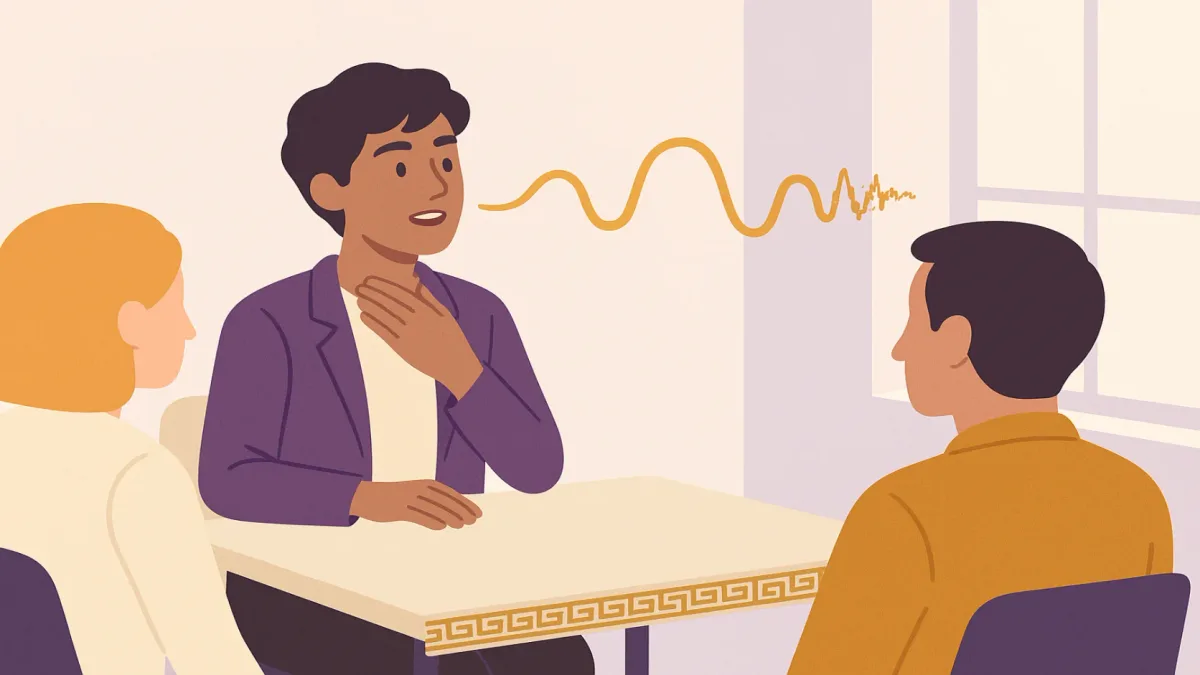
You probably noticed it on a recording. A meeting playback, a voice note, a rehearsal of an interview answer. The sentence starts fine, clear and full, and then somewhere around the last two or three words the sound drops into a low, popping crackle, like a door creaking or a stick being dragged along a fence. Every sentence. Once you have heard it you cannot stop hearing it, and the next question is how to make it stop.
Most advice on vocal fry is some version of "speak higher" or "breathe more" or "have more energy". The first one is a bad idea for most people, the second is too vague to act on, and the third is a description of the problem dressed up as a solution. Here is what almost none of that advice tells you: vocal fry is a specific mode of vibration that happens when there is not enough air moving through the folds, and in ordinary speech it shows up in one predictable place, the end of the sentence. That makes it far more fixable than it feels. You are not changing your voice. You are changing what happens in the last half-second of each sentence.
This guide sits under how to speak with authority, because the two topics are tangled together: the "lower your voice" advice that people follow in search of authority is one of the most reliable ways to produce fry. It is a sibling of how to stop sounding monotone and how to project your voice, the other two guides about what your voice does rather than what your words say. If your wider goal is sounding clear and finished rather than fixing one tell, start at how to be more articulate.
Here is the sequence:
- Learn what fry is: a low-airflow, low-pressure vibration that ordinary speakers drift into at the ends of phrases.
- Find your cause. For most people it is running out of air on long sentences, pushing the pitch down, or low energy late in the day.
- Get an honest read on whether it matters. The research shows a real but small penalty, and it depends on context.
- Measure it: record twenty sentences and count how many endings crackle.
- Fix the air first: one breath per sentence, and the last word as loud as the first.
- Stop forcing your pitch down. Find your natural speaking pitch and stay there.
- Rebuild energy into sentence endings with the landing drill.
- Warm the voice up on days that matter and run the two-week plan.
- Re-record the same twenty sentences and compare the count.
A word on the goal. Vocal fry is a normal register that every healthy voice can produce, and some fry at the end of a relaxed sentence among friends is not a problem to be fixed. The goal is control: being able to finish a sentence clearly when it counts, in a meeting, an interview or a recorded pitch, instead of having the last three words of every point disappear into a crackle you did not choose.
What is vocal fry, and what does it sound like?
Vocal fry is the lowest register of the human voice. In normal speech, your vocal folds open and close in a fast, regular cycle, somewhere around a hundred to two hundred and fifty times a second, which the ear hears as a smooth tone. In fry, the folds close tightly, the airflow drops, and they vibrate slowly and irregularly, in pops that are slow enough to hear as individual clicks. Voice scientists call it creaky voice, glottal fry, or pulse register. Listeners describe it as a rattle, a croak, or the sound of popcorn.
In speech it rarely runs through a whole sentence. It appears in the last word or two, when the pitch has fallen, the air is nearly gone and the speaker is coasting to a stop. Studies that measure where fry occurs in read sentences find it concentrated at the ends. In a study of thirty-four female college students, roughly two-thirds used fry, and it was most likely at the end of sentences (Wolk, Abdelli-Beruh and Slavin, Journal of Voice 26(3), 2012). The same group found the same sentence-final pattern in thirty-four young men, who used it less often than the women but in the same place (Abdelli-Beruh, Wolk and Slavin, Journal of Voice 28(2), 2014). In both studies fry was rare on a long, sustained vowel. That detail matters: when the air is steady, the voice does not fry. It fries when the air runs down.
So "vocal fry when talking" is not usually a voice that is creaky. It is a voice that ends sentences creaky. Everything below follows from that.
What causes vocal fry when speaking?
Vocal fry is caused by the vocal folds vibrating with too little air behind them. The clearest measurement comes from a study that recorded twenty speakers producing the same vowels and syllables in their normal voice and in fry, with airflow and pressure measured at the same time. Airflow in the normal voice was nearly three times what it was in fry, and the pressure under the folds was about one and a half times higher (Blomgren, Chen, Ng and Gilbert, Journal of the Acoustical Society of America 103(5), 1998). Fry is what the folds do when the air supply is low and they are pressed together: instead of a fast, even vibration, they open and snap shut in slow, irregular pulses.
That is the mechanism. The question for you is why the air runs low. In ordinary speakers there are three common reasons, and they usually combine.
You are finishing sentences on the dregs of a breath. A shallow breath at the top of the chest carries about one clause comfortably. If your sentences run to three clauses, the last one is produced on whatever air is left, with the pitch falling and the pressure dropping, which is exactly the recipe for fry. People who speak in long, unplanned sentences fry more than people who speak in short ones, for no reason other than arithmetic. If you also notice your endings going quiet and your consonants blurring, this is your cause, and breathing exercises for public speaking covers the breath side in full.
You are pushing your pitch below where your voice sits. Every voice has a comfortable range, and the bottom of that range is where fry begins. People who have absorbed the idea that a deep voice sounds authoritative drive their pitch down toward the floor of their range, and at the floor the folds cannot sustain a clean vibration, so the voice breaks into creak. This is the most common cause among people who are deliberately trying to sound more serious, and it is the reason the "speak lower" advice backfires. The authority research points the other way: in a 2015 study, speakers put in a high-power role did not drop their pitch, they held it steadier and used more variation in loudness, and listeners could hear the difference (Ko, Sadler and Galinsky, 2015). A forced low voice that crackles at the end of every sentence is not what authority sounds like.
You are tired, relaxed or low on energy. Fry needs very little effort, which is why it turns up at the end of the day, at the end of a long meeting, and in the slouched, half-attentive register people use with close friends. The folds are relaxed, the breath is passive, and the voice sinks into the cheapest mode available. This is also why fry carries a social meaning for many listeners: it is the sound of someone not bothering. In a presentation, that reading is unfair, but it is the one the room will make.
There is a fourth factor worth naming honestly. For some speakers, especially younger American women, fry is a learned feature of the way their peer group talks, not a breath problem. A 2020 systematic review of the research on how common creaky voice is found ten studies covering 297 speakers, four of which found American women creaking more than men, and concluded that the popular claim that fry is rising among young women is "not yet substantiated by quantitative evidence" (Dallaston and Docherty, PLOS ONE 15(3), 2020). If fry is part of how you talk with friends, nobody needs you to change that. The skill this guide teaches is being able to switch it off in the rooms where it costs you.
Is vocal fry bad?
Vocal fry is not bad for your voice in ordinary use, but it does cost you something with listeners, and the honest answer has three parts.
The health question first. There is no well-defined vocal pathology associated with vocal fry, and a commentary from the National Center for Voice and Speech, whose director Ingo Titze is one of the most cited voice scientists alive, says exactly that. Their argument against fry in speech is not that it damages the folds; it is that it is "not so much a vocal health issue as an intelligibility and cognitive burden issue", because a creaky, low-energy ending is harder for a listener to decode (Titze, Guzman and van Mersbergen, NCVS Insights). You will find clinicians who are more cautious about sustained fry for long periods, and the evidence base on either side is thin. What nobody has shown is that the few creaky words at the ends of your sentences are hurting you physically.
The perception question. The study everybody cites is a 2014 experiment in which seven young women and seven young men each recorded the phrase "Thank you for considering me for this opportunity" twice, once in their normal voice and once in fry. Eight hundred listeners, half men and half women, heard the pairs and chose which speaker sounded more educated, competent, trustworthy, attractive and hireable. On every trait, for both sexes of speaker, the normal voice was preferred well above chance, and the penalty was larger for female speakers on trustworthiness, competence, education and hireability (Anderson, Klofstad, Mayew and Venkatachalam, PLOS ONE 9(5), 2014). Female listeners judged fry more harshly than male listeners did.
Source: Anderson, Klofstad, Mayew and Venkatachalam, PLOS ONE (2014)
Two things are worth knowing about that study before you panic. The effects were real but small; the sex-of-speaker differences explained around one percent of the variance in judgments. And the speakers were coached to fry the whole phrase, which is not how fry sounds in real speech, where it lands on a word or two. It is evidence that a creaky delivery of a formal sentence costs you a little, not that the occasional creaky ending will cost you a job.
The context question. A later study took this further. Eight women recorded speech that varied in pitch, speed and whether fry was present, and 463 adults rated the speakers for intelligence and likability. The effect of fry depended on everything around it: it hurt with low pitch and a fast rate, and helped with high pitch and a fast rate (Parker and Borrie, Journal of Voice 32(5), 2018). In other words, fry is not one thing to listeners. Fry on a low, fast, trailing-off ending reads as checked out. The same creak in a lively, higher voice barely registers.
Put the three together and the practical verdict is this: fry at the ends of your sentences is not harming your voice, it is costing you a small amount of perceived competence in formal settings, and the version that costs the most is precisely the version most people produce when they are trying to sound serious, a forced-low pitch trailing off at the end. That is the version this guide fixes.
How to tell if you have vocal fry: the twenty-ending test
You find out whether you have vocal fry by recording twenty sentences and counting how many of the endings crackle. Do not rely on how your voice feels from inside; fry is almost silent to the speaker, because the pulses are too low and quiet to hear over the sound in your own head. You need the recording.
The protocol takes five minutes:
- Pick a prompt that resembles the real situation. Explain what you do for a living, or answer "tell me about a project you are proud of", unscripted. Reading aloud produces less fry than conversation does, so a read passage will under-count.
- Record about two minutes on your phone at arm's length, in a quiet room.
- Play it back and stop at every full stop. Listen only to the last two words. Mark each ending as clear, creaky, or dropped (too quiet to tell, which counts as creaky for this purpose).
- Count the first twenty sentences. Your fry score is the number of creaky endings out of twenty.
- Note where the creak starts. On most people it begins on the second-to-last word. On some it starts earlier, which usually means the sentence was too long for the breath.
Read the score against this band:
- 0 to 3 out of 20. Normal. Some fry at the ends of relaxed sentences is universal. If someone has told you that you fry, ask them which sentences, because the problem may be one or two long ones.
- 4 to 9 out of 20. A habit worth working on in the rooms that matter. Fixes 1 and 3 below will usually clear most of it in a couple of weeks.
- 10 or more out of 20. Fry is your default ending. Work all four fixes, and start with fix 2, because at this rate it is almost always a pitch floor problem as well as a breath problem.
Keep the recording. The point of the test is not the number, it is having a baseline to compare with in two weeks, when you record the same prompt again. If you practice with an app that keeps your recordings and timestamps where your flow broke, jumping to sentence endings is quick; how to practice public speaking covers the recording-and-review loop in general.
How to stop vocal fry when speaking: four fixes
The four fixes below are ordered by how often they are the real cause. Most people need the first and third. People who have been deliberately lowering their voice need the second. Everybody benefits from the fourth on days that matter.
Fix 1: finish every sentence on air
Fry at the end of a sentence is what you sound like when the breath has run out before the words have. The fix is to make sure the breath lasts longer than the sentence, which you can do from either end.
From the breath end: take a breath at every full stop, whether or not you feel you need one, and take it low, into the sides of the ribs rather than the top of the chest. A low breath carries a longer sentence, and if "take it low" is itself the mystery, how to speak from your diaphragm walks through where that breath goes and how to tell it is driving the voice rather than your throat. Then set one rule you can check on a recording: the last word of each sentence should be as loud as the first. Not louder, not a performance, just not quieter. Fry cannot survive that rule, because it needs the pressure to drop and you are holding it up.
From the sentence end: shorten them. A sentence that needs two breaths is two sentences. If you find yourself frying on the third clause of a long thought, the thought was built wrong for speaking, and how to stop rambling when you talk covers how to build shorter ones.
The drill that connects the two is the counted exhale. Take a low breath, then count aloud from one to ten at normal speaking volume, with a clean full stop after ten, and listen for where the crackle starts. If it starts at seven, you have a sentence budget of about seven words on a lazy breath. Repeat with a fuller, lower breath and watch the number climb. Most people get to fifteen clean counts within a few days. The aim is not to count to fifty; it is to know your budget and breathe before you exceed it.
Fix 2: stop pushing your pitch down
If your fry score was high and you have ever tried to sound more serious by speaking lower, this is your cause. Find the floor of your range and get off it.
The test is a hum. Hum a comfortable note, the one you would use to say "mm-hmm" in agreement, and let it fall open into "mm-hmm, right" without changing anything. The pitch your voice lands on is your natural speaking pitch, and for almost everyone it is higher than the pitch they use when they are trying to sound authoritative. Now say a full sentence starting from that hum: "mm-hmm, we should move the launch to the twelfth." Notice that the ending has no fry, because you are nowhere near the floor.
The guard rails matter here, because the opposite error is just as common. You are not trying to raise your voice. Pushing above your natural pitch produces a thin, strained sound, and pushing far above it tips into falsetto, which reads as nervous. You are trying to stop pushing down, and let the voice sit where the hum put it. Nobody can tell you a target in hertz; the hum tells you.
What about sounding authoritative? Do not lower your pitch across the sentence. Instead, hold it steady through the sentence and let it step down, cleanly, on the last stressed word, then stop. A step down is a short, controlled drop that stays in the clear zone. A slide down is a long descent that falls through the floor into creak. How to speak with authority covers the research on why steady beats deep, and the sentence-ending drill that goes with it.
Fix 3: put the energy back into the last three words
Fry is the sound of a sentence being abandoned. The speaker has mentally moved on to the next point before the current one has finished, and the ending is produced on autopilot with no breath, no pitch and no intention behind it. The fix is to decide, before you start the sentence, what the last word is going to be, and then land it.
The landing drill: write six sentences you would actually say at work, each ending on a concrete noun or number. "The retention number for March is eleven percent." "We need the decision by Thursday." Read each one aloud and treat the last word as the point of the sentence, giving it slightly more length and a clean full stop. Then record the same six sentences without reading, from memory, and check the endings. When the last word is the reason you said the sentence, the voice does not abandon it.
This dovetails with a habit that matters far beyond fry: trailing clauses. "We need the decision by Thursday... or whenever, really" is a sentence that has been handed an extra tail with no air to support it, and the tail is where the fry lives. Finish on the noun and stop. How to use pauses when speaking covers what to do with the silence after the full stop, which is the other half of the habit.
Fix 4: warm the voice up on days that matter
Fry is more likely on a cold, tired or dehydrated voice, which is why it turns up in the first meeting of the morning and the last one of the afternoon. On days with a presentation or an interview, five minutes of warm-up makes the clear voice easier to find and keep.
Three exercises are standard in voice training and all three keep the air moving through the folds while the tissue warms up: a gentle hum on a comfortable pitch, sliding up and down a little; lip trills, blowing air through loosely closed lips so they flutter, on a hum; and straw phonation, humming through a drinking straw for a minute or two, a semi-occluded vocal tract exercise developed by Titze's group that is widely used by speech-language pathologists. If you only have thirty seconds, hum. Then drink water. Vocal warm-ups for public speaking has a full routine with timings.
Work the fixes one at a time and re-record the twenty-ending test after each week. If you add breath, pitch, landing and warm-up all at once, you will not know which one moved the number, and you will not know which ones you can drop. Most people find that fix 1 alone takes a score of eight down to three or four.
A two-week plan to reduce vocal fry
Reducing vocal fry takes about two weeks of five-minute daily practice for most people whose fry is a breath or pitch habit, longer if it is a deep-set feature of how you talk with everyone. Nobody has measured this in a study, so treat the schedule as a reasonable plan rather than a promise, and let the twenty-ending count tell you how you are doing.
Days 1 to 2: measure. Run the twenty-ending test on a work prompt. Write down the score and where in the sentence the creak starts. Do the hum test and note whether your usual speaking pitch sits above or below it.
Days 3 to 7: breath. Each day, two minutes of the counted exhale, then two minutes of talking about your work with one breath per sentence and the last word as loud as the first. Record the second part and spot-check five endings.
Days 8 to 10: pitch and landing. Start each session from the hum and speak six sentences from it. Then the landing drill: six work sentences ending on a noun or number, read then from memory. Spot-check endings.
Days 11 to 13: pressure. Do the same drills, but answer a hard question out loud without preparation, the kind an interviewer or an executive would ask. Fry comes back under pressure before it comes back anywhere else, so this is the rehearsal that matters. Impromptu speaking has a stock of practice questions.
Day 14: re-measure. Same prompt as day 1, same room, same phone. Compare the count. If it has halved, you have the mechanism; keep the one-breath-per-sentence rule as a habit and let the rest go. If it has not moved, the cause is probably pitch rather than breath, and fix 2 deserves another week on its own.
Vocal fry in the workplace: calls, interviews and the end of the day
Vocal fry in the workplace shows up in three predictable situations, and each one has its own fix.
Video calls. Laptop microphones and meeting-app compression are unkind to fry. The low pulses come through as a muddy rattle, and the quiet endings get cut off by noise suppression entirely, so your colleagues hear sentences that simply stop. Sit up, keep the microphone at a constant distance, and apply the last-word-as-loud-as-the-first rule more strictly than you would in a room. Recording one call with your own consent and listening back is the fastest education in how you actually sound on a call; how to be confident on video calls covers the rest of the on-camera habits.
Interviews. Fry is most expensive here, because the formal-sentence, job-application context is exactly the one the 2014 study tested, and because interviewers are listening to your endings for how sure you are. The specific trap is the pitch floor: candidates who want to sound calm and senior drop their voice, and the endings creak. Start your answers from the hum pitch, keep sentences short enough for one breath, and land the last word of each answer on something concrete. The behavioral-answer format in how to be confident in an interview is built around finished sentences for this reason.
The end of the day. The four o'clock meeting, the status update after a long day, the call you take when you are tired. Energy is low, breath is passive, and fry is the cheapest register available. You cannot always fix the tiredness, but you can fix the mechanics: stand up for the call if you can, take a real breath before each point, and shorten the sentences. A tired speaker in short, finished sentences sounds fine. A tired speaker in long, trailing ones sounds done.
When vocal fry is fine, and when to see a professional
Vocal fry is fine when it is relaxed, occasional, and in a context where nobody is grading you. Among friends, at the end of a funny story, or on the last word of a sentence that has clearly landed, a little creak is just the sound of a voice winding down, and listeners in that context do not penalise it. The research on prevalence suggests it is common across English speakers of both sexes, and the context research suggests listeners read it differently depending on everything around it. You do not need to chase every creaky ending out of your speech, and trying to will make you sound stiff.
Fry becomes a problem in two situations. The first is social: a formal room where the crackle at the end of your sentences is being read as uncertainty or disengagement, which is the territory this guide covers. The second is physical, and it is rarer: if your voice is regularly hoarse, scratchy or tired by the end of a normal day, if speaking is uncomfortable, or if hoarseness has lasted more than two or three weeks, that is not a technique problem to drill through. Persistent voice change deserves a look from a doctor or an ear, nose and throat specialist, and a speech-language pathologist can assess whether what you are hearing is fry at all. Do not add volume or pitch exercises on top of a voice that already hurts.
One more distinction worth making. If your voice gets creaky and quiet specifically when you are nervous, alongside a shake or a wobble, the cause is adrenaline rather than habit, and how to stop your voice from shaking when speaking deals with that version. The fixes overlap, since both come back to breath, but the starting point is different.
Key takeaways
- Vocal fry is the voice's lowest register: the folds vibrate slowly and irregularly when airflow and pressure are low. Measured directly, normal voice carries nearly three times the airflow and about one and a half times the pressure of fry.
- In ordinary speech it lands at the ends of sentences, where the breath has run out and the pitch has fallen. Two studies of 34 women and 34 men found fry concentrated sentence-finally and rare on a sustained vowel.
- It is not an air shortage you can fix by "breathing more". It is a sentence ending produced on no air, so the fix is one breath per sentence and the last word as loud as the first.
- The "speak lower" advice causes fry. Your voice fries at the floor of its range, and high-power speakers in the research held their pitch steady rather than dropping it. Find your natural pitch with a hum and stay there.
- Listeners do penalise it, a little: 800 listeners preferred the normal-voice version of a job-application phrase on every trait, with a bigger penalty for women. The effects were small and depend on context; fry on a low, fast, trailing ending costs the most.
- It is not damaging your voice in ordinary use. The case against it from voice scientists is about intelligibility, not injury.
- Measure before and after: record twenty sentences, count the creaky endings, work one fix at a time, and re-count after two weeks.
Frequently asked questions
What causes vocal fry when speaking?
Vocal fry is caused by the vocal folds vibrating with too little air behind them: a 1998 study that measured twenty speakers found normal voice carried nearly three times the airflow and about one and a half times the under-fold pressure of fry. In everyday speech the air runs low for three reasons: you are finishing a long sentence on the end of a shallow breath, you are pushing your pitch down to the floor of your range where the folds cannot sustain a clean vibration, or you are tired and letting the voice sink into its cheapest mode. For some speakers it is also a learned feature of how their peer group talks rather than a breath problem.
Is vocal fry bad for your voice?
Not in ordinary use. No well-defined vocal pathology has been associated with vocal fry, and the National Center for Voice and Speech describes the case against it as an intelligibility problem, not a health one. Some clinicians are more cautious about sustaining fry for long stretches, and the evidence either way is thin. The occasional creaky word at the end of a sentence is not injuring you. If your voice is hoarse or uncomfortable at the end of a normal day, or hoarseness lasts more than two or three weeks, see a doctor rather than drilling through it.
How do I reduce vocal fry?
Record twenty sentences and count the creaky endings so you have a baseline. Then take one breath per sentence, low into the ribs, and keep the last word as loud as the first; fry needs the pressure to drop and that rule holds it up. Stop pushing your pitch down: hum a comfortable "mm-hmm", speak from that pitch, and let the voice step down cleanly on the last stressed word rather than sliding into creak. Decide the last word of each sentence before you start and land it. Re-record after two weeks and compare the count.
Why do I have vocal fry when talking but not when singing or reading aloud?
Because singing and reading aloud keep the air moving. Studies that look for fry find it rare on sustained vowels and far more common at the ends of conversational sentences, and one review found creak more than twice as common in conversation as in reading. When you read or sing, you plan the breath and the phrase ends on air. When you talk, you build sentences as you go, often run out of breath before the words, and finish the last word or two on nothing, which is exactly where fry appears.
Does vocal fry make you sound less confident?
In formal contexts it can. When 800 listeners heard the same job-application phrase in a normal voice and in fry, they rated the normal version as more competent, educated, trustworthy and hireable, with a larger penalty for female speakers. The effects were small, and later research found the effect depends on context: fry on a low, fast, trailing-off ending reads as checked out, while the same creak in a lively, higher voice barely registers. The version that costs the most is the forced-low, trailing-off ending people produce when they are trying to sound serious.
How do I stop vocal fry in the workplace and on video calls?
Apply the ending rule more strictly than you would in a room, because laptop microphones and noise suppression turn creaky, quiet endings into sentences that simply stop. Sit up, keep the microphone at a constant distance, breathe before each point and keep sentences short enough for one breath. In interviews, start answers from your natural hum pitch instead of dropping your voice, and land each answer on something concrete. Late in the day, when fry is most likely, stand up for the call and shorten your sentences.
Can men have vocal fry?
Yes. In a study of 34 young men, fry appeared significantly more often in sentences than on a sustained vowel and significantly more often at the ends of sentences, the same pattern found in women. Men used it less often in sentences than women did, and in one British study men creaked more than women. The listener penalty in the 2014 hiring study applied to male speakers too, though it was smaller than the penalty for female speakers.
What vocal fry exercises actually work?
The ones that keep air moving through the folds. The counted exhale: breathe low and count aloud to ten with a clean full stop, noting where the crackle starts, then repeat with a fuller breath. The hum-to-speech test: hum "mm-hmm" and speak a sentence from that pitch. The landing drill: six work sentences ending on a concrete noun or number, read aloud and then from memory, with the last word as loud as the first. And on days that matter, a short warm-up of humming, lip trills and straw phonation. Whisper tests and tongue twisters, which some guides recommend, do not target the sentence ending where fry actually lives.
Conclusion
Vocal fry is not your voice being too low; it is your sentences running out of air before they run out of words. Record twenty sentences today and count the creaky endings, then take one breath per sentence and keep the last word as loud as the first. Say six work sentences out loud right now, landing each one on its final word, and listen to how different the ending sounds.