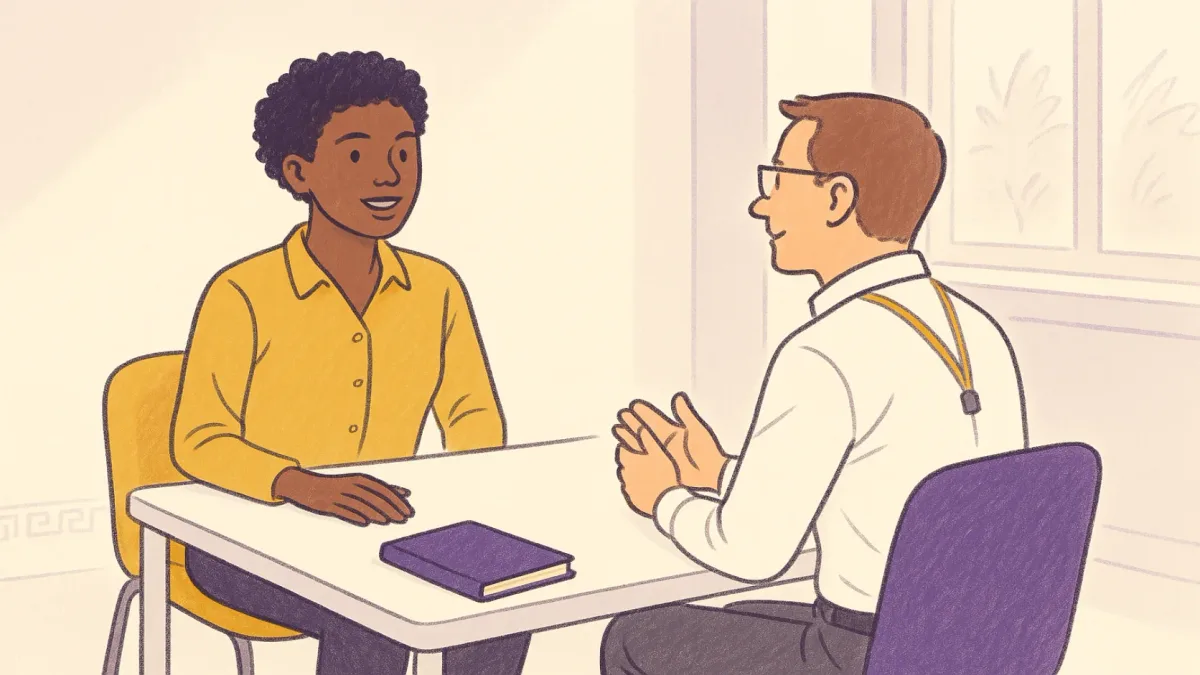
Almost every guide to interview confidence makes the same quiet assumption: that if you can get yourself to feel confident, through breathing, a good night's sleep, the right outfit or a two-minute power pose in the toilets, confidence will come out of your mouth on its own. It is a kind assumption and it is mostly backwards. Plenty of people walk into interviews feeling fine and sound tentative, and plenty of people walk in with a heart rate of 110 and sound like the obvious hire. The interviewer never gets to see the feeling. They get the delivery.
This guide is about the delivery. It sits under how to prepare for an interview, which covers what to say, and next to how to calm interview nerves, which covers the physical spike and how to bring it down. Here we take the nerves as given and ask a narrower question: with the heart rate you actually have, what does an interviewer hear and see, and which of those things can you change in a week? The general principle, that confidence is a set of behaviours rather than a feeling, is laid out in how to speak with confidence. This is the interview-shaped version of it.
Here is the sequence:
- Accept that the interviewer rates what crosses the table, and that research on interviews shows your nerves cross it far less than you think.
- Win the first two minutes with one finished, specific answer to the small talk and a 60-second "tell me about yourself" you have said aloud before.
- Sound confident by steadying your pitch, slowing your pace and ending statements on a falling note, rather than by lowering your voice.
- Answer every question with the answer first, one reason or example, and a stop, and strip the hedges that quietly cancel it.
- Hold a still, open seated posture with eye contact that lands when you make a point, and skip the power pose, which the larger study could not replicate.
- Plan your recovery for the question that goes wrong: name it, give the nearest true thing, and finish the sentence.
- Say "I'm excited" rather than "calm down" on the way in; the arousal stays, but it gets pointed at the conversation.
- Rehearse on a recording and score five observable things, because those are the only things the interviewer will be scoring too.
What does "confident in an interview" actually mean to the interviewer?
To the interviewer, confidence is not a feeling they detect; it is a judgement they build from a handful of observable cues, mostly in your voice and mostly early. Three studies make this concrete, and together they are the reason this guide is about delivery rather than mood.
The first measured which cues interviewers actually respond to. Timothy DeGroot and Stephan Motowidlo videotaped interviews with two groups of managers, 60 at a utility company and 110 at a news publisher, and coded two bundles of behaviour: a vocal bundle (pitch, pitch variability, speaking rate, pauses and loudness variability) and a visual bundle (appearance, smiling, gaze, hand movement and body orientation). In the larger sample, the vocal bundle predicted the interviewers' judgements, and it also predicted the managers' later performance ratings from their supervisors, both at about r = .20. The visual bundle predicted interviewers' judgements to a similar degree. What carried the effect was the interviewer's personal reaction to the candidate: how much they liked, trusted and found credible the person in front of them (DeGroot and Motowidlo, Journal of Applied Psychology, 1999). Voice and body are not decoration on top of your answers. They are a large part of what the interviewer's judgement is made of.
The second measured when. Murray Barrick, Brian Swider and Greg Stewart had interviewers rate candidates after only the rapport-building small talk at the start of a structured interview, before a single real question, and then followed what happened. Those two-minute ratings correlated with the interviewers' end-of-interview scores at r = .42 and with whether the candidate was actually offered the internship at r = .22. The part that should change how you prepare is which early judgement travelled: it was the interviewer's early read of the candidate's competence, not how much they liked them, that predicted the ratings of a different interviewer and even of an interviewer who skipped the small talk altogether (Barrick, Swider and Stewart, Journal of Applied Psychology, 2010). Interviewers decide, early, whether you seem capable, and they decide it from the way you handle the easy part.
The third is the one to hold onto when your hands are damp. Kenneth Savitsky and Thomas Gilovich paired up forty Cornell students and had each give a three-minute speech on a topic they had not prepared. Speakers felt nervous at about 6 on a 0-to-10 scale and believed they looked nervous at 6.55. Their partners, watching from a few feet away, put them at 5.25, and twenty-seven of the forty speakers overestimated how nervous they looked (Savitsky and Gilovich, Journal of Experimental Social Psychology, 2003). The feeling is loud from the inside and faint from across a table. What the interviewer gets is whatever reaches the surface: your pace, your pauses, where your sentences end, where your eyes go. Those are the things this guide works on, because those are the things that are actually being scored.
None of this means the feeling is irrelevant. A spike of adrenaline speeds your pace, shortens your breath and makes you swallow the ends of sentences, which are exactly the cues on the right-hand side. The point is that you treat those cues as the target, and bring the feeling down as a means to that end, not the other way round. If the spike itself is the problem, start with how to calm interview nerves and come back here.
How to be confident in an interview in the first two minutes
You are confident in the first two minutes by treating the small talk as the first question, because to the interviewer it is. Barrick, Swider and Stewart's finding is blunt: by the time the structured questions start, the interviewer already has a read on your competence, and that read survives into the ratings of people who were not even in the room. Most candidates spend those two minutes on autopilot ("Fine thanks, yes, found it easily") and start trying only when the "real" interview begins. That is the wrong way round.
What a confident first two minutes sound like is not charm. It is three finished sentences with one concrete detail in each.
- The walk in. Greet the person by name, hold eye contact for the length of the greeting, and sit when invited. If there is a handshake, make it one firm pump; if there isn't, don't chase one. Say less than you want to.
- The small talk. Answer the "how was your journey / how's your day" question with a complete sentence that contains one specific thing, and then stop: "Good, thanks. I came in on the 8:40 so I had twenty minutes to walk past the building and look at the site plan in the lobby." A specific detail reads as a person who notices things, which is the competence signal the research says is being formed. A one-word answer reads as someone bracing.
- The opening question. "Tell me about yourself" or "walk me through your background" is almost always the first real question, and it is the single best investment of rehearsal time you can make, because it is the one question you know is coming. Build a version that runs sixty to ninety seconds, leads with what you do now, gives one proof point and ends on why you are in this room. The full structure is in how to answer "tell me about yourself". Say it aloud at least ten times before the day. You should be able to start it without thinking, which frees your attention for the interviewer's face.
Here is what the difference sounds like for the opening question, on the same person.
- Bracing: "So, um, I guess I've been in marketing for about, well, six years now? I started at a small agency and then, you know, moved to a bigger one, and I've kind of done a bit of everything, really, content, some paid, a bit of analytics, so, yeah."
- Confident: "I'm a marketing manager. For the last three years I've run demand generation for a 40-person software company, where my main job was turning a content programme into a pipeline, which went from about 10 per cent of leads to just over a third. Before that I spent three years at an agency learning paid and analytics across a dozen clients. I'm here because this role is the first time I'd own the whole funnel, and that's the thing I want next."
The second version is not more confident because the person feels better. It is more confident because every sentence finishes, there is a number in it, and it ends on a reason to be there instead of a trailing "so, yeah". That is the shape you are rehearsing. The research on first impressions suggests the frame is set within a tenth of a second of seeing a face (Willis and Todorov, Psychological Science, 2006), which you cannot do much about, but the two-minute competence read is made from what you say, and that you can prepare.
How do you sound confident in an interview?
You sound confident in an interview with three things the ear picks up before it registers any content: a pitch that holds steady across each sentence, a pace slower than the adrenaline wants, and endings that fall. The voice carries more of the interviewer's judgement than most candidates realise, and the clearest demonstration of that comes from a study that compared hearing a candidate with reading the same candidate.
Juliana Schroeder and Nicholas Epley recorded MBA students giving the short pitches employers ask for in interviews, then showed them to evaluators, including professional recruiters, as audio, as video, or as a written transcript. Across several experiments, people who heard a pitch rated the candidate as more competent, thoughtful and intelligent than people who read the identical words, and they were more interested in hiring them. Adding video to audio did not improve the ratings; adding a voice to the text, even an untrained adult or an actor reading it aloud, restored them (Schroeder and Epley, Psychological Science, 2015). The authors' conclusion was that a voice conveys a thinking mind in a way text does not. For you, the implication is that the interviewer is forming an opinion of your intellect from your intonation, and an interview answer delivered in a flat, rushed monotone is handing back most of the advantage that speaking gives you.
So what should the voice do?
Steady the pitch; don't lower it. The "speak in a deeper voice" advice is everywhere and the research points elsewhere. When Sei Jin Ko, Melody Sadler and Adam Galinsky assigned people to high-power or low-power roles and recorded them reading the same passage, the high-power speakers' pitch went slightly up and became less variable, while their loudness became more variable, and a separate group of listeners could tell from the audio alone who had been given power (Ko, Sadler and Galinsky, 2015). What listeners hear as confidence is control of pitch, not depth. Nerves make pitch wobble; the fix is a steady line through the sentence, with the emphasis placed by loudness on the word that matters. The whole treatment is in how to speak with authority.
Slow the first sentence of every answer. Adrenaline shortens your breath and speeds you up, and a fast first sentence tells the interviewer you want the question over with. You do not need to slow the whole answer. Slow the first ten words, deliberately, and the rest tends to follow. If speed is your known tell, the three-step reset in how to stop talking too fast is built for it.
Pause before you answer, on purpose. A half-second to a second of silence after a question reads as someone choosing their words, and it is free; beyond about a second it starts to read as reluctance, so if you need more time, buy it in words: "The closest example I have is from last year." The tariff on silence, with the research behind it, is in how to think before you speak.
End statements going down. A rising pitch at the end of a statement turns it into a question, and nervous speakers do it on their strongest material ("I led the migration?"). It is the single most audible leak of confidence and the easiest to fix on a recording, because you can hear it instantly. Say the last word of every claim at a slightly lower pitch than the word before it.
Say "I'm excited" on the way in, not "calm down." In a 2014 study, 140 people prepared a two-minute speech and were told to say either "I am excited" or "I am calm" before giving it on camera. Blind raters judged the "excited" group as more persuasive, competent and confident, and those speakers talked for longer, 167 seconds against 132, even though the two groups felt equally anxious (Brooks, Journal of Experimental Psychology: General, 2014). You are not going to remove the arousal in the lift. You can decide what it is about.
How do you answer interview questions confidently?
You answer interview questions confidently by putting the answer in the first sentence, supporting it with one reason or one example, and stopping, and by cutting the hedges that quietly take the answer back. Content matters, of course, and the story-building side of this lives in how to answer behavioral interview questions. But two candidates with the same story can sound like different hires, and the difference is almost always in the shape of the sentences.
The shape is: answer, reason, stop. Not "context, context, context, answer, qualification". The interviewer asked a question; the first sentence out of your mouth should be recognisable as an answer to it. Then one piece of evidence. Then a full stop that you actually honour. Most nervous answers are not wrong, they are unfinished: the candidate reaches the end of the point and, hearing silence, keeps talking into it until the point is buried under qualifications. If this is you, the point-first structure in how to stop rambling when you talk is the fix.
Then there are the hedges. These are the words that make a true, strong claim sound like a guess, and under interview nerves they multiply:
- Disclaimers before the claim: "I'm not sure if this is what you're looking for, but…", "This might not be relevant…"
- Softeners inside it: "kind of", "sort of", "a bit", "just", "I think", "I guess", "basically".
- Trailing clauses after it: "…so, yeah.", "…if that makes sense?", "…but I don't know."
- Apologies for existing: "Sorry, I'm rambling.", "Sorry, that was a long answer."
You will not remove all of them, and you should not try to speak like a press release. But one hedge per answer is a style; four is a signal. Here is what cutting them does to three common questions.
"What's your experience with managing budgets?"
- Hedged: "Um, so, I've done a bit of budget stuff, I guess? Like, at my last place I sort of owned the team budget, it wasn't huge or anything, but I kind of kept it on track, so, yeah, I think I'd be okay with that."
- Confident: "I owned my team's budget for two years, about £400k a year across people and tools. The thing I'm proudest of is that we came in within 3 per cent both years, mainly because I moved to monthly reforecasts instead of waiting for the quarter."
"Why did you leave your last role?"
- Hedged: "It's kind of complicated, I don't want to say anything bad, but, basically, it just wasn't really, um, the right fit anymore, I suppose, so I thought I'd see what else was out there."
- Confident: "I'd done the job I was hired to do, which was get the support team to a four-hour response time, and the next step there was managing a bigger version of the same thing. I want to work on product instead, which is why this role is the one I applied for."
"Tell me about a time you made a mistake."
- Hedged: "Oh, gosh, there are probably loads, haha. Um, I guess one time I sort of missed a deadline? It wasn't entirely my fault, there were a lot of factors, but I suppose I could have flagged it earlier, maybe."
- Confident: "I under-scoped a client migration by about three weeks because I estimated it from the last one without checking the data volume. I told the client the day I realised, we re-planned together, and I've started every estimate since with the data size. It was uncomfortable and it was the right call."
Notice what the confident versions do not do. They do not claim more. In the mistake answer the confident version admits a bigger error than the hedged one. They are confident because they are specific, finished and unapologetic about being true. Specificity is the thing nerves push you away from, because a vague answer feels safer. It is not safer; it is forgettable, and it leaves the interviewer with nothing to rate but the hedging around it.
A note on "I think." It is not always a hedge. "I think the bigger risk is the timeline" is a confident sentence, because you are giving a view. "I think I managed that okay, I think" is not, because you are asking for permission to have done it. The test is whether the sentence would be stronger with "I think" removed. If yes, remove it.
What does confident body language in an interview look like?
Confident body language in an interview is mostly stillness: a seated posture that is open and upright without being rigid, hands that rest or gesture rather than fidget, and eye contact that lands when you make a point and relaxes when you are thinking. DeGroot and Motowidlo's visual bundle (gaze, smiling, body orientation, hand movement) predicted interviewers' judgements about as strongly as the vocal bundle did, so this matters; but it matters as a floor, not a ceiling. Nobody was ever hired for their posture. Plenty of people have lost the two-minute competence read by jiggling a leg under the table for twenty minutes.
Sit so that you can breathe. Back against the chair, both feet on the floor, hands on the table or in your lap. Lean in a little when the interviewer is speaking. The point of this posture is not that it "looks confident"; it is that a collapsed, perched posture compresses your breath and raises your pitch, which then sounds nervous. Seated speaking has its own rules, half of which invert the standing advice, and they are in body language for public speaking.
Give your hands a home. Clasped loosely on the table, or one resting on the other in your lap. Gesture when you are describing something with a shape (a process, a before-and-after), then bring them back. The fidgets to catch on a recording: pen clicking, hair, the edge of the table, the ring. The full treatment is in what to do with your hands when public speaking.
Make eye contact on the point, not continuously. Looking at the interviewer while you deliver the first sentence of an answer and again on the result is what reads as conviction. Looking away briefly while you think is normal and reads as thinking. Staring throughout reads as effort. In a panel, give the first sentence to the person who asked and the result to the others. The mechanics are in how to make eye contact when public speaking.
Smile when you mean it. A smile at the greeting, at a shared joke and at the close. Not held throughout, which reads as a mask, and not withheld entirely, which reads as grim. If you are on the phone, smiling still changes the sound of your voice enough to be heard, which is one of the main moves in how to sound confident on a phone interview.
Should you do a power pose before an interview?
Do it if you like it, in private, and do not expect it to change how you perform. The power pose, two minutes standing like a superhero before a high-stakes event, is recommended on several of the top-ranking pages for this query, and it comes from a 2010 study of 42 people that reported changes in testosterone, cortisol and risk-taking. The large replication did not find them. Eva Ranehill and colleagues ran the same design with 200 participants (98 women, 102 men), poses held for three minutes rather than one, and an experimenter blind to condition. Posing did make people say they felt more powerful, a small effect (d = 0.34). It had no significant effect on testosterone, cortisol, risk-taking in either direction, or willingness to compete (Ranehill and colleagues, Psychological Science, 2015). The original study's lead author later wrote publicly that she no longer believed in the embodied effects of power poses (summary at the British Psychological Society).
So the honest version is: a power pose may make you feel slightly more powerful for a minute, which is pleasant, and there is no good evidence it changes anything the interviewer will observe. Two minutes spent saying your opening answer aloud in the same toilets will change something they observe. Choose that.
How do you stay confident when an interview question goes wrong?
You stay confident when a question goes wrong by treating recovery as a delivery skill: name what happened in one plain sentence, give the nearest true thing you have, and finish the sentence with a full stop. The question you cannot answer is coming in most interviews, and the candidates who look confident afterwards are not the ones who had an answer; they are the ones who handled not having one without apologising for it.
Three versions of "wrong", and the move for each:
- You don't have the experience. Say so in one clause and pivot to the closest thing you do have: "I haven't run a team of that size. The closest I've done is leading a project with eight people across three teams, which had the same problem of nobody reporting to me, and here's how I handled that." The confident part is the absence of a preamble about how sorry you are.
- Your mind goes blank. Say "Give me a second on that," take one breath, and restate the question in your own words, which usually hands you the first sentence of the answer. The research on the pause, and the full recovery script, is in what to do when your mind goes blank. Do not fill the silence with "um, so, yeah"; the blank is survivable, the narration of it is what sounds like panic.
- You stumble mid-answer. Stop, say the sentence again from the beginning, correctly, and carry on. Do not comment on it. Remember the Savitsky and Gilovich result: the interviewer registered less of that stumble than you did, and the only way to make them notice it is to point at it.
The one recovery that reliably fails is the apology spiral: "Sorry, that was a terrible answer, let me try again, sorry." One correction is fine. Apologising for the correction converts a small wobble into the thing the interviewer remembers. Fix it, finish it, move on.
If the question goes wrong in a group or panel interview, there is one more piece of research to use. Cameron Anderson and Gavin Kilduff put 68 strangers into four-person groups and had observers rate each member's competence. The members who spoke early and often were rated most competent, and that held even when their answers were no better than the quieter members' (Anderson and Kilduff, Journal of Personality and Social Psychology, 2009). You do not have to be first every time. But in a group exercise, one early, finished contribution buys you a frame that a later, better contribution cannot. Speak in the first two minutes, say one complete thing, and stop.
How do you build interview confidence before the day?
You build interview confidence by rehearsing out loud, on a recording, and scoring the five things the interviewer will actually observe, rather than by reading your notes one more time. Silent preparation builds knowledge. It does not build delivery, and delivery is what the two-minute read and the vocal bundle are made from. The practical setup is in mock interview practice; this is the scoring.
Record yourself answering five questions: "tell me about yourself", one behavioural question, one "why this role", one weakness question and one you hope they will not ask. Then listen back with a pen and score each answer on the five observables.
- First sentence. Was it an answer to the question, finished, with no disclaimer in front of it? Yes or no.
- Hedges. Count them: "kind of", "sort of", "just", "I guess", "if that makes sense", "sorry". Target: one or fewer per answer.
- Endings. Did the last word of each claim go down or up? Mark every rise. Target: none on a statement.
- Pace of the first ten words. Was it slower than the rest of the answer, or faster? If faster, you are starting answers on adrenaline.
- The stop. Did the answer end on the result and then stop, or did it end on "so, yeah" and a restart? Mark the overrun in seconds.
Fix one thing per round, in that order, because the earlier items make the later ones easier: a finished first sentence removes most hedges on its own, and a slower start usually fixes the endings. Three rounds over a week is enough to move all five. Keep the recordings; hearing your own Monday version on Friday is the fastest confidence you will get, because it is confidence with evidence.
If you want the counting done for you, Orator records a practice answer and gives you the filler-word count, a confidence and clarity score, and the timestamps where the flow broke, so the five-check audit above takes a minute instead of twenty. The judgement about what to fix first is still yours.
Two more things belong in the week before. Say your opening answer aloud every day; it is the one question you know is coming and it sets the frame for the rest. And if the interview is on video or a one-way recording platform, run one practice take on camera, because the eye line and the pause behave differently through a lens; the specifics are in how to be confident on video calls and, for recorded questions with a timer, one-way video interview.
Key takeaways
- Interviewers rate what crosses the table: vocal cues (pitch, pace, pauses) and visual cues predicted their judgements at about r = .20, and a candidate's two-minute first impression correlated r = .42 with the final rating. The feeling of nerves itself reaches them far less than you think.
- Win the first two minutes with finished sentences that each contain one specific detail, and a 60-to-90-second "tell me about yourself" you have said aloud ten times.
- Sound confident by holding a steady pitch (not a deeper one), slowing the first ten words of every answer, pausing up to a second before answering, and ending statements on a falling note.
- Answer, reason, stop. Strip disclaimers, softeners, trailing clauses and apologies; one hedge per answer is a style, four is a signal.
- Still, open seated posture, hands with a home, eye contact on the point. The power pose made people feel slightly more powerful in the 200-person replication and changed nothing else.
- When a question goes wrong, name it in one clause, give the nearest true thing, and finish without apologising for the fix.
- Build it on a recording by scoring five observables (first sentence, hedges, endings, pace of the opening, the stop), fixing one per round.
Frequently asked questions
How do I sound confident in an interview when I'm nervous?
Work on the three vocal cues the interviewer hears before any content: hold your pitch steady through each sentence rather than trying to lower it, slow down the first ten words of every answer, and end statements on a falling pitch so they do not turn into questions. Pause for up to a second before answering; it reads as choosing your words. Research comparing heard and read job pitches found that evaluators rated candidates as more competent and intelligent when they heard a voice, so a flat, rushed delivery gives away most of the advantage of speaking at all.
How do I appear more confident in an interview?
Focus on what the interviewer can observe: a finished, specific answer to the small talk and the opening question, sentences that end with a full stop instead of "so, yeah" or "if that makes sense", a still and open seated posture, and eye contact that lands when you make a point. Studies of real interviews show candidates' first two minutes predict the final rating, and that interviewers build their judgement from vocal and visual cues rather than from how calm you feel. In a separate study, speakers looked noticeably less nervous to observers than they believed they did.
What is confident body language in an interview?
Mostly stillness. Sit back in the chair with both feet on the floor and your hands resting on the table or in your lap, lean in slightly when the interviewer speaks, gesture when you are describing something with a shape and then bring your hands back, make eye contact when you deliver the first sentence and the result of each answer, and smile at the greeting and the close rather than continuously. Fidgets (pen, hair, table edge) are the cue to catch on a recording. A power pose beforehand is optional; the 200-person replication found it changed how people said they felt and nothing they did.
How do I answer interview questions confidently?
Use the shape answer, reason, stop: make your first sentence recognisably an answer to the question, support it with one example or number, and stop at the result instead of talking into the silence. Then cut the hedges that take the answer back: disclaimers before it ("this might not be what you're looking for"), softeners inside it ("kind of", "just", "I guess"), trailing clauses after it ("so, yeah", "if that makes sense") and apologies. Specific, finished and unapologetic about being true is what confident sounds like, even when the content is an admission of a mistake.
How do I present myself in an interview?
Present yourself as a person who notices things and finishes sentences. Greet the interviewer by name with eye contact for the length of the greeting, answer the small talk with one complete sentence containing a specific detail, and deliver a rehearsed 60-to-90-second "tell me about yourself" that leads with what you do now, gives one proof point and ends on why you are in the room. Research on structured interviews found that the interviewer's early read of a candidate's competence, formed during the rapport stage, carried through to their final rating and even to other interviewers' ratings.
Can the interviewer tell I'm nervous?
Less than you think. In a study of impromptu speeches, speakers rated themselves as looking nervous at 6.55 out of 10 while the person watching them put it at 5.25, and 27 of 40 speakers overestimated how nervous they looked. What does reach the interviewer is the delivery effects of nerves, mainly a fast pace, a rising pitch and swallowed sentence endings, and those are fixable on a recording in a week. Some visible nerves also read as caring about the job; the problem is only when they stop your sentences finishing.
How do I be confident in an online or video interview?
The same delivery rules apply with two adjustments. Look at the camera, not the screen, when you deliver the first sentence and the result of each answer, because that is what reads as eye contact on the other side; and leave a slightly longer pause after each question, since lag makes a quick reply look like an interruption. Run at least one full practice take on camera before the day, because the eye line and the pause behave differently through a lens. For recorded, timed questions on a one-way platform, prepare to stop early rather than fill the whole clock.
Conclusion
Interview confidence is not a feeling you have to manufacture before you walk in; it is a short list of things the interviewer can observe, and every one of them can be rehearsed. Finish your sentences, steady your pitch, slow your first ten words, and treat the small talk as the first question. Record your opening answer today, score the five checks, and fix the first one that fails.