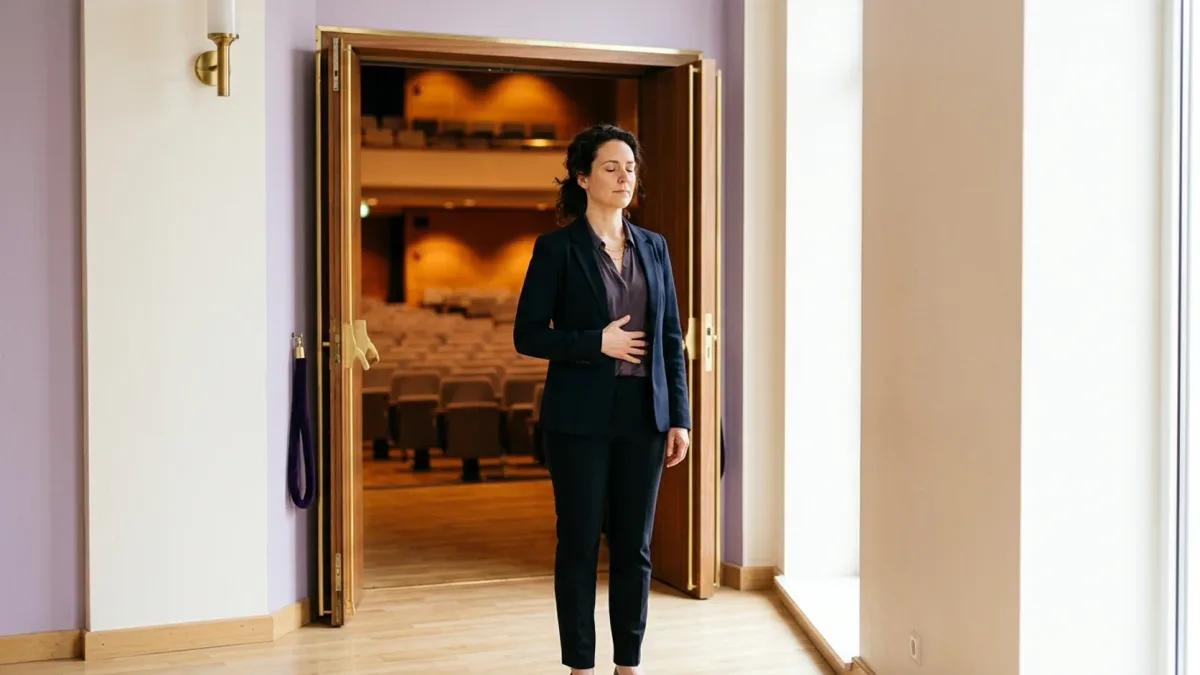
Almost every guide on this subject hands you the same six exercises and leaves you to work out which one you needed. That's the wrong order. A voice that shakes, a sentence that runs out of air halfway, and a chest that won't loosen twenty minutes before you go on are three different failures. They have different causes, and the technique that fixes one can make another worse.
So here's the thing worth knowing before any of the exercises: the big, dramatic deep breath you take right before your first sentence is actively counterproductive. Holding a large breath at the top raises the air pressure under your vocal cords, and your voice comes out pressed and strained on exactly the words you most wanted to land (Connected Speech Pathology). Most people do this. It is the single most common breathing mistake in public speaking.
- Work out which symptom you actually have — shaking, air loss, racing, or tightness.
- Learn diaphragmatic breathing lying down, when you are calm, not in the hallway.
- Practise it daily for two to three weeks so it is available under adrenaline.
- Mark your script at the natural punctuation breaks where you will breathe.
- Rehearse out loud, breathing only at those marks.
- Ten minutes before you speak, run box breathing or a long-exhale cycle.
- At the doorway, take one ordinary breath — release a little of it — and start.
- While speaking, take silent nose breaths at your marks and let the pauses stand.
Why does anxiety change how you breathe?
Adrenaline moves your breathing up into your chest and speeds it up. Shallow, fast, high breathing is efficient for running away from something and useless for speaking, because speech needs a long, controlled outward airflow — the opposite of what a startled body wants to do.
That's why the fix is mechanical rather than motivational. Telling yourself to relax does very little. Deliberately lengthening your exhale does a lot, because a slow out-breath is one of the few direct levers you have on your own autonomic nervous system.
Source: Zaccaro et al., Frontiers in Human Neuroscience, 2018
A 2018 systematic review in Frontiers in Human Neuroscience examined slow-breathing techniques — defined as fewer than ten breaths per minute — and found consistent links to increased heart-rate variability and parasympathetic activity, alongside EEG changes associated with emotional control (Zaccaro et al., 2018). Normal resting breathing runs roughly twelve to twenty breaths a minute. Getting under ten is the whole trick, and the exhale is what gets you there.
This is also why breathing work sits underneath so much other speaking advice. How to calm presentation nerves covers the wider pre-talk routine; breathing is the part of it that acts fastest.
Which breathing problem do you actually have?
Match the symptom to the mechanism before you pick an exercise. Most people are handed a calming technique when their actual problem is breath support, or vice versa.
| What you notice | What's actually happening | What fixes it |
|---|---|---|
| Your voice shakes or wobbles | Chest breathing plus muscular tension; unsteady airflow across the vocal folds | Diaphragmatic breathing, trained in advance — not a bigger breath |
| You run out of air mid-sentence | Phrases too long for one breath, or breathing only when desperate | Breath marks at punctuation; shorter phrases |
| You gasp audibly between sentences | Fast mouth breathing under pressure | Silent nose breaths at planned pauses |
| You speed up and cannot slow down | Not breathing at all — you're talking through the pauses | Deliberate pauses, which force a breath |
| Chest tight, heart racing beforehand | Sympathetic arousal in the waiting period | Long-exhale or box breathing, ten minutes out |
| Voice sounds pressed on the first line | A big held breath before speaking | One ordinary breath, partly released, then start |
Two of those rows point somewhere other than breathing. If your voice shakes, the underlying pattern is worth its own read — how to stop your voice from shaking when speaking covers the tension side that breath alone won't solve. If you speed up, breathing is a symptom rather than the cause; how to stop talking too fast diagnoses that properly.
What are the best breathing exercises for public speaking?
Six, and they do different jobs. Learn the first one properly; the rest are variations you can pick up in a minute each.
Diaphragmatic breathing (the foundation). Lie on your back, one hand on your chest, one on your belly just below the ribs. Breathe so the lower hand rises and the upper one stays still. That's it. It feels like nothing the first time and unfamiliar for about a week. Practise it lying down before you attempt it standing, because gravity does half the work for you.
Box breathing (pre-talk calm). Inhale four counts, hold four, exhale four, hold four. Repeat for sixty to ninety seconds. Its virtue is that the counting occupies the part of your mind that would otherwise be rehearsing catastrophe.
The long exhale (fastest calming). Inhale four counts, exhale eight. The 4-7-8 pattern is the well-known version, but the exact counts matter less than the ratio — the exhale needs to be roughly twice the inhale. Two or three cycles is enough. More than that and some people start to feel light-headed.
Straw breathing (breath control). Exhale slowly through a drinking straw, or through pursed lips. It teaches you to meter air out gradually rather than dumping it in the first three words, which is the actual skill speaking requires.
Silent nose breaths (during the speech). Breathe in through your nose at your planned pauses. A quick gulp through an open mouth is audible from several rows back; a nose breath at a full stop is not.
Phrase practice (breath support). Read a paragraph aloud, breathing only at the punctuation you have marked. Uncomfortable at first, automatic within a fortnight.
Straw breathing overlaps with vocal warm-ups, and if you're doing both there's no need to duplicate the work — vocal warm ups for public speaking covers lip trills, humming, and the rest of the pre-talk voice routine that pairs with these.
How do you breathe while speaking without running out of air?
Stop treating breathing as something that happens between sentences by accident, and plan it. One comfortable breath carries most speakers about a phrase — roughly ten to fifteen words (Connected Speech Pathology).
Source: Connected Speech Pathology
Print your opening and closing — the two parts you've scripted — and mark every point where you intend to breathe. Commas and full stops, not arbitrary gaps. Then rehearse breathing only at those marks. Where you find yourself starving for air before the next mark, the sentence is too long; cut it rather than trying to develop bigger lungs.
There's a useful side effect here. The pauses you need for breath are the same pauses that make a speaker sound composed, so planning your breathing improves your delivery even when you aren't nervous. How to use pauses when speaking covers the deliberate version of this. Volume works the same way — projection comes from steady breath support rather than effort in the throat, which is the substance of how to project your voice.
When should you use each breathing exercise?
This is where most advice goes wrong. The techniques are not interchangeable, and the useful distinction is between training breathing — which takes weeks and has to be learned while you're calm — and rescue breathing, which works in sixty seconds but only if you've already trained.
The stage people skip is the first one. Attempting diaphragmatic breathing for the first time while your heart is going at 110 does not work — you have no reference for what it should feel like, and the attempt itself becomes another thing to be anxious about. Two to three weeks of a few minutes a day is what makes it available when you need it.
If breathing work is one piece of a larger fear rather than a delivery tweak, it belongs inside a fuller plan: how to overcome fear of public speaking sets out the exposure side, which is what actually moves the baseline over months.
Which breathing mistakes make speaking anxiety worse?
Four, and the first is nearly universal.
The big deep breath before you start. A large breath held at the top puts pressure under the vocal folds and presses your first phrase. Take an ordinary breath, let a little of it go, then speak. It feels underwhelming and sounds much better.
Learning the technique under pressure. See above. Breathing exercises are a trained reflex, not an instruction you can follow for the first time in a corridor.
Over-breathing. Ten minutes of enthusiastic deep breathing can leave you light-headed and tingling, which your body will happily interpret as more evidence that something is wrong. Two or three cycles of a long exhale is the dose. Stop there.
Holding your breath while you think. Very common in question-and-answer sections, where people stop breathing entirely while formulating a reply, then speak on empty. Breathe out, then answer.
If your breathing problems show up in ordinary conversation rather than only when speaking publicly — persistent breathlessness, dizziness, or a sense of not getting a full breath — that's worth raising with a doctor rather than treating as stage fright. Speaking anxiety is situational by definition.
The general principle holds across all four: breathing well when you speak is a habit built quietly in advance, not a technique applied loudly in the moment. That's the same shape as most of how to speak with confidence — the composure is manufactured weeks earlier.
Key takeaways
- Breathing does two separate jobs when you speak: calming your nervous system beforehand, and supporting your voice during. Different techniques, different moments.
- Match the exercise to the symptom — a shaky voice, air running out, audible gasping, and pre-talk tightness each need a different fix.
- Slow breathing under ten breaths a minute is the rate associated with parasympathetic shifts; the long exhale is what gets you there.
- One comfortable breath carries about ten to fifteen words. Mark your breaths at punctuation and cut sentences that outrun them.
- Never take a big held breath before your first line — it pressurises the vocal folds and makes your opening sound strained.
- Diaphragmatic breathing has to be trained while you're calm, over two to three weeks. It is not available on demand the first time you try it.
Frequently asked questions
What are the best breathing exercises for public speaking anxiety?
For anxiety specifically, use a long exhale: inhale for four counts and exhale for eight, two or three cycles, about ten minutes before you speak. Box breathing — four in, four hold, four out, four hold — works similarly and has the advantage of occupying your attention. Both rely on the exhale being longer than the inhale, which is the part that shifts your nervous system.
How do you breathe when speaking in public?
Breathe in through your nose at the punctuation, not whenever you run short. Mark the breaks in your opening and closing beforehand, then rehearse breathing only at those marks. Nose breaths are silent; a fast mouth gulp is audible several rows back. The pauses this creates also make you sound more composed, so it costs you nothing in delivery.
What is diaphragmatic breathing for public speaking?
Breathing low, so your belly moves and your chest stays relatively still, rather than lifting your shoulders. It gives you a steadier and longer airflow, which is what a voice needs to stay level. Learn it lying on your back with a hand on your belly and a hand on your chest — the lower hand should rise, the upper one shouldn't — before trying it standing up.
Should you do box breathing before a speech?
Yes, roughly ten minutes before rather than seconds before. Sixty to ninety seconds of four-count breathing lowers arousal and gives your mind a counting task instead of a catastrophising one. What it will not do is fix your breathing at the lectern — by then the useful move is one ordinary breath, partly released, then your first line.
How do you stop running out of breath when speaking?
Usually the sentences are too long, not the lungs too small. One breath carries most speakers ten to fifteen words. Mark where you'll breathe, rehearse to those marks, and shorten any sentence you can't finish comfortably. Straw breathing — exhaling slowly through a straw or pursed lips — trains you to release air gradually instead of spending most of it on the first few words.
How long does it take for breathing exercises to help with public speaking?
Calming techniques like the long exhale work within a couple of minutes the first time you use them. Diaphragmatic breathing is different — it needs two to three weeks of a few minutes daily before it's reliable under adrenaline. That gap is why people conclude breathing exercises don't work: they tried one for the first time in the corridor, which is the one situation where it won't.
Conclusion
Breathing is the fastest lever you have on a nervous body, but only if you've pulled it before. Train the low, slow breath while you're calm, plan where the breaths go in your script, and resist the enormous dramatic inhale before your first sentence. Read a paragraph aloud tonight, breathing only at the full stops, and notice how much of the shakiness was never about nerves at all.