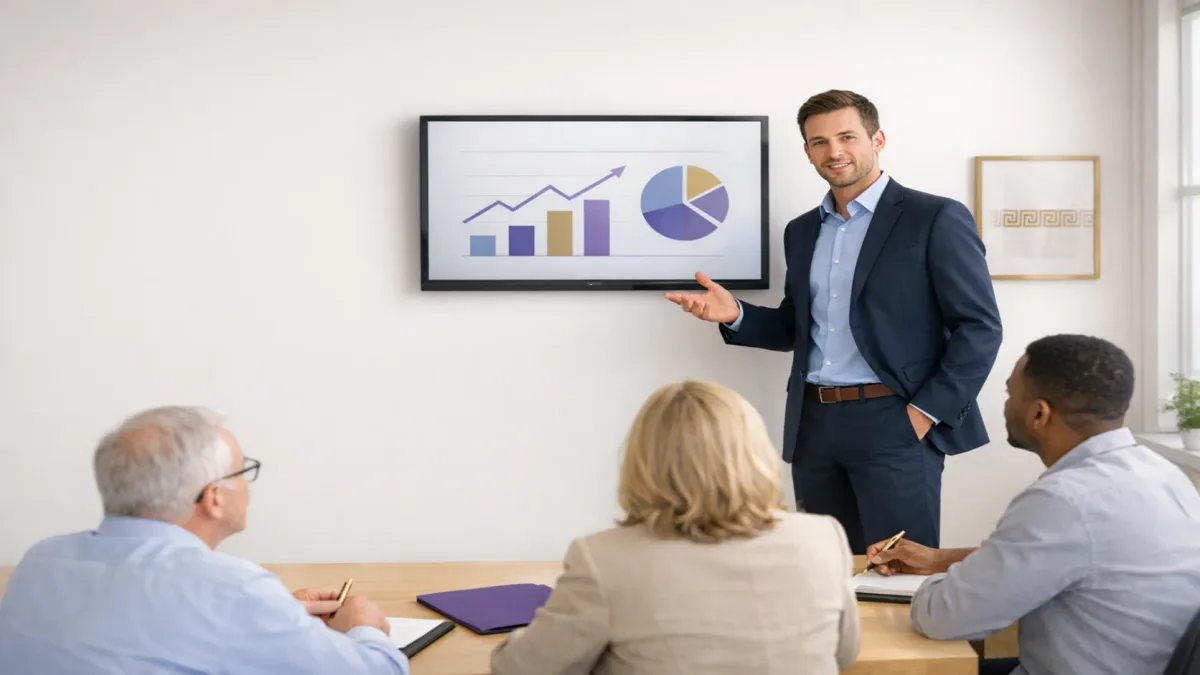
Most advice on interview presentations is really advice on slides: use a template, keep the font big, don't cram. That's fine, but it's not why candidates fail. They fail because they answer a slightly different question from the one they were asked, run three minutes over, and then wobble on the first follow-up. All three are delivery problems, and the slides don't fix any of them.
This guide covers the part the template sites skip: what the panel is actually scoring, how to budget the minutes, what a strong ten-minute version sounds like, how to rehearse, and how to handle the questions afterwards. For the general skill of presenting, start with our pillar guide on how to give a presentation. Everything below is specific to the interview format.
Here is the sequence:
- Confirm the brief, the time limit, the format, and who's on the panel.
- Write the one-sentence recommendation you want them to remember.
- Budget the minutes, and plan to finish a minute early.
- Build the talk: opening, context, three supports, close.
- Make a small number of slides that support the talk and don't replace it.
- Rehearse out loud at least five times, with a timer and a recording.
- Write and practise answers to the ten questions you're most likely to get.
- Deliver, hand over to questions cleanly, and answer like a colleague.
What is an interview presentation, and what is the panel really scoring?
An interview presentation is a stage in a job interview where you present on a set topic, usually for 5 to 20 minutes, followed by questions from the panel. Common briefs are "how would you approach the first 90 days?", "walk us through a project you're proud of", "analyse this case and recommend a course of action", or simply "tell us about yourself".
Employers add the stage because it works as a small work sample. Instead of asking you whether you can explain a plan to senior people, they watch you do it. That matters. In Schmidt and Hunter's widely cited review of selection methods, work-sample tests were among the strongest single predictors of job performance (Schmidt & Hunter, Psychological Bulletin, 1998). A later meta-analysis put the corrected figure noticeably lower, at about .33 rather than .54, which is still a real signal (Roth, Bobko & McFarland, Personnel Psychology, 2005). Either way, panels treat the presentation as evidence, not a formality.
So what's on the scoresheet? Rubrics vary, but nearly all of them reduce to four things:
| What they score | What it looks like when you get it | What it looks like when you don't |
|---|---|---|
| Fit to the brief | Every section answers the question they set | A polished general talk with the brief tacked on at the end |
| Judgment | A clear recommendation, with trade-offs named | Ten ideas, no priority, no "and here's what I wouldn't do" |
| Structure and time | Finishes on time, signposted, easy to follow | Runs over, rushes the ending, loses the thread |
| Composure under questions | Clarifies, answers, admits limits calmly | Defends every point, guesses, or freezes |
Notice what isn't on that list: slide design. A clean deck helps, but no panel hires the best template. They hire the person who seemed most like a colleague they'd want in the room.
What should you ask before you start preparing?
Ask four things as soon as you get the brief: exactly how long you have, whether questions come during or after, what equipment you'll have, and who'll be on the panel. Recruiters and hiring managers expect these questions. Asking them is a small signal of the judgment they're about to test.
The answers change your preparation more than anything else you'll do:
- Length. "Ten minutes" sometimes means ten minutes plus questions, and sometimes ten minutes including questions. That's a 40% difference in your content.
- Questions during or after. If the panel can interrupt, your structure has to survive being broken up, so signpost more and script less.
- Equipment. Will there be a screen and a clicker? Should you bring a laptop, send a PDF in advance, or present with no slides? If it's on video, who shares the screen?
- The panel. A hiring manager, an HR partner and a technical specialist each listen for different things. Knowing who's there tells you which questions to rehearse.
A short email covers it:
Thanks for the brief. To prepare properly, could you confirm how long the presentation should run and whether questions come during or after it? I'd also like to know what equipment will be available, whether you'd like the slides in advance, and who will be on the panel.
If the brief itself is vague, ask one clarifying question rather than guessing. "Is there a particular part of the business you'd like me to focus on?" is fine. Then make a sensible assumption, and say it out loud at the start of the talk.
How long should an interview presentation be?
Exactly as long as they asked, minus about 10%. If you're given ten minutes, plan for nine. Running over in an interview presentation is a scored mistake, because managing a fixed amount of time is part of what's being tested. Some panels will stop you mid-sentence when time is up.
Here's how the minutes break down for the three most common slots:
| Section | 5-minute slot | 10-minute slot | 15-minute slot |
|---|---|---|---|
| Opening and recommendation | 0:30 | 1:00 | 1:30 |
| Context: the problem as you see it | 0:45 | 1:30 | 2:30 |
| Three supports | 2:45 | 5:00 | 8:00 |
| Close and handover | 0:30 | 1:00 | 1:30 |
| Buffer, unplanned | 0:30 | 1:30 | 1:30 |
| Spoken words, roughly | 550 | 1,100 | 1,800 |
The word counts assume about 130 words a minute, a comfortable pace for a nervous speaker in a quiet room. If your slot is five minutes, our guide on how to give a 5 minute presentation goes through that format minute by minute.
How many slides? For ten minutes, six to eight is plenty: a title, your recommendation, one slide per support, and a closing slide that restates the recommendation. Slides are for the panel to look at while you talk, not for you to read from.
A structure that works for any interview presentation topic
Whatever the brief, the same five-part shape holds up: a one-sentence recommendation, the problem as you understand it, three supports, the risks you'd watch for, and a close that hands over to questions. It works because it puts your judgment first, which is the thing being scored, and gives the panel an easy thread to follow.
1. Lead with the recommendation. Don't build up to your answer. Say it in the first minute: "My recommendation is to fix onboarding before spending anything on acquisition, and I'll show you why." Panels see five or six of these in a day. The ones they remember give the answer first.
2. Show you understood the problem. Spend a minute restating the situation in your own words, including any assumption you've made. This is where you prove you read the brief properly, and it's the section most candidates skip.
3. Give three supports, and stop at three. Each support is one reason, one piece of evidence, and one consequence. If you have a fourth idea, put it in your back pocket for the Q&A. That's exactly where it scores best.
4. Name what you'd watch for. One short section on risks, trade-offs, or what you'd do differently with more information. It's the clearest evidence of judgment in the whole talk, and almost nobody includes it.
5. Close and hand over. Restate the recommendation in one sentence, then invite questions on something specific (see the example below). Opening and closing lines matter more than their seconds suggest. Our guides on how to start a presentation and how to end a presentation have more lines to borrow.
How do you choose a topic when the brief is open?
Sometimes the brief is "present on a topic of your choice" or "anything relevant to the role". Pick a topic where three things overlap: it's relevant to the job, you have real experience of it, and you can show judgment in it, not just knowledge. A project you led, with a decision you'd make differently now, is almost always a better choice than a general industry overview.
Interview presentation topics that work well, by role:
| Role type | Strong topic | Why it works |
|---|---|---|
| Manager or team lead | Your first 90 days: what you'd learn, fix, and leave alone | Shows prioritisation and restraint |
| Sales or account management | How you'd approach a named target account | Shows research and commercial thinking |
| Marketing | One channel you'd grow, with a test plan and budget | Shows you think in experiments, not ideas |
| Technical or engineering | A system you'd change, and the migration risk | Shows trade-off thinking, not just skill |
| Graduate or entry-level | A project from study or work, and what you learned from it | Shows reflection, which is what they're hiring |
| Teaching or training | A ten-minute lesson on something you know well | Is the job, done in front of them |
Avoid topics that only show enthusiasm ("why I love this industry"), topics that criticise the company without a fix, and anything you'd need to learn from scratch. The panel will ask follow-ups, and they'll quickly find where your knowledge ends.
How do you give a presentation about yourself in an interview?
Treat "present about yourself" as a career story with a point, not a CV read aloud. Choose three moments that each show a strength the job needs, tell each one briefly with a specific result, and finish by connecting them to this role. The same principle sits behind a good answer to "tell me about yourself", just stretched to five or ten minutes.
A shape that works:
- Who you are, in one line. Your current role and the kind of problem you're good at solving.
- Three moments. Each one is a situation, what you did, and what changed as a result. Pick moments that match the three things the job advert keeps repeating.
- The thread. What the three moments have in common. This is the sentence the panel should remember.
- Why this role. Why the thread leads here, now.
Keep personal detail light and relevant. One human touch, such as why you got into the field, helps people remember you. Five of them turn it into a speech at a party. For the short spoken version, see how to answer "tell me about yourself".
Interview presentation example: a 10-minute talk from opening to close
Here's a worked interview presentation example. The brief: a marketing manager role at a subscription software company. "In ten minutes, tell us how you'd grow trial-to-paid conversion in your first 90 days."
Opening, about 45 seconds.
"Thank you for having me. You asked how I'd grow trial-to-paid conversion in my first 90 days. My recommendation is to spend the first month on one thing: getting new trial users to their first finished project inside three days. The data you shared suggests that's where most trials are lost, and it's cheaper to fix than anything at the top of the funnel. I'll cover what I think is happening, the three changes I'd make, and what I'd watch for. I'll keep it to nine minutes so we have time to talk."
Context, about 90 seconds. Restate the numbers from the brief. Name your assumption: "I'm assuming trial length stays at 14 days. If that's flexible, it changes point three."
Three supports, about five minutes.
- Support one: a shorter onboarding path, with the evidence from the brief and one example from your past work.
- Support two: a day-two email triggered by what the user hasn't done yet, with a simple test design.
- Support three: a sales-assist step for teams of five or more, with the rough cost.
Risks, about 45 seconds. "Two things I'd watch for: improving activation can hide a pricing problem, and email tests need four weeks to read properly, so I wouldn't call a result before day 30."
Close and handover, about 45 seconds.
"So, in one line: fix the first three days before buying more traffic. I've kept the budget figures and the 60- and 90-day plan in the appendix. I'm happy to go deeper on any of the three changes, or on how I'd measure them."
The last line matters more than it looks. It points the first question at the material you've prepared best.
How should you rehearse an interview presentation?
Rehearse out loud, standing up, with a timer, at least five times. Reading it through in your head doesn't count, because silent reading runs far faster than speech and hides every sentence you can't actually say. The goal isn't to memorise a script. It's to know the structure so well you could give the talk from the slide titles alone.
A five-run plan over three or four days:
- Run 1: the rough run. Talk it through from your notes. Expect it to run 30% long. Mark every place you stumbled.
- Run 2: the cut. Cut until you finish at 90% of the time limit. Cut whole sections, not adjectives.
- Run 3: the recording. Record it on your phone and watch it back once at normal speed. Note your opening, your pace, and the places your voice drops. Our guide on how to record yourself speaking covers what to look for.
- Run 4: the interrupted run. Ask someone to interrupt twice with questions. Practise getting back on track: "Good question. I'll come back to it in the risks section. So, the second change…"
- Run 5: the cold run. Give it to someone who hasn't seen it, then ask them to repeat back your recommendation. If they can't, your opening isn't clear enough.
Then rehearse the Q&A separately. That's the part most candidates never practise, and it usually carries as much weight as the talk. A mock interview practice session, with a friend or an AI interviewer that asks unscripted follow-ups, is the closest you'll get to the real panel.
Learn your first 30 seconds and your last 30 seconds word for word. Everything in between should be learned as structure, not script. Nerves peak at the start, and a memorised opening carries you through them. A memorised close means you always land the ending, even if the middle runs long.
How do you deliver it in the room?
Deliver it the way you'd present to colleagues: standing if you can, looking at the panel rather than the screen, and pausing between sections. The opening minutes matter more than they seem to. In a study of real interviews, early impressions of a candidate's competence predicted later interview scores and even job offers (Barrick, Swider & Stewart, Journal of Applied Psychology, 2010).
A few specifics that make the biggest difference:
- Spread your eye contact across the whole panel. It's natural to talk to the most senior person or the friendliest face. Give each panel member a full sentence of eye contact in turn, including the quiet one taking notes. Our guide on eye contact when public speaking has the technique.
- Talk to the people, not the screen. Glance at a slide, then turn back to the panel before you speak. If you need to read your slides, there's too much on them.
- Pause at each signpost. A two-second pause between sections tells the panel a new point is starting. It also gives you time to breathe, which steadies your voice.
- Hold notes if you need them. Index cards with your section headings are completely acceptable. Reading full sentences from paper isn't.
What about nerves? Most candidates feel them, and interviewers know it. Interview anxiety does predict slightly lower interview performance (McCarthy & Goffin, Personnel Psychology, 2004), and interviewers mainly pick it up through behaviour, such as a slower speaking rate and less assertive delivery (Feiler & Powell, Journal of Business and Psychology, 2016). That's useful news. Behaviour is the part you can rehearse. Telling yourself "I'm excited" instead of "calm down" has also been shown to improve performance in public speaking tasks (Brooks, Journal of Experimental Psychology: General, 2014). For the full routine, see how to calm interview nerves.
How do you handle questions from the interview panel?
Treat the questions as the second half of the presentation, because to the panel they are. Listen to the whole question, pause before you answer, give the direct answer first, and then one sentence of reasoning. If you don't know, say what you'd do to find out. Panels are testing how you think when you can't prepare, not whether you know everything.
The five kinds of question you'll get, and how to handle each:
| Question type | Example | How to answer |
|---|---|---|
| Clarifying | "What did you mean by activation?" | Define it in one sentence and give an example. Don't re-present the slide. |
| Challenging | "Isn't that just a pricing problem?" | Take it seriously, agree with the part that's true, then explain your view: "Possibly, and that's one of the risks I'd watch. Here's why I'd still start with onboarding." |
| Extending | "What would you do in month three?" | This is where your back-pocket fourth idea goes. Keep it short. |
| Knowledge gap | "How does this work with our partner channel?" | "I don't know enough about your partner channel to say. I'd start by asking the partner team X and Y." |
| Personal | "Have you done this before?" | A specific example with a result. This is a behavioural question in disguise. |
Never argue to win a point. A challenge from a panel member is usually an invitation to show how you take feedback. "That's a fair push, and I'd want to test it" scores better than a strong defence of a guess. Our guide on how to handle questions after a presentation goes into more depth, including what to do when two panel members disagree.
What if something goes wrong?
Something small usually does: a slide won't load, you lose your place, or you're running long. What the panel remembers is how you handled it, so have a plan for the four most likely problems before you walk in.
- You're running over. Skip straight to your close. Plan this cut in rehearsal: "In the interest of time, I'll go straight to my recommendation." That line, said calmly, looks like good time management, not failure.
- Your mind goes blank. Look at your slide title, pause, and restate your recommendation. It's the one sentence you know cold, and it gets you moving again. What to do when your mind goes blank has more recovery lines.
- The tech fails. Bring the deck on a USB stick and as a PDF, and email it in advance. If all else fails, say "Let me talk you through it," and do. A candidate who presents fluently without slides is very convincing.
- It's on a video call. Put your notes beside the camera, not below it. Share only the presentation window, test it beforehand with someone else, and decide what you'll say if screen sharing fails. Our virtual presentation guide covers the setup.
Key takeaways
- An interview presentation is a work sample. The panel scores fit to the brief, judgment, structure and time, and composure under questions, not slide design.
- Ask about length, when questions come, equipment, and who's on the panel before you prepare anything.
- Plan to finish at 90% of the time limit. That's about 1,000–1,100 spoken words for a ten-minute slot.
- Lead with one recommendation, show you understood the problem, give three supports, name the risks, then hand over to questions.
- Rehearse out loud at least five times, including one recorded run, one interrupted run and one cold run, and rehearse the Q&A separately.
- Answer panel questions directly, admit what you don't know, and treat challenges as a test of how you take feedback.
Frequently asked questions
How do you do a presentation for a job interview?
Confirm the brief, time limit, format and panel first. Then write a one-sentence recommendation, structure the talk as opening, context, three supports, risks and close, and make six to eight simple slides. Rehearse out loud at least five times with a timer, plan to finish a minute early, and practise answering likely panel questions separately.
How long should an interview presentation be?
As long as the brief says, and no longer. Most interview presentations are 5, 10 or 15 minutes, followed by 10 to 20 minutes of questions. Plan to finish at about 90% of the limit (nine minutes for a ten-minute slot), because panels often treat overrunning as a sign of poor judgment.
What should a presentation for an interview about yourself include?
Three career moments that each show a strength the job needs, told as situation, action and result. Add the thread that connects them and why that thread leads to this role. Open with a one-line summary of who you are. Keep personal detail to one relevant touch, and don't walk through your CV in date order.
What are good interview presentation topics?
The best topics overlap the role, your real experience, and a decision that shows judgment. Strong choices include a 90-day plan, a project you led and what you'd change, a test plan for one channel or account, or a short lesson for teaching roles. Avoid general industry overviews and topics you'd need to learn from scratch.
How many slides should an interview presentation have?
For a ten-minute presentation, six to eight slides is enough: title, recommendation, one per support, risks, and a closing slide that restates the recommendation. For five minutes, three to five. Put detail such as budgets or longer plans in an appendix you can show if the panel asks.
Can you use notes in an interview presentation?
Yes. Index cards with your section headings and a few key numbers are normal and won't count against you. What hurts is reading full sentences from paper or slides, because the panel loses your eye contact. Memorise only your first and last 30 seconds, and learn everything in between as structure.
Conclusion
An interview presentation rewards the same things the job does: reading a brief carefully, making a call, fitting it into the time you have, and staying steady when someone pushes back. Get the recommendation into the first minute, finish early, and spend as much rehearsal on the questions as on the talk. Then say it out loud, all the way through, until the ending arrives on time without you having to rush.