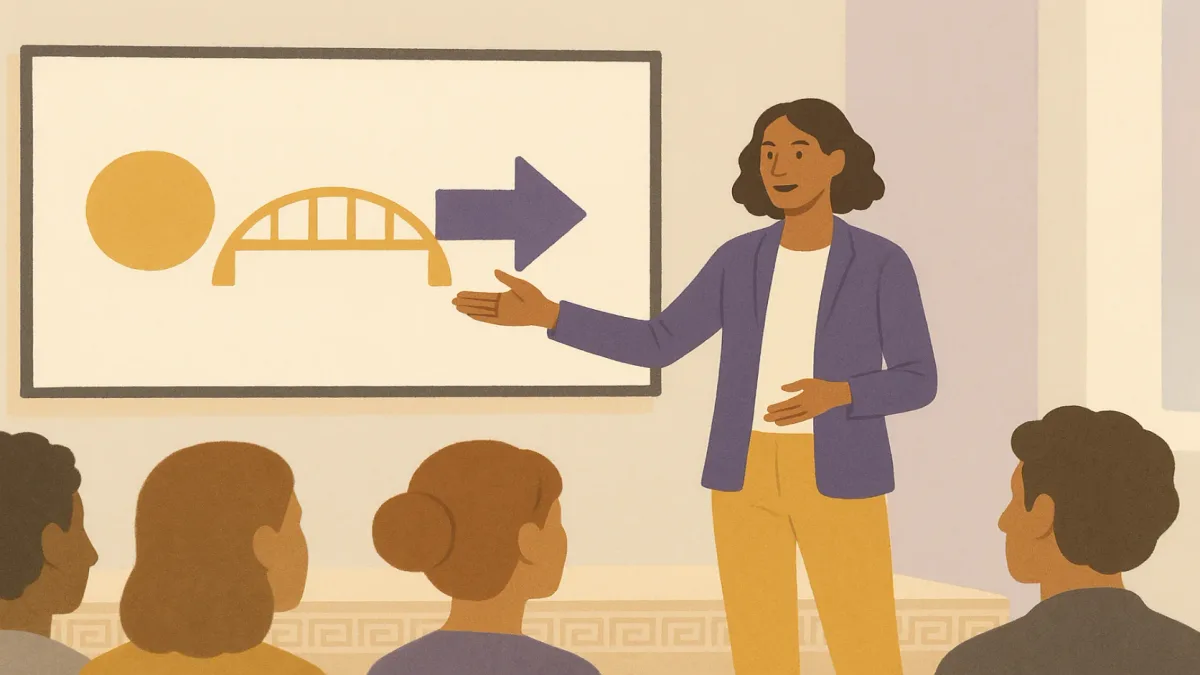
You have a good talk. The points are right, the order is right, the slides are fine. And when you play back a recording, every section runs straight into the next with the same three words: "So... um, so..." The audience never hears a door close or a door open. They hear one long corridor, and somewhere around minute six they stop being sure which room they are in.
That is a transitions problem, and it is the most fixable problem in public speaking, because the fix is a handful of sentences you can write tonight. What makes it hard is that most guides to speech transitions give you the wrong unit. They hand you a table of transition words, "in addition", "on the other hand", "consequently", and send you off to sprinkle them. Those words have a job, and this guide gives you the table too. But the thing that actually keeps a listener oriented is bigger than a word. It is a short, deliberate sentence that says what we just did and what we are about to do, and the studies on what listeners retain point at that sentence, not the vocabulary.
This guide sits under how to give a presentation, which covers building the spine the transitions sit on, and alongside how to memorize a speech, which makes the case that the seams are the one part of a talk worth learning verbatim. This one is only about the seams: what to say at them, how to say it, and how to find the ones you are fumbling.
Here is the sequence:
- Understand what a transition is for: a location signal for a listener who cannot scroll back.
- Know which kind of transition the evidence favours: the structural signpost over the connective word.
- Mark every seam in your talk, usually one more than the number of sections.
- Write a close-and-open sentence for each seam, twelve to twenty-five words, and learn it word for word.
- Deliver each one after a pause, slower than the material around it, with a change of position.
- Add location markers and internal summaries once the talk runs past ten minutes.
- Use transition words inside sections for local logic, not as a substitute for the signpost.
- Record a run, listen only to the seams, and replace every "so... so" with a written sentence.
What are speech transitions and why do listeners need them?
A speech transition is anything that tells the audience you are moving from one idea to another and how the two relate. It can be as small as "first" or as large as a full sentence: "That is the problem. Now let me show you what it costs." The reason listeners need them is one that readers do not: a reader who loses the thread glances up at the heading or rereads a paragraph. A listener has no page. If they miss the moment a new point began, everything that follows is filed under the old point, and they spend the next minute quietly trying to work out why it does not fit.
Writers on speech have called transitions signposts, bridges, and seams. Each metaphor carries a piece of the truth. A signpost tells you where you are. A bridge tells you two things connect. A seam is where a garment is most likely to tear. Transitions are all three, and the seam image is the most useful for practice, because it tells you where to look when a talk feels loose: not inside the sections, which are usually fine, but at the joins between them.
The practical consequence is that transitions are not decoration you add after writing. They are part of the structure, and if you cannot write a clean transition between two sections, the sections are often in the wrong order or one of them is two ideas pretending to be one. Writing the seams is a cheap test of the spine.
What does the research say about which transitions actually work?
The useful finding comes from studies of lectures, which are the most-studied kind of talk because the listeners sit a test afterwards. In the most cited of these, Chaudron and Richards (Applied Linguistics, 1986) played four versions of the same lecture to different groups: a plain scripted version, one with "macro-markers" added, one with "micro-markers" added, and one with both. Macro-markers were sentences about the structure of the talk itself: "Today I am going to be talking about...", "Let us move on now to...". Micro-markers were the small connectives, "so", "right", "well", "OK", "now". The macro-markers improved recall. The micro-markers, on their own, made no significant difference.
That is the single most important thing to know about speech transitions. The sentence that names the structure moves recall. The word that merely links two clauses does not. Most of the "so... so... so" in a recorded run-through is micro-markers doing a job they cannot do.
The second study puts numbers on what a listener keeps. Titsworth and Kiewra (Contemporary Educational Psychology, 2004) had 223 students watch scripted lectures that were identical except for one thing: the cued version signalled the lecture's organisation out loud each time a new point began, with explicit transitions between main and subordinate points and verbal summaries. Students who heard the cued version recorded far more of the lecture in their notes. As Luo, Kiewra and Samuelson summarise it (Instructional Science, 2016), the cued group noted 54 percent of the lecture's organisational points and 80 percent of its details, against 15 and 37 percent for the uncued group. The cues also had what the authors call a moderately consistent effect on cognitive learning when the students were tested, and tested again a week later.
Source: Titsworth & Kiewra, 2004
Read that carefully, because it is not a result about note-taking technique. The lecture content was the same. The only thing that changed was that the speaker said, out loud, where each point sat in the structure. The listeners who heard that captured more than three times as much of the organisation and more than twice as many of the details.
One caution, so you do not over-learn the lesson. The small connectives are not useless; they are just not transitions. Flowerdew and Tauroza (Studies in Second Language Acquisition, 1995) took a real, unscripted lecture and deleted its micro-markers, then showed both versions to 63 first-year engineering students listening in their second language. The group that heard the original scored 36.4 percent on a written recall test against 21.6 percent for the deleted version, and 69.3 against 49.4 on short-answer questions. In a natural talk, the little words mark where one chunk ends and the next begins, and ripping them out hurts, especially for anyone working hard to follow. So keep your "so" and your "now". Just stop asking them to carry the structure. That is the signpost's job.
Where do transitions go in a speech?
The rule from every public speaking textbook is right and worth stating plainly: a transition belongs after the introduction, between each main point, and before the conclusion. For a talk with three points, that is four seams. For a talk with four points, five. Count them now for whatever you are preparing. The number is usually one more than the number of sections, and in most draft talks at least two of those seams have nothing written at them.
There is a second layer for anything longer than about ten minutes. Inside a long section, listeners need a smaller version of the same signal: an internal preview when the section has sub-parts ("There are two reasons this failed, and the second is the one that matters"), and an internal summary when the section has run long enough that its opening is out of working memory ("So far in this section: the vendor missed twice, and both times for the same cause"). The textbook names for these are internal previews and internal summaries, and they are the difference between a long talk that feels guided and one that feels like a document being read aloud.
A transition is also a rescue rope. If you lose your place inside a section, the fastest recovery is to say the next transition sentence, because it is the one line you know verbatim and it carries you into the next section with momentum. What to do when your mind goes blank builds the full protocol around this, and it only works if the transitions exist as written sentences before the day.
How do you write a transition sentence that works?
Every strong transition has two halves. The first closes the point you are leaving by naming what it established. The second opens the next point by naming it and, when you can, saying why it follows. Textbooks call this review-preview. The simplest way to hold it in your head is close, then open.
Some rules for the sentence itself, learned from writing a lot of them:
- Name the thing, not the slot. "So that's the problem" is weaker than "So that's the problem: a two-day median reply." The second version restates the point's content in five words, which is a free rehearsal for the listener's memory.
- Twelve to twenty-five words. Shorter than that and there is no room to close and open both. Longer and it becomes a paragraph the audience has to process, which defeats the purpose.
- Say why the next point follows, if there is a why. "The obvious fixes didn't work, and I want to show you why, because it changes what we should do" is stronger than "Next, the fixes," because it tells the listener what to listen for.
- Do not preview the whole rest of the talk at every seam. One transition opens one point. A seam that says "and then after that we'll look at cost, and then risk, and then timeline" is an outline, not a transition, and it spends attention the next section needs.
- Write it down, word for word. This is the one part of a talk where improvising costs the most, because you are at the exact moment where your own working memory is switching rooms. The seams are the fifteen percent of a speech worth learning verbatim; how to memorize a speech makes the full case.
A worked example: every transition in a five-minute talk
Here is the full set of seams for a short internal talk, the kind most people actually give. The talk argues that the team should move customer support off a shared email address and onto a ticketing tool. It has an opening, four points, and an ask. That is five seams, and here is what is written at each.
Opening to point one. The hook has just landed: a real customer waited three days for a reply about a billing error.
"That is not an unusual story. It is our median. Let me start with how bad the delay actually is, because the number surprised me."
Point one to point two. Point one has shown the data: a two-day median reply time, rising.
"So that's the problem: a two-day median, and getting worse. The obvious fixes didn't work, and I want to show you why, because the reason changes what we should do."
Point two to point three. Point two has walked through three attempts, a rota, a shared inbox label, and a weekly review, each of which decayed within a month.
"Three fixes, three failures, all for the same reason: an email has no owner. The proposal is built around fixing that one thing."
Point three to point four. Point three has described the tool and the workflow.
"That's what it looks like day to day. Now the part you're waiting for: what it costs, and what could go wrong."
Point four to the close. Point four has covered price, a two-week migration, and the risk of losing email history.
"So: a few hundred a month, two weeks to switch, and one real risk we can contain. Here's what I'm asking for today."
Notice what the five sentences have in common. Each one restates the content of the point it is leaving in a handful of words, each names the next point, three of the five say why the next point follows, and together they are a complete summary of the talk. If someone heard only the transitions, they would know the argument. That is the test: read your transitions in sequence, on their own, and see whether they tell the story. If they do, the structure is sound. If they do not, the problem is usually in the structure, and the fix belongs in how to write a speech rather than at the seams.
Write the transitions before the slides. A deck built first tends to dictate an order the argument would not have chosen, and you end up writing seams to justify a sequence rather than a sequence that produces clean seams. If a transition will not come, the two sections it joins are the thing to look at.
How do you deliver a transition so the audience notices it?
A transition sentence is only half of the signal. The other half is physical, and it is what separates a seam the room feels from one it misses even though you said the words.
Pause before it. The single highest-value change is a silence of one to two seconds between the last sentence of a section and the transition. The room uses that silence to close the idea. Most speakers fill it with the connective instead, "and so", "which brings me to", which is the micro-marker the research says carries nothing. How to use pauses when speaking calls this the transition pause and names it the most under-used pause of the five.
Say it slower and a little lower. The sentence should sound different from the material around it: unhurried, settled, slightly lower in energy for the close, lifting for the open. If you deliver the transition at the same pace as the content, it blends in and the listener does not register that anything changed. This is also where a speaker who talks too fast loses the most, because speed flattens the seams first.
Move. Change where you are standing, or at least your weight and your angle to the room, on the transition. In a long session, a speaker rooted to one spot becomes furniture, and how to keep an audience engaged puts a change of physical position at section boundaries on its short list of attention resets. The movement does not need to be large. A step and a turn is plenty.
Look at a different part of the room. Close the old point to the people you were looking at, then open the new one to someone else. The eye-contact shift is a small cue, but the audience reads it as a new beginning.
Do not announce the mechanism. "Now I'll transition to my next point" is a sentence about the talk's plumbing. The audience should feel the door, not be told there is one. Say the close and the open, and let the structure speak.
What should transitions look like in a long talk?
Everything above holds for a forty-minute talk, with two additions, because the listener's working memory is now carrying far more.
Add location markers. At each act-level seam, say where this point sits in the whole: "That's the first of three reasons," "We're halfway," "This is the last piece before the recommendation." A listener who knows there are three reasons and that this is the second can relax in a way a listener who does not know how long the corridor is cannot. The number of listeners who have quietly checked their watch during a talk because they had no idea how much was left is larger than any speaker wants to believe.
Add internal summaries at the act level. Before moving from one act to the next, give a two-sentence recap of the act you are leaving. This is the "verbal summaries of lecture content" that the cued lectures in Titsworth and Kiewra's study included, and in a long talk it does a job no single transition can: it restates material that left working memory ten minutes ago, so the next act builds on something the audience can still see.
For a talk this long, write the act-level seams as full signposts of two or three sentences, not the one-line joins you would use in a five-minute talk, and script them. How to memorize a speech has the word budget: a twenty-minute talk needs roughly 180 memorised words, and most of them are seams.
What about transitions between speakers in a group presentation?
A handover between speakers is a transition with a third half: the name. The formula is close, introduce, open, and it has to be done by the speaker who is leaving, not the one arriving. "That's the technical case: it works, and it's been tested. Priya is going to take you through what it costs, because she ran the numbers." Then stop talking and turn towards the next speaker.
Three things go wrong in handovers, and all three are avoidable in rehearsal. The leaving speaker trails off instead of closing, so the arriving speaker inherits a half-finished thought. The arriving speaker restarts from zero, "Hi everyone, so I'm going to talk about costs," re-introducing a point that was just introduced for them. And nobody rehearses the handover sentence itself, because each person rehearses their own section alone. Rehearse the seams together at least once, with the actual words, and the group talk stops sounding like four separate talks. How to speak on a panel covers the related problem of transitioning in and out of other people's points when nobody owns the running order.
What transition words and phrases work in a speech?
Here is the table most guides lead with. It belongs here, after the signpost, because these are the small tools for logic inside a section, not the structural signal between sections. Used inside a point, they tell the listener how two sentences relate. Used alone at a seam, they are the micro-markers that Chaudron and Richards found made no difference to recall.
| Job | Words and phrases that do it |
|---|---|
| Adding to a point | and, also, as well as, what's more, on top of that, in addition |
| Contrasting | but, however, on the other hand, even so, that said, the opposite is true for |
| Cause and consequence | so, because, which means, as a result, that's why, therefore |
| Sequence and time | first, then, next, after that, at the same time, finally, before, since |
| Giving an example | for instance, take, here's one case, to show you what I mean |
| Emphasis | the key thing, above all, if you remember one thing, this is the part that matters |
| Returning to an earlier point | remember the customer from the start, back to the number I showed you, as I said |
| Signalling a summary | so, in short, what this adds up to, the picture is |
Two notes on using them. First, prefer the short, spoken forms. "So" and "which means" are what people say; "consequently" and "furthermore" are what people write, and a speech full of written connectives sounds read. Second, vary them. A section where every third sentence starts with "also" has the same flattening effect as a seam that starts with "so": the listener stops hearing the word at all.
"Moving on", "next slide", "okay so", and "anyway" are not transitions. They are confessions that a transition was not written. Each one tells the audience you are leaving a point without saying what it established or where you are going. If you hear any of them on a recording, there is a seam there with nothing at it.
How do you transition to the conclusion of a speech?
The seam before the conclusion is the most important one in the talk and the one most often skipped, because the speaker is relieved to be near the end and runs the last point straight into "so, to wrap up." A listener needs to be told, clearly, that the argument is complete and the landing is coming, because that is the cue to start consolidating.
The transition to the conclusion is a close-and-open like any other, except that the close is the whole talk. "So: a two-day reply, three fixes that failed for one reason, a tool that fixes that reason, and a cost we can afford. Here's what I'm asking for." Three to four short clauses that name each point, then the open. Do not say "in conclusion"; the summary is the signal, and how to end a presentation covers what belongs after it.
One habit worth building: write this transition first, before the body. If you cannot summarise the talk in four clauses, you do not yet know what the talk is, and that is cheaper to find out on day one than in the rehearsal the night before.
How do you find the transitions you are fumbling?
You cannot hear your own seams while producing them. Your attention at a boundary is on retrieving the next section, which is exactly why "so... um, so" comes out: it is the sound of a working memory switching rooms with nothing scripted to say. The only reliable way to find the seams that are not working is a recording, listened to in a specific way.
Here is the audit. It takes ten minutes on a five-minute talk.
- Record a full run. Standing, at speaking pace, with whatever notes you will actually use.
- Listen only for the seams. Skip the content. Mark every point where one section ends and the next begins.
- Grade each seam. Silent, where you simply started the next section with no signal at all. Connective, where you said "so", "moving on", "next", "and then", "okay". Signpost, where you said a sentence that named what you just established and what comes next.
- Count the filler at the seams. "Um", "uh", and "so" cluster at boundaries more than anywhere else in a talk, because that is where retrieval is hardest. A seam with three filler words in it is a seam with no written sentence.
- Write a sentence for every silent and connective seam. Close and open, twelve to twenty-five words, named content on both sides.
- Run it again and listen for the pause. On the second recording, the thing to check is not the words but whether there was a one-to-two-second silence before each signpost. If there was not, the sentence is right but the delivery is still blending it in.
Two or three cycles of this is usually enough to move a talk from "one long corridor" to "a sequence of rooms", and the improvement is the kind listeners notice without being able to name. They say the talk was clear, or easy to follow, which is the audience's phrase for "I always knew where I was."
Orator records a run and timestamps the filler words and flow breaks, which makes the seam audit faster: the clusters of filler on the timeline are the seams, and you can jump to each one instead of listening through the whole run. The grading and the rewriting are still yours to do.
Key takeaways
- A speech transition is a sentence at the seam between two points that closes the one you are leaving and opens the one you are entering. Its job is to tell a listener, who cannot scroll back, where they are.
- The research favours structural signposts over connective words: macro-markers that name the structure improved recall and micro-markers like "so" and "now" alone did not (Chaudron & Richards, 1986). Signposted lectures left listeners with 54 percent of the organisation in their notes against 15 percent without (Titsworth & Kiewra, 2004).
- Count your seams: one after the opening, one between each pair of points, one before the conclusion. Every one gets a written sentence of twelve to twenty-five words that names the content on both sides.
- Deliver each transition after a one-to-two-second pause, slower than the material around it, with a change of position and of where you are looking.
- Past ten minutes, add location markers ("that's two of three") and act-level internal summaries, and script the seams as full signposts.
- Transition words like "however" and "as a result" belong inside sections for local logic. "Moving on", "next slide", and "okay so" are confessions that no transition was written.
- Record a run, listen only to the seams, grade each as silent, connective, or signpost, and write a sentence for every one that is not a signpost.
Frequently asked questions
What are the best transition words for speeches?
The best transition words for speeches are the short, spoken ones: "so", "but", "which means", "then", "for instance", "the key thing", "back to". They do local work inside a section, showing how one sentence relates to the next. They are not a substitute for a transition between sections, which needs a full sentence that names what you just established and what comes next. Research on lectures found that connective words on their own did nothing for recall while structural signpost sentences did, so use the words for logic and the sentence for structure.
How do you transition in a speech from one point to the next?
Close, then open. Say one clause that restates what the point you are leaving established, in named content rather than a slot ("So that's the problem: a two-day median reply"), then one clause that names the next point and, if possible, why it follows ("The obvious fixes didn't work, and I want to show you why"). Twelve to twenty-five words, written in advance and learned word for word. Pause for one to two seconds before saying it, say it slower than the surrounding material, and change your position or where you are looking as you do.
What are good transition sentences for a speech?
A good transition sentence names content on both sides of the seam. Examples: "That's the problem: a two-day median, and getting worse. The obvious fixes didn't work, and here's why." "Three fixes, three failures, all for the same reason: an email has no owner. The proposal is built around fixing that one thing." "That's what it looks like day to day. Now the part you're waiting for: what it costs." Read your transitions in sequence on their own; if they summarise the whole talk, they are good ones.
What is signposting in a speech?
Signposting is telling the audience, out loud, where they are in the structure of the talk: what you have covered, what is coming, and how many parts there are. It includes the transitions between points, previews at the start of a section ("there are two reasons, and the second matters more"), summaries at the end of a long section, and location markers ("that's two of three"). In a study of 223 students, lectures that signposted their organisation left listeners with more than three times as many of the organisational points in their notes as the same lecture without the cues.
How do you transition to the conclusion of a speech?
Use a close-and-open where the close is the whole talk. Give three or four short clauses that name each main point in order ("a two-day reply, three fixes that failed for one reason, a tool that fixes it, and a cost we can afford"), then open the ask or the final message ("here's what I'm asking for"). Do not say "in conclusion"; the summary is the signal. Write this transition first, before the body, because if you cannot summarise the talk in four clauses you do not yet know what the talk is.
How do you transition between speakers in a group presentation?
The leaving speaker does it, with a three-part sentence: close the point, name the next speaker and their topic, and say why it follows ("That's the technical case. Priya will take you through what it costs, because she ran the numbers"). Then stop and turn towards them. The arriving speaker should start the content, not re-introduce themselves or the topic. Rehearse the handover sentences together at least once with the real words, because each person rehearsing alone is why group talks sound like four separate talks.
How many transitions should a speech have?
One more than the number of main points: after the introduction, between each pair of points, and before the conclusion. A three-point talk has four seams. Past about ten minutes, add internal previews and summaries inside long sections and location markers at act-level boundaries. Fewer than this and listeners lose their place; more than this, with a transition every few sentences, and the talk sounds like an outline being read, because the connectives stop being heard.
Why do I say 'so' and 'um' so much between points?
Because the seam is where your working memory is switching from one section to the next, and if there is no written sentence there, the retrieval effort comes out as filler. "So... um, so" is the sound of a speaker looking for the next room. The fix is not to suppress the filler but to give the seam a scripted sentence to say and a pause before it. Record a run and listen only at the boundaries: the filler clusters there, and each cluster marks a transition that was never written.
Conclusion
Transitions are the one part of a talk where a few sentences do structural work out of all proportion to their length, and the research on what listeners keep points squarely at them: the sentence that names where we are, not the word that links two clauses. Count your seams, write a close-and-open for each, and learn them word for word. Then record a run tonight, skip the content, and listen only to the joins. The "so... so" you hear is exactly where the next sentence belongs.