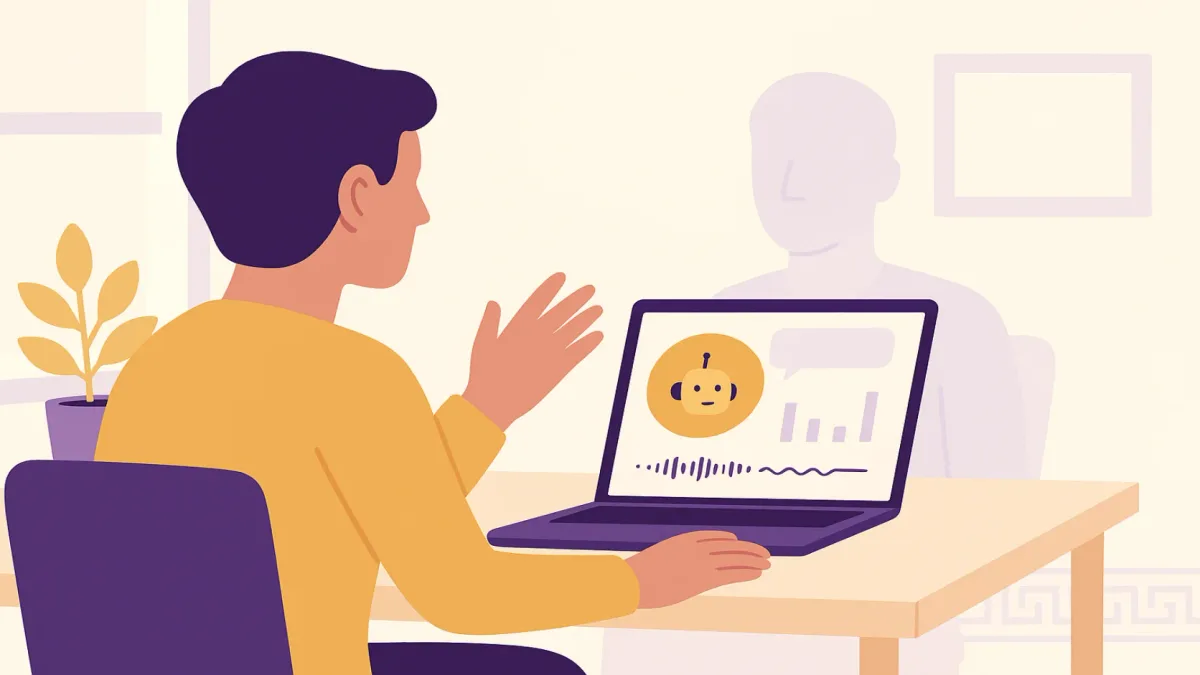
Full disclosure before anything else: we make Orator, which competes with Yoodli. That is exactly why this review sticks to things you can check yourself — Yoodli's published prices, its own help centre, its terms — and why the verdict section says plainly who should buy Yoodli instead of us.
The reason this review needs to exist is that almost nothing ranking for it describes the current product. The top organic result is a Reddit thread from 2022 about Yoodli's terms and conditions. The strongest editorial review is a CNET piece from May 2025 that tested Yoodli in passing. Several pages are published by competing AI tools, and one is confidently titled "Yoodli Review 2027." Meanwhile Yoodli raised a $40M Series B in December 2025 and rebuilt itself around a different customer. So the useful thing to do here is report what is actually true in September 2026.
What is Yoodli in 2026?
Yoodli launched as a consumer "Grammarly for speech" and is now something else. Its own description is "a secure, experiential learning platform that uses AI roleplays to help teams prepare for and practice high-stakes conversations" (Yoodli Help Center). The homepage tagline is "Train like an athlete, sell like a pro," and the logos under it are Google Cloud, Snowflake and Harness rather than universities or Toastmasters clubs.
That repositioning is backed by real money. The company — founded in Seattle in 2021 by two ex-Google X and ex-Apple engineers, out of the Allen Institute for AI — raised a $40M Series B led by WestBridge Capital in December 2025, roughly tripling its valuation to a reported $300M+ (TechCrunch, 2025). The case studies it now leads with are enterprise training outcomes: Google Cloud rolling a pitch certification out to 15,000+ employees, Snowflake saving 1,200+ hours of manager coaching per quarter.
There are three practice modes (Yoodli Help Center):
- Conversation roleplay — sales discovery, objection handling, negotiation, performance reviews. An AI plays the other person and asks unscripted follow-ups.
- Speech or presentation — the classic monologue practice, with optional AI Q&A afterwards.
- Interview roleplay — the same engine pointed at interview questions.
This matters more than any feature comparison. If you arrived here because you want to get better at giving a talk, you are evaluating a product whose roadmap is now owned by sales-enablement buyers. It still does speech practice. It is no longer what the company is optimising for.
What does Yoodli actually measure?
Yoodli's analysis splits into delivery metrics and content metrics. On delivery it reports filler words, pace in words per minute, pausing, and word-choice variety, plus a camera-based eye-contact estimate when you have video on. On content it scores conciseness, sentence starters and an overall content-quality read, which is the part most of the category does not attempt.
The coaching targets are specific rather than vague. Yoodli's own guidance pushes filler-word use down toward roughly 4% of total words, and it will flag a 180 wpm delivery and suggest getting under about 170 (Yoodli). If you want the underlying mechanics of how any of these tools generate that feedback, our guide to what an AI speech coach is and how it works walks through the pipeline.
Reliability is not uniform across those metrics, and it is worth knowing which numbers to trust.
Filler-word counting is the most dependable thing here — it is a transcript search, and independent testing puts it within a couple of counts over a ten-minute session. The eye-contact score is the least dependable: it is inferred from a webcam, so your camera height, your monitor position and your lighting move it as much as your actual behaviour does. Treat filler and pace as measurements. Treat eye contact as a hint.
Where does Yoodli actually run?
This is the single most-misreported fact about the product, so it is worth being blunt about it.
Yoodli runs in the browser (Chrome, Edge, Firefox, Brave, Safari 17+), as a desktop app for Mac and Windows that sits quietly until you start a call and records only your own voice, and as an integration inside Zoom, Microsoft Teams and Google Meet (Yoodli Help Center).
It does not have an iPhone app or an Android app.
Several software directories list Yoodli's deployment as "Web, Android, iPhone/iPad," and review sites copy that line without checking. There is no Yoodli app on the App Store or Google Play — searching either store returns competitors instead. If you wanted to practise on your phone during a commute, Yoodli is not the tool, and no amount of directory metadata changes that. Our roundup of the best public speaking apps separates the genuinely mobile ones from the desktop-only ones.
The flip side is the thing Yoodli does that phone apps structurally cannot: because it joins your actual video calls, it can score meetings and sales calls you were already going to have. That is a real advantage if your speaking problem happens in calls rather than on stages.
How much does Yoodli cost in 2026?
Checked on Yoodli's pricing page, 25 September 2026:
| Plan | Price | What you get |
|---|---|---|
| Starter | $0 | Up to 5 roleplays total, live AI roleplays, feedback on uploads, no card required |
| Pro | $8/mo billed annually | Up to 10 roleplays per week, unused ones do not roll over |
| Advanced | $20/mo billed annually | Unlimited roleplays, data excluded from AI training, reimbursable as a learning benefit |
| Team & Enterprise | Quote only | Custom roleplays, dashboards, SSO, SCIM, LMS/HRIS integrations, SOC 2 Type 2 |
Two traps in that table deserve calling out, because published reviews fall into both.
The $8 and $20 figures are annual-billed rates, not what you pay month to month. Yoodli's pricing page shows them under a billing toggle set to annual, with a "SAVE 40%" badge on that option — which, taken at face value, implies a monthly-billed price closer to $13 and $33. Third-party sites confidently print $11 and $28 as the monthly rates; those numbers do not come from Yoodli. Check the toggle yourself before you assume $8 is your monthly cost.
Enterprise pricing is genuinely unpublished. You will find "$600 per user per year" repeated across review farms. Yoodli's own page says contact sales, and nothing else.
One more thing to know before you subscribe: Yoodli's terms state that refunds are issued only where required by law, and that billing renews automatically until you cancel (Yoodli Terms of Service). Set a calendar reminder before the annual renewal, not after it.
Is Yoodli free?
There is a free plan, but it is not a free tier in the usual sense and the distinction matters.
Starter gives you five roleplays for the lifetime of the account — not five a month, not five a week. Yoodli's help centre spells it out: the plan is "limited to 5 lifetime practice sessions, each a speech, interview, or roleplay over 30 seconds" (Yoodli). Anything under thirty seconds does not burn a session; anything over it does, whether or not the session went well.
There is also no free trial of the paid plans. That is unusual in this category and it changes how you should evaluate the product: your entire evaluation budget is five conversations, and then it is a purchase decision. Compare that to Speeko, which runs a genuine 7-day trial on its paid tiers — our Speeko review covers how that one works. Our roundup of free public speaking apps puts each free cap side by side.
So: free to try, briefly, and not free to use.
What is Yoodli good at?
Three things, and the first one is genuinely differentiated.
Roleplay that does not follow a script. Most of this category records you talking to yourself and grades the recording. Yoodli's AI plays a counterpart that responds to what you actually said and asks follow-ups you did not plan for. That is a different and harder skill than delivering prepared material, and it is the closest thing in the category to rehearsing the moment that actually goes wrong. Its multi-persona roleplays — simulating a buying committee or an interview panel rather than one person — are rare anywhere else.
Scoring conversations you were already having. Because it joins Zoom, Teams and Meet, you can get feedback on real meetings instead of carving out separate practice time. For people whose problem shows up at work rather than on stage, that removes the main reason speaking practice dies in week three. If that is your situation, how to speak up in meetings covers the behavioural side.
Credible security posture. SOC 2 Type 2 certified and GDPR compliant, with SSO, SCIM and data-retention controls on the team plans. If you need to get a speaking tool past your own IT department, this is the one most likely to survive review.
Where does Yoodli fall short?
It grades how you said it better than what you said. The recurring theme in independent reviews is that Yoodli reads pacing, filler and clarity well but does not reliably judge whether your argument was any good. A polished delivery of a weak point scores well.
The feedback can attach to the wrong person. CNET's reviewer uploaded a recording and found Yoodli had critiqued the other speaker on the tape rather than her (CNET, 2025). Worth a sanity check on your first upload before you act on anything it tells you.
There is almost no independent ratings volume. Yoodli's G2 score looks strong at roughly 4.7, but it rests on single-digit review counts. Capterra has zero reviews. Its Trustpilot profile is unclaimed with exactly one review on it. Any figure you see quoted as "Yoodli's rating" is a very small sample, and because there is no App Store or Play listing there is no large public review pool anywhere. That is not a scandal — it is a consequence of being enterprise-led — but do not mistake those numbers for consensus.
Individual features are not the priority any more. With the money and the case studies pointing at enterprise training, a solo subscriber is no longer the customer the roadmap serves. That is a reasonable risk to accept for $8 a month and a bad one to build a year of practice around.
It still does not give you an audience. The roleplay counterpart is the closest thing in the category, but nothing here reproduces the physiological spike of a real room watching you. That is a limitation Orator shares, and one worth naming rather than glossing — if fear rather than delivery is your actual problem, see how to overcome fear of public speaking instead of shopping for an app.
What happens to your recordings?
Short version, because Yoodli vs Speeko covers the meeting-recording question in more depth: the policies are older than the company's current shape, and you should read them rather than assume.
Yoodli's Terms of Service was last updated in September 2023 and its Privacy Policy in September 2024 — both predate the enterprise pivot and the Series B. The privacy policy states that Yoodli analyses recordings you enable "in order to provide analytics on your visual, verbal, and vocal delivery," and that you can opt out of your data being used to improve its AI through a setting in your profile (Yoodli Privacy Policy). On the Advanced plan, that exclusion is the default rather than something you have to go and switch on.
The reason a four-year-old Reddit thread about Yoodli's terms is still the top result for this search is that nobody has answered the question plainly. Here is the plain answer: the opt-out exists, the paid tier makes it the default, and the documents governing all of it are old enough that a cautious buyer should read them before recording client calls.
Yoodli review verdict: who should pay for it?
| Your situation | Buy Yoodli? | Why |
|---|---|---|
| You practise sales calls, objections or negotiations | Yes | Unscripted roleplay is the best in the category |
| You need feedback on real Zoom or Teams meetings | Yes | Nothing phone-based can join your calls |
| You are preparing for an interview panel | Yes | Multi-persona roleplay simulates the panel, not one person |
| You need IT approval for a speaking tool | Yes | SOC 2 Type 2 and SSO clear procurement |
| You want to practise on your phone | No | There is no iOS or Android app |
| You are rehearsing a prepared talk or speech | Probably not | You are paying for roleplay you will not use |
| Your problem is fear, not delivery | No | No app in this category fixes audience anxiety |
If Yoodli is not the fit, Yoodli alternatives breaks the subscription down by which part of it you actually needed, and Yoodli vs Orai runs the closest head-to-head on measurement, platform and price.
How to spend the five free sessions well
Five lifetime roleplays is a small evaluation budget, so do not waste three of them working out what the buttons do. Run them in this order:
- Do a throwaway 20-second recording first. Under thirty seconds does not count against your five, so use it to learn the interface and check your mic.
- Run a real roleplay, not a speech. Roleplay is the thing you would be paying for. Testing it with a monologue tells you nothing you could not get cheaper elsewhere.
- Check the feedback is about you. Confirm it scored the right speaker before you trust any number it produced.
- Deliberately go off-script mid-conversation. The whole proposition is unscripted follow-ups. Say something the AI could not have anticipated and see whether it actually adapts.
- Run the same scenario a second time and see whether the numbers move when you change one thing. A coaching tool is only useful if its feedback is repeatable.
- Decide before you spend the fifth. Keep one session in reserve so the decision is not forced by having run out.
Key takeaways
- Yoodli is now an enterprise sales-training platform that still sells individual plans, not the consumer speech coach most reviews describe.
- There is no iPhone or Android app, despite directory listings that say otherwise — it is browser, Mac/Windows desktop, and Zoom/Teams/Meet only.
- The free Starter plan is five roleplays for the lifetime of the account, and there is no free trial of the paid tiers.
- Pro is $8/mo and Advanced $20/mo billed annually; the monthly-billed rates are higher and are not the figures most reviews quote.
- Its roleplay engine is the category's best at unscripted back-and-forth; its weakness is judging what you said rather than how you said it.
Frequently asked questions
Is Yoodli free?
Yoodli has a free Starter plan, but it is capped at five roleplays for the lifetime of the account rather than five per month. A session only counts against that total if it runs longer than thirty seconds, so short test recordings are effectively free. There is no free trial of the Pro or Advanced plans, which means your entire evaluation happens inside those five sessions before any payment decision. That is a tighter free allowance than most competitors offer — Speeko runs a 7-day trial on its paid tiers, and several apps have permanently free limited modes.
How much does Yoodli cost?
As of September 2026, Yoodli Pro is $8 a month and Yoodli Advanced is $20 a month, both billed annually. Those are the annual-equivalent rates Yoodli displays by default; the monthly-billed prices are higher, and the site advertises a 40% saving for paying yearly. Team and Enterprise plans are quote-only — Yoodli publishes no per-seat figure, so any specific enterprise number you see quoted elsewhere is not from Yoodli. Refunds are only issued where the law requires them, and subscriptions renew automatically.
Does Yoodli have a mobile app?
No. Yoodli runs in the browser, as a desktop app for Mac and Windows, and as an integration inside Zoom, Microsoft Teams and Google Meet. There is no Yoodli app on the App Store or Google Play. Several software directories incorrectly list it as available on iPhone and Android, and review sites repeat that listing without checking, but searching either store returns other apps entirely. If practising on a phone matters to you, this is a genuine disqualifier rather than a minor inconvenience.
Is Yoodli worth it for individuals?
It depends entirely on whether you want roleplay or rehearsal. If you are practising sales conversations, objection handling or interview panels — anything where someone talks back — Yoodli's unscripted roleplay is the strongest thing in the category and $8 a month is reasonable for it. If you are rehearsing a prepared speech, you are paying for the expensive feature you will not use, and cheaper apps measure pace and filler words just as accurately. Factor in that the company's roadmap now serves enterprise training buyers rather than individual speakers.
Does Yoodli use your recordings to train its AI?
By default on the free and Pro plans, your data may be used to improve the platform, and Yoodli's privacy policy describes an opt-out setting in your profile. On the Advanced plan, exclusion from AI training is the default rather than something you enable. Worth knowing: Yoodli's Terms of Service was last updated in September 2023 and its Privacy Policy in September 2024, both before the company's enterprise repositioning. If you plan to record client or candidate conversations, read the current documents yourself rather than relying on any review, including this one.
Conclusion
The honest summary of Yoodli in 2026 is that it is very good at one specific thing — practising a conversation that answers back — and increasingly built for companies buying it in bulk rather than for you. Judge it on whether unscripted roleplay is the practice you actually need, spend the five free sessions deliberately, and check the billing toggle before you assume the price. Then go say the words out loud, because no scorecard substitutes for the reps.