Search for free public speaking apps and every list hands you the same six names with "Free" in a column. That column is doing a lot of work it has not earned. On one app it means the whole product costs nothing. On the next it means five recordings and then a paywall. On a third it means the download is free and the feedback is not.
So this guide does the thing the listicles skip: it reads the caps. What you can do without paying, how fast you hit the wall, and — the part almost nobody says out loud — whether an app is even the right first purchase at $0, given that the two tools that do most of the work are already on your phone.
Here is the order it works through:
- Learn the four meanings of "free" so a comparison table stops misleading you.
- Read the actual caps on each app's free tier, in units you will hit.
- Build the $0 stack — camera, transcript, timer — and run it for two weeks.
- Use free tiers as a diagnostic, not as a habit, because that is what they are sized for.
- Check vendor risk before you put a practice history anywhere free.
- Decide whether to pay using one question, not a feature list.
What does "free" actually mean on a public speaking app?
Four different deals wear the same word. Sorting an app into the right bucket tells you more than any feature list, because it tells you when you will hit the wall.
- Free forever, with limits. The core product works unpaid, indefinitely, with some features or volume held back. This is the only bucket you can build a habit inside.
- A capped free tier. You get a fixed allowance for the lifetime of the account — not per month, not per week. Five sessions is a demo with a login, not a free plan.
- A free download that paywalls the loop. Installing costs nothing and so does your first taste of feedback. Then the part you actually came for goes behind a subscription.
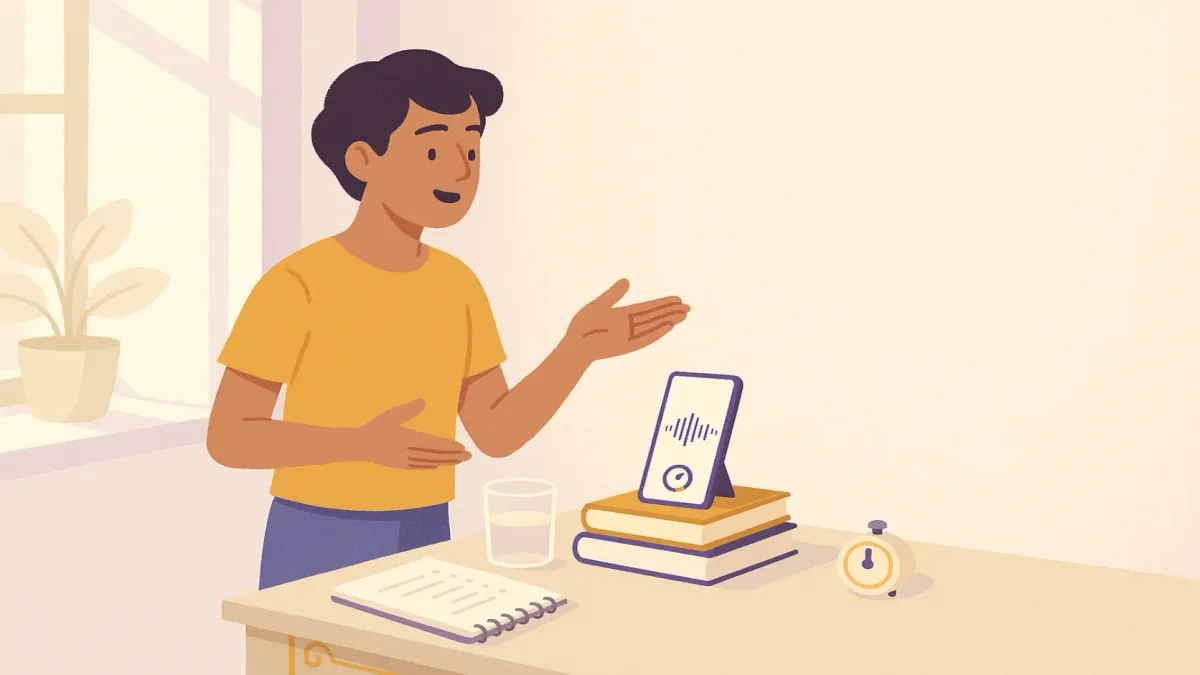
- Free tools that were never practice apps. A voice recorder, a phone camera, a transcript, a timer. Zero cost, no account, no cap, and between them they cover the two things that matter most: speaking out loud and reviewing what came out.
The fourth bucket is the one that gets left off every roundup, because nobody monetises a phone camera. It is also where anyone starting from nothing should start.
Treat any free-tier number you read — here included — as a snapshot. Caps in this category get cut, not raised: the same plans described as generous in 2024 roundups are now measured in lifetime sessions. Check the vendor's own pricing page before you plan a routine around one.
Which public speaking apps are actually free, and what are the real caps?
Verified against each vendor's own pricing page and App Store listing in September 2026.
| App | Which kind of free | The real cap | Platform |
|---|---|---|---|
| Speeko | Free forever, with limits | Free to download; core exercises and feedback usable unpaid, full access behind a subscription ($24.99/mo, $99.99/yr, or a $69.99/yr tier via the App Store) | iOS, iPadOS, macOS, Android, web |
| Yoodli | Capped free tier | Starter is 5 sessions for the lifetime of the account — and "any practice session over 30 seconds counts as a roleplay" (Yoodli pricing). Pro is $8/mo billed annually for 10 roleplays a week | Web, plus meeting integrations |
| Orai | Free download, paywalled loop | Free to download and try; the full feedback experience requires a subscription | iOS, Android, web |
| Orator | Free early access | Free through the waitlist during early access | iOS |
| VirtualSpeech | No free tier | Paid; VR headset optional but not required | Web, VR |
| Poised | Do not start here | Shutting down 8 October 2026 (Poised) despite still appearing on current roundups | Mac, Windows |
| Phone camera + transcript | Genuinely free | No cap, no account | Already installed |
Two entries on that table deserve a second look.
Yoodli's 30-second rule is the most important number in this guide. Five lifetime sessions sounds like a week of practice until you learn that anything over half a minute burns one. A single rehearsal of a five-minute talk is one session. Clear your throat, restart, and try again — that is two. Realistically the free plan is one afternoon of evaluating the product, which is exactly what it is designed to be. Nothing dishonest about that; just do not build a fortnight around it.
Speeko is the closest thing here to a usable free tier, which is why "is Speeko free" is a question people keep asking and getting a mushy answer to. The honest answer: the app is a free download and its core exercises give you feedback without paying, while full access is a subscription — and its App Store price and its own site's price are different, so compare both before you subscribe. Our full Speeko review works through the free tier’s real limits and the price gap between storefronts. If it is the subscription rather than the product that is pushing you away, Speeko alternatives breaks the price down by which part of it you actually use.
For the full ranked comparison of what each of these apps measures and who each one suits — free tier or not — the best public speaking app roundup is the parent guide to this one.
What is the best free app to practice public speaking?
The camera app you already have, for the first two weeks. This is not a dodge, and it is not "you can't get anything for free" — it is that the mechanism doing the work in every paid app is speaking out loud and then watching yourself, and you can run that mechanism today at zero cost with no allowance to ration.
Here is the $0 stack, in the order you use it.
| Tool | What it replaces | Where to get it |
|---|---|---|
| Phone camera, propped up | The recording and the playback | Already installed |
| Your phone's voice-to-text, or any free transcription | Filler-word and rambling analysis — you read them instead of being scored on them | Already installed |
| A kitchen or phone timer | Pacing and over-run detection | Already installed |
| A 650-word document | The word budget for five minutes at a delivered pace | Any text editor |
And the routine, which takes fifteen minutes a day:
- Record three minutes of your actual talk on the camera, standing up, phone at eye height. Not a summary of it — the real thing.
- Watch it once with the sound off. You are only looking at what your hands and eyes do. Nothing else.
- Watch it again with your eyes shut. Now you only hear pace, filler, and where you trail off.
- Transcribe the audio and read the transcript on the page. Every "um", every sentence that never ends, every point you made twice is suddenly visible and countable. This is the single highest-value free step, and no free app tier gives you a better version of it.
- Fix exactly one thing tomorrow. One. Pick the loudest problem in the transcript and ignore the rest.
- Repeat for ten days, keeping every recording so you can compare day one to day ten.
Two weeks of that will tell you more about your own speaking than any free tier will, and it tells you something else that matters: which problem you actually have. That is the information you need before spending money, and it is the reason to start free even if you fully intend to pay. How to practice public speaking goes deeper on structuring the reps themselves.
Keep the recordings. The only thing a paid app gives you that the free stack cannot is a trend line, and you can build your own cheaply by keeping day one. Watching a ten-day-old recording of yourself is the most motivating thing in this entire guide.
What do you give up by not paying?
Being straight about this is the point. Four things, and only one of them is usually worth money on day one.
- Scoring and trend lines. An app counts your filler words, measures words per minute, and charts both over weeks. You can count them in a transcript; you will not keep doing it for twelve weeks. This is the real product.
- A prompt to practise at all. Notifications, streaks, five-minute daily exercises. Unglamorous, and the reason paid users practise more than free ones.
- Scenario simulation. A back-and-forth you have not had yet — an interview, a hard meeting, an objection — rather than analysis of a monologue you recorded. No free stack reproduces this; it is the one capability genuinely locked behind a product. What an AI speech coach actually does covers how that pipeline works and where it still falls short of a human ear.
- Audience exposure. If your problem is freezing when watched, no recording fixes it, free or paid, because being alone is the thing that makes it easy.
Notice what is not on that list: knowing what you sound like. That one is free, and it is where most of the improvement lives in the first month.
How should you use a free tier if you only get five sessions?
Spend it as a diagnostic, not as practice. A five-session allowance is enough to answer one question well, and wasting it on five casual rehearsals answers nothing.
- Record the same three minutes in each app you are evaluating. The same material, same time of day, same room. Comparing different talks across different apps tells you nothing.
- Do it on session one, not after a warm-up. You want the app's read on your baseline, not on your fourth take.
- Read what it measures, not what it scores. A number out of 100 is marketing. The list of metrics — filler words, pace, pauses, eye contact, word choice — tells you whether the app is even pointed at your problem.
- Check it caught something you had not noticed. If every flag is something your own transcript already showed you, the subscription is buying you convenience, not insight. That is a legitimate thing to buy — just know which one you are buying.
- Do not start a streak you cannot continue. Ten days of progress data inside an account that locks on day eleven is worse than no data, because you will not go back and rebuild it.
If comparing shortlists is where you are, the head-to-head on Speeko vs Orai does this comparison on metrics, session shape, platform, and price so you do not have to burn your own allowance on it.
Why do free tiers shrink, and what should you do about it?
Because free tiers in this category are acquisition budgets, and acquisition budgets get cut. Plans described as generous in older roundups are now measured in lifetime sessions, and the apps themselves are not permanent either.
Source: Poised
Poised raised venture funding, integrated with the major meeting platforms, and is closing. Anyone who spent two years building a practice history inside it has a deadline to export it. That is not a knock on one company; it is the structural fact about a category made mostly of small, venture-funded apps — the tool measuring your progress is usually less durable than the habit it is measuring.
Three practical rules follow, and they matter more on a free plan than a paid one, because free accounts get migrated last:
- Keep your own recordings, outside the app. Your camera roll is the only practice archive that survives a shutdown.
- Check the vendor is alive before you start. Roundups lag reality by a year or more. Load the homepage and look for a notice.
- Never let your only copy of a trend live behind a login you do not pay for. Free accounts have the least contractual claim to anything.
Free vs paid public speaking apps: when is it worth paying?
One question decides it: after two weeks of the free stack, do you know what your problem is?
If yes, and the problem is habit — you know exactly what to fix and you keep not practising — pay for the app whose main feature is a daily prompt. The subscription is buying adherence, which is a real thing to buy and roughly what a month of it costs.
If yes, and the problem is rehearsing a conversation — an interview next Thursday, an objection you keep fumbling, a hard meeting — pay for scenario simulation. That capability genuinely does not exist for free.
If no — if two weeks of recordings have not told you what is wrong — do not subscribe yet. An app will not tell you either; it will give you four numbers and you will not know which one matters. What you need at that point is another pair of ears, which is a different purchase entirely. Toastmasters alternatives compares apps against clubs, coaching, courses and Meetups on cost and feedback speed, and Agora Speakers vs Toastmasters puts the two free-versus-paid club options head to head.
And if the answer is that you freeze in front of people: no app tier, free or paid, is the answer, because practising alone is exactly what makes it easy. Start with how to overcome fear of public speaking, then add graded exposure to being watched.
Key takeaways
- "Free" means four different things here: free forever with limits, a lifetime-capped tier, a free download with a paywalled loop, and free tools that were never apps. Only the first and last support a habit.
- Yoodli's free Starter plan is five sessions for the lifetime of the account, and anything over 30 seconds counts as one. It is an evaluation budget, not a practice plan.
- Speeko is the closest to a usable free tier — free to download with core exercises unpaid — and its App Store price differs from its own site's, so compare both.
- The best free app to practise public speaking is your phone camera plus a transcript. Reading your own transcript is the highest-value free step and beats any free tier's scoring.
- Don't start with Poised: it shuts down on 8 October 2026 despite still appearing on current roundups.
- Free tiers shrink and apps close. Keep every recording outside the app, and never let your only trend line live behind a login you don't pay for.
- Pay when two weeks of free practice has told you which problem you have — for habit, or for scenario rehearsal. If it hasn't, buy ears, not an app.
Frequently asked questions
Is Speeko free?
Speeko is a free download and its core exercises give you feedback without paying, with full access behind a subscription — so "free with limits" rather than a free trial that ends. Prices differ by where you buy: its App Store listing shows $24.99/month, $99.99/year and a $69.99/year tier, while its own site has run $99.99/year and a lifetime option. Compare both before subscribing, because the gap is large.
What is the best free app to practise public speaking?
For your first two weeks, your phone's camera plus a transcript beats every free tier — no cap, no account, and it runs the same mechanism the paid apps run. Record three minutes standing up, watch it once muted, listen once with your eyes shut, then read the transcript and fix exactly one thing tomorrow. Among actual apps, Speeko's free download is the most usable unpaid, and Yoodli's free plan is best spent as a one-afternoon evaluation rather than a routine.
How many free sessions does Yoodli give you?
Five, for the lifetime of the account, on the Starter plan — and Yoodli counts "any practice session over 30 seconds" as a session. A single run-through of a short talk uses one, so a false start and a retake can cost you two. Paid tiers start at $8/month billed annually for up to ten roleplays a week.
Can you get better at public speaking without paying for an app?
Yes, and most people's first month of improvement needs nothing paid. The mechanism that works is speaking out loud and then reviewing the recording, which costs nothing — the transcript in particular makes filler words, repeated points and unfinished sentences countable in a way that no free tier's score does. What money buys is adherence (a daily prompt), trend lines over months, and scenario rehearsal you cannot reproduce alone.
Free vs paid public speaking apps — which should you choose?
Start free, for two weeks, and let it diagnose you. Pay if you now know the problem and it is either habit (you know what to fix and keep not practising — buy the daily prompt) or a specific upcoming conversation (buy scenario simulation, which has no free equivalent). Do not pay while you still cannot name the problem: an app will hand you four numbers and no way to rank them, and what you actually need then is another person listening.
Are there any public speaking apps that are completely free with no paid tier?
A few browser-based tools advertise no paid tier at all, but those claims come from the vendors themselves and the caps in this category move quickly in one direction — the free plans described as generous in 2024 roundups are now measured in lifetime sessions. Verify on the vendor's own pricing page the week you plan to rely on it, and keep your recordings outside whichever tool you pick, because free accounts have the weakest claim to their data when a product shuts down.
Is Poised still a good free option?
No. Poised is shutting down on 8 October 2026 according to a notice on its own homepage, despite still appearing on many current best-public-speaking-app roundups. Do not start a practice history there. If real-time coaching during live calls was the appeal, Yoodli is the closest replacement; if you wanted to rehearse before the call, that is a practice app rather than an overlay.
Conclusion
The honest summary of free public speaking apps is that the free tiers are evaluation budgets and the genuinely free tool is the one already in your pocket. Spend two weeks recording yourself, reading the transcript, and changing one thing a day — then you will know whether you are buying a habit, a rehearsal partner, or neither. Go record three minutes right now and read what you actually said.