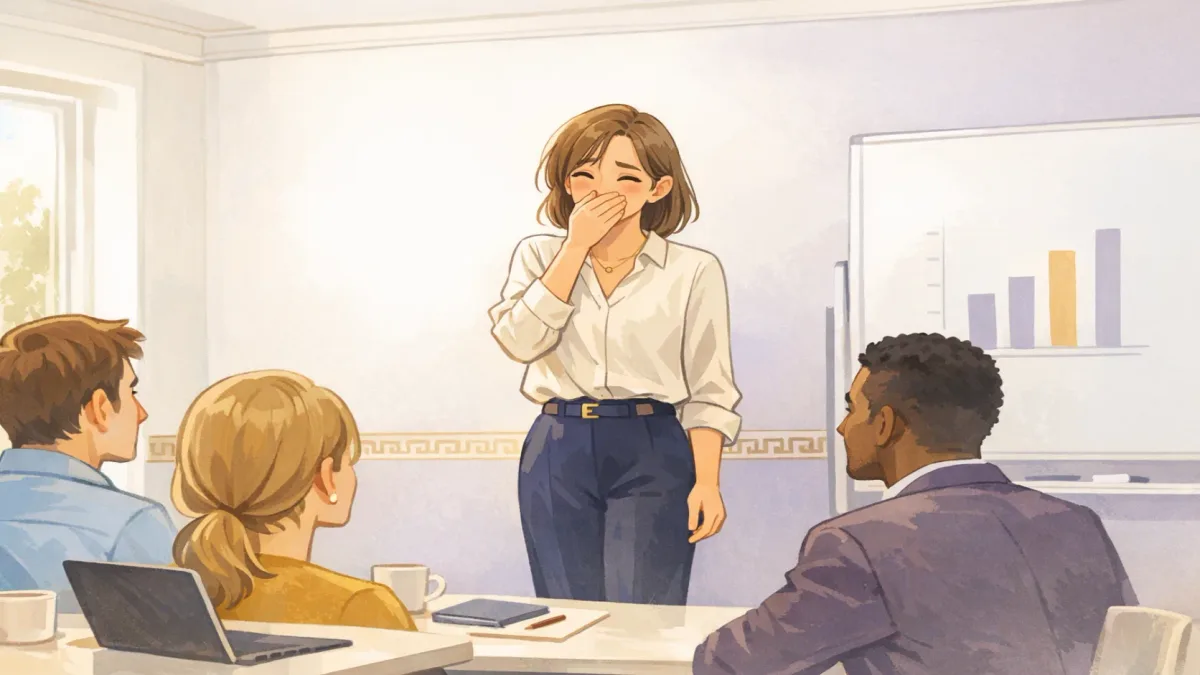
It tends to show up at the worst possible moment. You are telling a client the project is late, or walking a colleague through feedback they will not like, or standing up to open a presentation, and a short laugh escapes. Sometimes it is a breathy "heh" before the hard sentence. Sometimes it is a giggle you cannot shut down. Afterwards you replay it: they must think I don't care.
You do care. That is exactly the problem. Nervous laughter is not a sign that you find the situation funny. It is a sign that the situation is loaded and your body is looking for somewhere to put the tension. The fix is not willpower, because trying to clamp a laugh shut usually makes it bigger. The fix is to give the tension a different exit, and to practise that exit until it becomes the automatic one.
Here is the process this guide walks through:
- Understand what a nervous laugh is: a tension release, not amusement.
- Map your triggers. Most people have three or four predictable moments, not random ones.
- Pick a replacement behaviour for each trigger: an exhale, a held pause, or a planned line.
- Rehearse the hard moments out loud, on purpose, and catch the laugh on playback.
- Use an in-the-moment reset when the urge arrives: exhale, neutral face, next sentence.
- Prepare a one-line recovery for when a laugh slips out anyway.
- Know the rare cases where uncontrollable laughter is a medical issue, not a habit.
Why do I laugh when I'm nervous?
You laugh when you're nervous because laughter is mainly a social signal, not a reaction to jokes. The psychologist Robert Provine spent years recording real conversations and found that most laughter follows ordinary, unfunny remarks, that people rarely laugh alone, and that speakers laugh more than the people listening to them (Provine, 2004, Current Directions in Psychological Science). Laughter punctuates speech. It smooths, softens and signals "no threat here."
That last function is the one that misfires under pressure. When you are about to say something that could create conflict, disappointment or judgement, a short laugh is your nervous system's attempt to defuse it in advance. It's the vocal version of a raised palm: I'm harmless, please don't be upset. The neuroscientist V. S. Ramachandran called a version of this the "false alarm" theory: laughter signals to the group that an apparent threat is not a real one (Ramachandran, 1998, Medical Hypotheses). When the threat is real and you are the one delivering it, the signal fires anyway.
The most famous record of it comes from Stanley Milgram's 1963 obedience experiments. Participants told to give what they believed were painful shocks to another person showed what Milgram described as a "regular occurrence of nervous laughter," in some cases escalating into fits they could not stop (Milgram, 1963, Journal of Abnormal and Social Psychology). Nobody in that room found anything funny. They were under acute social strain, and laughter was the leak.
There is a related idea from Oriana Aragón's lab at Yale. People sometimes show an expression that seems to be the opposite of what they feel, like crying when overjoyed or a clenched "I could squeeze it" reaction to something cute. Her team's work suggests these mixed expressions may help people come back down from an overwhelming emotion (Aragón et al., 2015, Psychological Science). That research studied positive emotion, not anxiety, so treat it as an analogy rather than proof. But the pattern rhymes: a strong feeling comes out through the "wrong" expression because that expression brings the intensity down.
The useful takeaway from all of this: your nervous laugh is doing a job. It releases tension and signals peace. If you just block it, the tension is still there and finds another exit (a giggle, a smirk, a rush of words). If you give the tension a better exit, the laugh has nothing left to do.
Why nervous laughter hurts you in serious moments
Nervous laughter costs trust because listeners judge the laugh by its content, not your intent. A laugh in front of bad news reads as "this doesn't matter to me." A laugh after a hard question reads as "I'm not taking this seriously" or, worse, "I'm hiding something." The person hearing it can't see the tension behind it. They can only hear a laugh in a place where a laugh doesn't belong.
The settings where it does the most damage are predictable:
- Giving bad news or criticism. "Heh, so, the launch is going to slip." The laugh undercuts the seriousness and can feel dismissive to the person affected.
- Opening a presentation. A giggle on the first line reads as unprepared, and it often sets off a second one.
- Answering a hard question in Q&A. A laugh before the answer looks like you are dodging. For the full method on that moment, see how to handle questions after a presentation.
- Apologising or consoling. Condolences, apologies and personal disclosures are where an involuntary laugh feels most mortifying, and where the stakes for the relationship are highest.
- Being challenged by someone senior. The laugh is an appeasement signal, so it fires hardest when status feels threatened.
None of these mean you lack empathy. They mean your tension has a habitual exit, and the exit happens to be audible.
How to stop nervous laughing: map your triggers first
Nervous laughing is a habit loop, and habits are cue-driven. Before you can replace the laugh, you need to know exactly when it fires. Most people find their nervous laughter is far less random than it feels. It clusters around three or four specific moments.
Spend one week noting each time it happens. Write down three things:
| What to log | Example |
|---|---|
| The moment (what were you about to say or do?) | About to tell my manager the numbers were wrong |
| The feeling just before | Exposed, worried she'd be annoyed |
| What the laugh did for you | Bought a second; softened the blow before I said it |
After a week, the patterns show. Common ones: the half-second before a sentence that could disappoint someone, the moment eye contact feels too direct, the first line of anything formal, and the pause after someone asks you a question you don't yet know how to answer. Each of those is a cue. Each one gets its own replacement.
What to do instead of laughing
The replacement has to do the same job as the laugh: release a little tension and buy a second. If it doesn't do that job, the laugh comes back. Three replacements work well, and you can use different ones for different triggers.
1. The silent exhale
A slow breath out through the nose, about four seconds, does physically what the laugh was doing: it pushes air out and drops the tension in your chest and throat. Do it in the half-second before the loaded sentence. Nobody notices an exhale. Everybody notices a giggle. If your breath tends to get high and tight under pressure generally, the routines in breathing exercises for public speaking make this exhale easier to reach for.
2. The held pause with a neutral face
Instead of filling the moment with a laugh, fill it with stillness. Close your lips gently, let your face settle to neutral, and hold for a two-count before you speak. It feels long. To the listener it reads as you taking the matter seriously, which is the opposite of what the laugh communicated. A useful physical anchor: rest the tip of your tongue on the roof of your mouth during the pause. It keeps your jaw relaxed and makes a laugh harder to start.
3. The planned first line
Many nervous laughs happen because you are improvising the hardest sentence in real time. Write that sentence in advance and practise it until it comes out on autopilot. "I've got some news that isn't good, and I want to be straight with you." "Here's the short version: we're three weeks behind." A practised first line gives the tension a channel. Once the first sentence is out cleanly, the urge usually fades.
Match the replacement to the trigger. Exhale before bad news. Hold a neutral pause after a hard question. Use a planned line for openings. One replacement per trigger is easier to install than one universal fix.
Nervous laughter when presenting: a rehearsal drill
Nervous laughter when presenting is fixable in rehearsal because presentations are predictable. You know your opening, your hardest slide and the questions you dread. So you can rehearse those exact moments and catch the laugh before the real audience does.
Run this drill twice a week until the laugh stops showing up:
- Record the risky moments, not the whole talk. Your first 30 seconds, the slide with the bad number, and two answers to questions you're worried about.
- Play it back and mark every laugh. Include the small ones: a breathy "heh," a smile-laugh into a sentence, a laugh after a mistake. Note the exact word it came before.
- Install the replacement at that word. If you laughed before "the numbers came in lower," put your exhale right there and say it again.
- Re-record until three clean takes in a row. Clean means the line lands with a steady voice and neutral face.
- Add pressure. Do one take in front of a friend, or standing, or with a timer running. Mild pressure is what makes the new exit stick.
Some speaking coaches suggest a counterintuitive extra step: in early rehearsals, deliberately let the laugh happen on the risky line, then do it again without it. Making a habit voluntary for a few takes can make it easier to notice and stop. If you try it, drop it once you can feel the urge arriving. For the full self-review method, including what to listen for on each pass, see how to record yourself speaking.
How to stop laughing during a presentation, in the moment
When the urge hits mid-talk, run a five-second reset. Don't fight the laugh with your face, which turns into a visible strain. Redirect it.
- Stop talking for a beat. A laugh needs breath. If you pause, it has less fuel.
- Exhale slowly through your nose. Long breath out, shoulders down.
- Look at something neutral. Your notes, the slide, the back wall. Eye contact with a friendly face can set the laugh off again, so look away for a second.
- Say your next planned sentence slightly slower than normal. The slower pace signals control, and it's hard to laugh while speaking deliberately.
- Keep going. Do not comment on the urge you just beat.
If you also notice heat in your face, shaking hands or a dry mouth in the same moments, they come from the same stress response. How to stop blushing when speaking and how to stop shaking when presenting cover those in the same practical way.
What to say if you laugh anyway
You will laugh at the wrong time again at some point. What you do in the next three seconds matters more than the laugh. The goal is to own it briefly and return to the serious tone, without a long apology that keeps the spotlight on it.
| Situation | Recovery line |
|---|---|
| Laughed before bad news | "Sorry, nervous laugh. This is serious, so let me say it properly." Then say it. |
| Laughed during a presentation opening | Smile, pause, restart the sentence. No comment needed. |
| Laughed when asked a hard question | "That's a fair question, and I want to answer it properly." Then answer. |
| Laughed while consoling or apologising | "I'm sorry, that was nerves, not how I feel. I'm really sorry about this." |
| Laughed and someone looked offended | Afterwards, privately: "I laughed earlier when I was nervous. It wasn't about you." |
Two rules make every recovery work. First, name it in four or five words at most; "nervous laugh" is enough. Second, follow it immediately with the serious sentence in a steady voice. The steadiness after the laugh is what people remember. If an apology then turns into a long explanation, you're giving the moment more weight than it needs.
Is uncontrollable laughter ever a medical problem?
Occasionally, yes. Ordinary nervous laughter is common, tied to specific stressful moments, and something you can learn to redirect. But sudden episodes of laughing or crying that are out of proportion to how you actually feel, and that you genuinely can't control, can be a sign of a neurological condition called pseudobulbar affect (PBA). PBA usually occurs alongside conditions such as stroke, traumatic brain injury, multiple sclerosis, ALS, Parkinson's disease or dementia (Mayo Clinic, Pseudobulbar affect).
The difference is usually clear. Nervous laughter matches a feeling (tension, embarrassment) even if the expression is wrong for the setting. PBA episodes are disconnected from what you feel and can happen with no social trigger at all. If your laughing fits come out of nowhere, last much longer than the moment, or started after a head injury or neurological diagnosis, talk to a doctor. If your laughter is mainly part of a broader fear of speaking or social situations, the step-by-step approach in how to overcome fear of public speaking is a better starting point than habit drills alone.
How long does it take to stop nervous laughing?
For most people, the laugh fades in two to four weeks of deliberate practice on their specific triggers. Habit replacement is fastest when the cue is predictable and the replacement is rehearsed out loud, not just planned in your head. You'll usually notice the change in stages. First you catch the laugh on playback. Then you catch it a split second after it happens. Then you feel the urge before it arrives and the exhale takes over.
Expect it to come back briefly in new situations: a first meeting with a new boss, a talk to a bigger audience than usual. That isn't relapse. New stakes mean new tension, and the old exit gets tried once. Run the same replacement and it settles again. Nervous laughter is one of several signals of a nervous system working too hard. The broader habits in how to speak with confidence reduce how often that tension spikes in the first place.
Key takeaways
- Nervous laughter is a tension release and appeasement signal, not amusement. Laughter is mostly social, and speakers laugh more than listeners (Provine, 2004).
- Blocking the laugh rarely works, because the tension still needs an exit. Replace it with something that does the same job silently.
- Log your triggers for a week. Most nervous laughter clusters around three or four predictable moments.
- The three replacements: a silent exhale, a held neutral pause, and a planned first line.
- Rehearse the risky moments out loud, mark every laugh on playback, and install the replacement at that exact word.
- If it slips out, name it briefly and say the serious sentence steadily. The steadiness is what people remember.
- Laughing fits that come out of nowhere and don't match your feelings can be pseudobulbar affect. See a doctor about those.
Frequently asked questions
Why do I laugh when I'm nervous?
Because laughter is mainly a social signal that says "no threat here," and your nervous system fires it automatically when a moment feels tense. Research by Robert Provine found that most laughter follows ordinary remarks rather than jokes, and that speakers laugh more than listeners. When you're about to say something difficult, a nervous laugh is an attempt to soften it in advance and release tension.
How do I stop laughing during a presentation?
Rehearse the moments where it happens: your opening, your hardest slide and the questions you dread. Record them, mark every laugh on playback, and put a slow exhale or a two-second neutral pause at that exact point. In the moment, stop for a beat, exhale through your nose, glance at your notes instead of a friendly face, and say your next sentence slightly slower.
Why do I laugh at inappropriate times, like when someone is upset?
Serious emotional moments carry a lot of social tension, and laughter is one of the body's default ways to release tension and signal goodwill. It doesn't mean you find the situation funny or don't care. If it happens, acknowledge it briefly ("sorry, that was nerves, not how I feel") and follow with what you actually meant, in a steady voice.
Is nervous laughter a sign of anxiety?
It can be one sign among several. Most people laugh nervously sometimes, and it's normal in high-stakes moments. If it's part of a wider pattern of dreading or avoiding speaking situations, with blushing, shaking or racing thoughts, the underlying anxiety is worth addressing directly. If laughing fits are uncontrollable and unrelated to how you feel, see a doctor, as that can be a neurological condition.
Can you stop nervous laughing by biting your lip or pinching yourself?
Pain tricks can interrupt a laugh once, but they don't stop it coming back, and they're often visible. A strained face trying to hold in a laugh can look worse than the laugh. A slow exhale or a held pause with your tongue resting on the roof of your mouth works better, because it releases the tension rather than fighting it.
Conclusion
A nervous laugh isn't a character flaw. It's tension taking the nearest exit. Find the moments it fires, give each one a quieter exit (an exhale, a pause, a practised first line), and rehearse those exact moments out loud until the new exit wins. The serious sentences will start landing the way you meant them.