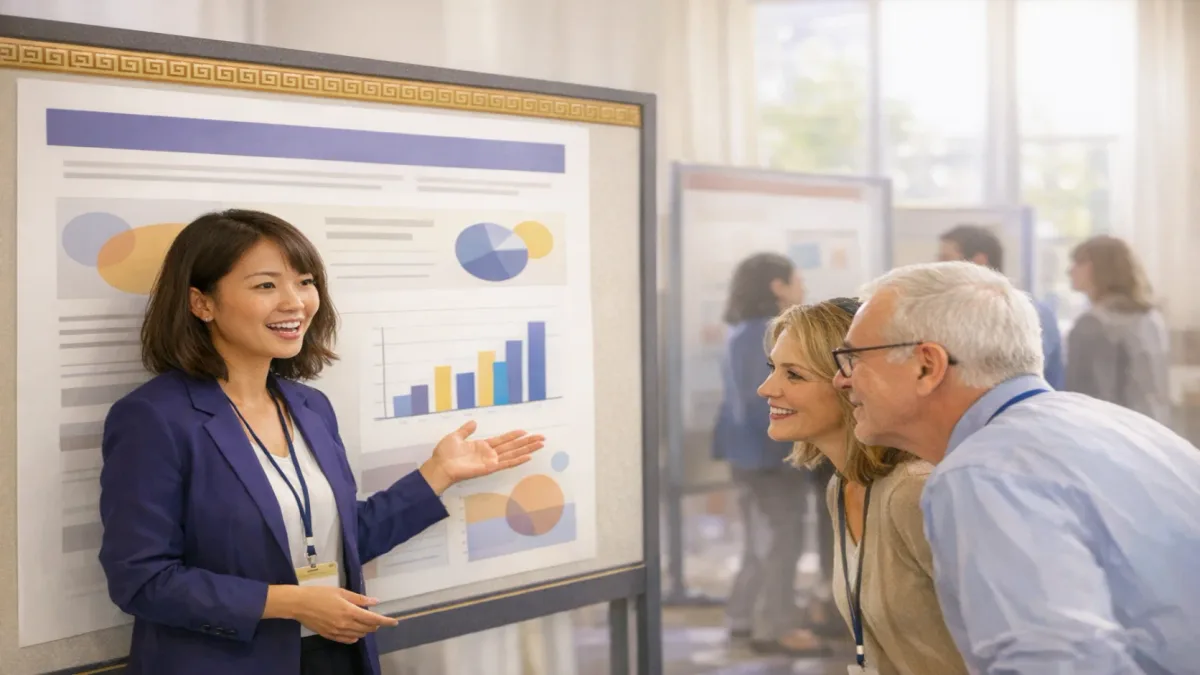
A poster session looks like a quiet room full of printed paper. In practice it is a two-hour run of very short spoken presentations, each given to one to four strangers who can walk away at any moment. Most poster advice is about layout, fonts and colour. This guide is about the part that happens after the poster is pinned up: what you actually say.
The numbers explain why delivery matters. In a study of a 1,800-delegate medical conference, fewer than 5% of delegates visited the posters. A median of 13 people glanced at each poster, 11 looked at it closely, and each poster drew only about four questions (Goodhand et al., Clinical Medicine, 2011). With that few visitors, each conversation counts.
Here is the method in order:
- Write one finding sentence that you could say if the visitor only stays for ten seconds.
- Build a 30-second opener from that sentence plus one figure.
- Extend it into a 2-minute pitch: gap, approach, finding, meaning.
- Prepare a 5-minute walkthrough for visitors who are in your field.
- Stand beside the poster, facing the aisle, with your hands free to point.
- Open conversations with people who slow down, using one low-pressure line.
- Point at figures, not text, and keep your body turned toward the visitor.
- Sort questions by type and answer the actual question in the first sentence.
- Handle groups and latecomers by restarting at the finding.
- End each conversation cleanly with a card, a QR code or a follow-up offer.
How is a poster presentation different from a conference talk?
A conference talk gives you 12 to 15 minutes, a seated audience and one fixed script. A poster presentation gives you dozens of tiny audiences, each arriving at a different moment and staying for a different length of time. That changes three things: length, order and interaction.
Length is variable. You never know if a visitor will stay for 20 seconds or 20 minutes. So you need a ladder of versions that each stand on their own, not one long script you can cut short.
Order is reversed. A talk can build up to its result. A poster pitch can't, because half your visitors leave before you'd get there. The finding goes first.
Interaction is the point. In a German survey of poster presenters and attendees, 55.4% of attendees and 49.1% of authors said they wanted one-on-one discussion at the poster (Salzl et al., Deutsches Ärzteblatt International, 2008). A poster is closer to a conversation than a lecture, and the best presenters treat it that way.
If you are also giving an oral talk at the same meeting, the timing, slide and rehearsal plan for that is in how to present research at a conference. Much of it transfers. The main difference is the length ladder below.
What should you say in the first 30 seconds of a poster presentation?
The first 30 seconds should contain three things: the question, the answer, and a pointer to the figure that proves it. Nothing else. No title reading, no "so, this is my poster", no thanks to co-authors.
A template:
"This project asks whether [X affects Y]. We tested it in [population or system], and the short answer is [finding in plain words]. This figure here shows it."
Then point at the figure and stop talking. The silence is deliberate. It gives the visitor a choice: ask a follow-up, read the figure, or say thanks and move on. All three are fine outcomes.
A worked example, for a hypothetical sleep study:
"This project asks whether a 20-minute nap before an exam changes recall. We tested it with 64 first-year students, and the short answer is yes, but only for students who slept less than six hours the night before. This figure shows the split."
Scientifica's poster guide suggests keeping the opening pitch to no more than three sentences and no longer than two minutes (Scientifica, 2026). The 30-second version is the tightest form of that rule. If you can't fit your poster into three sentences, the poster probably has more than one main message, and you should pick one before the session.
How do you build a 2-minute poster presentation script?
The 2-minute version extends the opener into four short beats. Use it when the visitor asks a follow-up or says "tell me more". Two minutes is the length several university guides land on: the University of Rhode Island's writing center recommends "a short speech (~2 minutes)" (URI Graduate Writing Center).
| Beat | Time | What you say | Where you point |
|---|---|---|---|
| Gap | ~20 s | What wasn't known and why it matters | The background box (briefly) |
| Approach | ~20 s | What you did, in one or two sentences | The methods schematic |
| Findings | ~60 s | Two results, each tied to its figure | Figure 1, then Figure 2 |
| Meaning | ~20 s | What it changes, and what you're doing next | The conclusion box |
Here is the same sleep study as a full 2-minute script:
Gap: "We know naps help memory in lab settings, but nobody had tested a nap right before a real exam, when students are anxious and often short on sleep."
Approach: "So we randomised 64 first-years to a 20-minute nap or a 20-minute rest, right before a recall test on material they'd studied the day before."
Findings: "Overall, the nap group recalled slightly more, but the difference wasn't significant. That's this panel. The interesting part is here: when we split by the previous night's sleep, students who'd had less than six hours got a large boost from the nap. Students who'd slept well got almost nothing."
Meaning: "So the practical message is that a pre-exam nap is a fix for a bad night, not a general study hack. Next we're testing it in a bigger, real exam period. Is this close to anything you work on?"
The closing question matters. It turns the pitch into a conversation and tells you which of the next 5 minutes the visitor actually wants.
What is the 30-second, 2-minute, 5-minute poster ladder?
The ladder is the core of how to present a poster well. Each version is complete on its own, and each one starts with the same finding sentence. You move up a rung only when the visitor asks.
The 5-minute version isn't a longer monologue. It's the 2-minute pitch plus whatever the visitor asks about: methods detail, limitations, the analysis you almost ran. Let their questions set the order. Keep two or three things ready to say about each part of the poster, and you can follow wherever they go.
Should you memorise a poster presentation script? Memorise the finding sentence and the opener word for word, because those are what you'll say most often and what nerves knock out first. For the 2-minute and 5-minute versions, memorise the beats, not the words. A word-for-word script sounds recited by the third visitor, and it breaks the moment someone interrupts. How to memorize a speech explains why memorising the structure rather than the sentences holds up better under pressure.
Where should you stand when presenting a poster?
Stand beside the poster, not in front of it. UAB Libraries' guide puts it simply: "Stand beside, not in front of, your poster so that interested attendees can easily view the content" (UAB Libraries). Most first-time presenters stand squarely in front, which blocks the very thing people came to look at.
Four positioning habits make a difference:
- Angle your body toward the aisle, about 45 degrees, so you can see people approaching and they can see you're available.
- Keep your hands free. Put your phone and drink down. You'll need one hand for pointing, and holding a cup reads as "on a break".
- Point without turning your back. Reach across with the hand nearest the poster and keep your shoulders open to the visitor. If you turn fully to face the poster, you lose eye contact and they lose your voice.
- Step back when someone is reading. If a visitor is reading quietly, give them a metre of space. Crowding a reader is the fastest way to make them leave.
Eye contact works differently at a poster than on a stage. You're talking to one to four people at arm's length, so hold each person's gaze for a full sentence, then look at the figure you're pointing at, then back. The general rules are in how to make eye contact when public speaking, and the hand-position advice in what to do with your hands when public speaking applies to pointing too.
How do you start a conversation with people walking past?
Wait until someone slows down or reads your title, then offer one short, low-pressure line. Don't call out to people who are walking at full speed. That feels like being stopped by a street fundraiser.
Opening lines that work:
- For someone reading the title: "Want the 30-second version?"
- For someone looking at a figure: "That's the main result. Happy to walk you through it."
- For someone who seems unsure: "Are you working on anything related?"
- For someone who's clearly an expert: "I'd really value your take on this second figure."
Each line gives the visitor an easy yes and an easy no. If they say no, say "No problem, enjoy the session" and look away. Visitors often come back once they know you won't pin them down.
Posters are also a good place for quiet presenters, because the conversations are short and one-to-one. If starting conversations with strangers is the hard part for you, public speaking for introverts covers how to prepare for exactly this kind of short, repeated exchange.
How do you walk visitors through the figures?
Talk about what the figure shows, not what the text says. Visitors can read your text. They came to hear what you think it means.
A simple pattern for each figure:
- Orient: "This axis is time, this is recall score."
- Point: "This line is the nap group."
- Interpret: "The gap opens here, after the first night of poor sleep."
That takes about 15 seconds per figure and stops visitors from squinting at axis labels while you talk past them. Posters that win attention tend to have less text, not more. In the Goodhand study, delegates' favourite posters averaged 326 words per square metre, against 782 for the lowest-ranked posters (Goodhand et al., Clinical Medicine, 2011). If your poster is dense, your spoken walkthrough has to do even more of the work. The same rules for making a chart readable in seconds are in how to present data.
How do you handle questions at a poster presentation?
Answer the actual question in your first sentence, then add detail only if they want it. Poster questions are usually more technical and more direct than talk questions, because the asker is standing a metre away and isn't performing for a room.
| Question type | What it sounds like | How to answer |
|---|---|---|
| Clarifying | "What's on this axis?" | Answer in one sentence and point. |
| Methods | "How did you control for X?" | Say what you did. If you didn't control for it, say so plainly. |
| Challenge | "Couldn't this just be Y?" | "That's a real possibility. Here's why we think it's less likely…" |
| Extension | "Have you tried it in Z?" | "Not yet. Do you think it would hold?" |
| Comment | "We saw something similar in…" | Thank them and ask a follow-up. This is a networking moment. |
| Off-topic | "What do you think about [big debate]?" | Give a brief view, then bring it back to your finding. |
Two habits help most. First, check understanding by asking "Was that clear?" instead of "Do you understand?", a swap Scientifica's guide recommends because it puts the burden on you, not the visitor (Scientifica, 2026). Second, when you don't know, say so precisely: "I don't know, and I'd want to check our data before guessing." Experts trust that more than a confident bluff.
If a discussion runs long and other visitors are waiting, offer to continue it over coffee after the session. The full question-handling playbook, including hostile and multi-part questions, is in how to handle questions after a presentation.
How do you handle groups, latecomers and ending conversations?
Groups and latecomers are where most poster presenters lose the thread. Three situations come up again and again:
Someone arrives mid-pitch. Nod to acknowledge them, finish your current sentence, then say, "Let me back up for a second. The short version is [finding sentence]." Restarting at the finding takes ten seconds and brings both visitors to the same point.
A group of three or four stops at once. Give the 2-minute pitch to the group, not to the person nearest you. Make eye contact with each person once. Then take questions in the order they're asked.
You need to end the conversation. Endings are where people feel most awkward, so prepare one or two lines in advance:
- "I don't want to keep you from the other posters. Here's a QR code for the full paper."
- "Can I email you the preprint? I'd love to hear what you think."
- "I see a couple of people waiting, but come back if you think of anything else."
Have a QR code or small handout ready. It gives every conversation a natural end point and gives the visitor something to remember you by. Recall of posters is low two weeks after a conference, according to the Goodhand study, so a link back to the work does real follow-up for you.
How do you present a poster in class?
A class poster presentation follows the same ladder, with two changes. First, your audience is usually your instructor plus classmates, so the "visitor" is often grading you against a rubric. Find out whether the instructor expects a set-length talk (often 3 to 5 minutes) or an informal walk-by, and rehearse that exact length.
Second, the instructor will usually ask at least one question that tests whether you understand the work yourself. Prepare for "Why did you choose this method?" and "What would you do differently?" Both are predictable, and both reward a short, honest answer. The broader setup for graded talks, including what instructors actually listen for, is in how to give a class presentation.
How should you rehearse a poster presentation?
Rehearse out loud, standing up, with the poster (or a printout of it) in front of you. Reading your script silently doesn't prepare you for the real thing, which is speaking while pointing, while someone watches your face.
A rehearsal plan for the week before:
- Day 1: Say the finding sentence out loud ten times until it comes out the same way every time.
- Day 2: Time the 30-second opener and the 2-minute pitch with a stopwatch. Cut until both fit.
- Day 3: Record yourself giving the 2-minute pitch on video. Watch for whether you turn your back to point. The review checklist in how to record yourself speaking works for this.
- Day 4: Give the pitch to a friend or labmate and ask them to interrupt you with a question halfway through. Practise restarting at the finding.
- Day 5: Run five quick "visitors" in a row. Vary what each person asks. This is the closest thing to the real session.
Interruption practice matters most, because it's the thing a poster session does constantly and a talk rehearsal never does. If nobody's available, an AI practice partner that can play a sceptical visitor and cut in mid-sentence is a reasonable substitute. More general rehearsal methods are in how to practice public speaking.
Key takeaways
- A poster presentation is many short conversations, not one talk. Fewer than 5% of delegates visited posters in one 1,800-delegate study, so each visitor counts.
- Prepare a ladder: a 30-second opener, a 2-minute pitch and a 5-minute walkthrough, each starting with the same finding sentence.
- The 2-minute script is gap, approach, two findings with their figures, and meaning, ending with a question back to the visitor.
- Stand beside the poster at an angle to the aisle, keep your hands free, and point without turning your back.
- Open with one low-pressure line for people who slow down, and talk about what each figure means rather than reading the text.
- Answer each question in the first sentence, say "I don't know" precisely when you don't, and prepare two lines to end conversations.
- Rehearse out loud with interruptions. That's what a poster session actually feels like.
Frequently asked questions
What should I say during a poster presentation?
Start with a 30-second opener: the question your project asks, the answer in plain words, and a pointer to the figure that shows it. If the visitor wants more, extend it to a 2-minute pitch covering the gap, your approach, two findings and what they mean. End by asking the visitor a question, such as whether the work relates to what they do.
How long should a poster presentation be?
Prepare three lengths rather than one: about 30 seconds for people passing by, about 2 minutes for people who stop, and about 5 minutes for people in your field who want detail. University guides commonly recommend a pitch of around 2 minutes. If a class assignment sets a fixed time, rehearse that exact length with a stopwatch.
Should I memorize a poster presentation script?
Memorize the finding sentence and the 30-second opener word for word, because you'll say them most and nerves hit hardest in the first seconds. For the longer versions, memorize the beats (gap, approach, findings, meaning) rather than exact sentences. A fully memorized script sounds recited after a few visitors and breaks when someone interrupts.
What are the best poster presentation tips for a first conference?
Stand beside the poster, not in front of it. Lead with the finding instead of the title. Point at figures and explain what they mean rather than reading the text. Keep your hands free, bring a QR code or handout, and prepare two polite lines for ending conversations. Rehearse out loud with someone interrupting you at least once.
What do you do if nobody stops at your poster?
Low traffic is normal: in one large study, fewer than 5% of delegates visited posters. Stand at an angle to the aisle with your hands free, so you look available. When someone slows down or reads your title, offer a short line such as "Want the 30-second version?" Don't call out to people walking at full speed.
Conclusion
Presenting a poster well is less about the printout and more about three spoken versions of one finding, delivered from the side of the board to whoever stops. Write the finding sentence first, build the 30-second and 2-minute versions from it, and rehearse them out loud with someone cutting in. That's what makes the real session feel familiar.