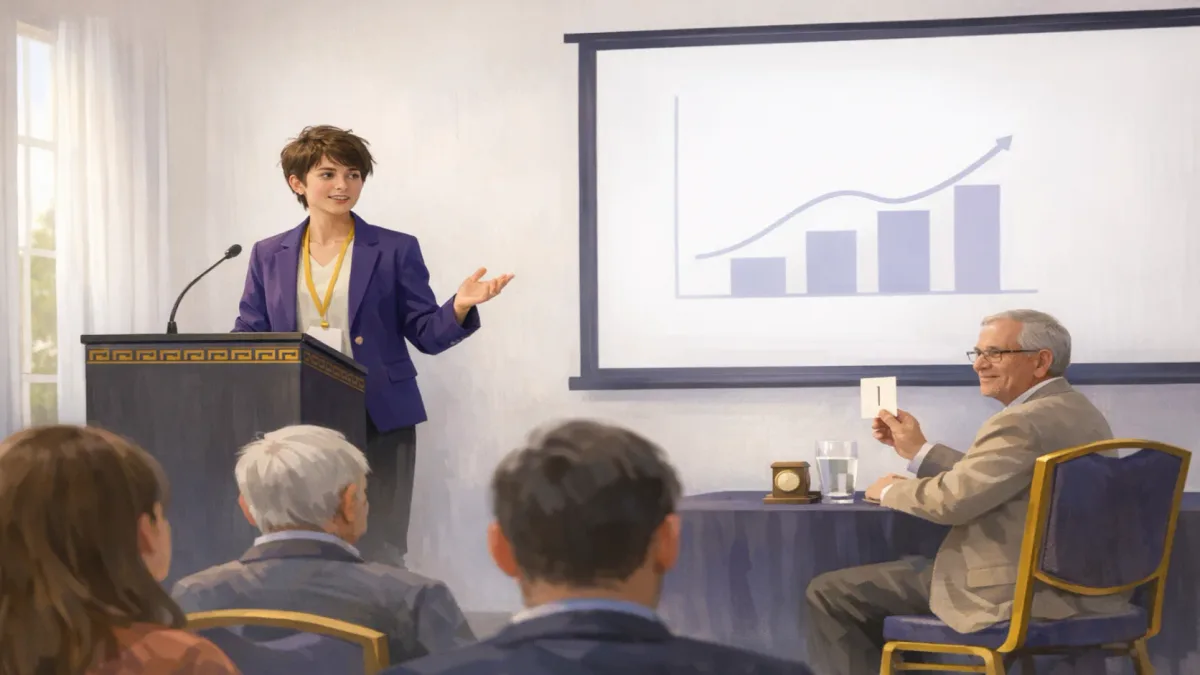
Most first conference talks fail in the same way. The speaker starts from the paper, tries to fit all of it in, runs out of time during the results, and skips the conclusion while the session chair holds up a card. Nobody in the room remembers the finding, because the speaker never had time to say it clearly.
The fix is not better slides or more confidence. It is accepting that a conference talk is a different document from your paper, with its own word budget and its own structure. This guide covers the conference-specific parts: the time arithmetic, converting a paper, slides built for listening, the session chair, poster pitches, and questions from people who know your field. For the general process behind any talk, start with our pillar on how to give a presentation.
Here is the sequence:
- Check your slot length and how much of it is Q&A.
- Write the one-finding sentence your talk exists to deliver.
- Convert the paper section by section, cutting about two-thirds of it.
- Budget your minutes and words at around 130–150 words per minute.
- Cap your slides at about one per minute of talking time.
- Rewrite every slide headline as a full-sentence claim.
- Rehearse out loud with a stopwatch, recording at least one run.
- Meet the session chair and learn the time cards before you speak.
- Prepare backup slides and short answers for expert questions.
- If you're presenting a poster, rehearse a 30-second and a 2-minute pitch.
How long is a conference talk, and how much can you actually say?
Most contributed conference talks are 10, 12, 15, or 20-minute slots, and the slot usually includes questions. A "15-minute talk" is typically 12 minutes of speaking plus 3 minutes of Q&A. Check the program or email the organizers, because this number drives every other decision.
Then do the arithmetic. The average conversational speaking rate for American English is about 150 words per minute (National Center for Voice and Speech). Conference talks run slower than conversation because of slide changes, pauses on figures, and technical terms, so plan for 130 to 150. At that rate, 12 minutes of speaking holds about 1,600 to 1,800 words.
Your paper is probably 5,000 to 8,000 words. Even a short 6,000-word paper has to lose about 70% of its words to become a 12-minute talk. That's the core insight most first-time presenters miss: you are not summarizing the paper, you are choosing the small part of it worth saying out loud.
| Slot | Speaking time | Q&A | Spoken words (130–150 wpm) | Slides (about 1 per minute) |
|---|---|---|---|---|
| 10 minutes | 8 min | 2 min | 1,050–1,200 | 6–8 |
| 12 minutes | 10 min | 2 min | 1,300–1,500 | 8–10 |
| 15 minutes | 12 min | 3 min | 1,550–1,800 | 10–12 |
| 20 minutes | 15–16 min | 4–5 min | 1,950–2,400 | 13–16 |
Shorter slots force harder choices, and the logic from how to give a 5 minute presentation applies directly: plan for less time than you're given, because nobody has ever been criticized for finishing a conference talk thirty seconds early.
What is your one-finding sentence?
Before you open your slide software, write one sentence that states what you found and why it matters. A useful template: "We found [result] in [system or population], which means [implication for the field]." For example: "We found that drought-stressed seedlings recover root growth within ten days, which means current irrigation schedules are watering twice as often as they need to."
Philip Bourne's widely cited rules for oral presentations recommend leaving the audience with no more than about three take-home points (Bourne, PLoS Computational Biology, 2007). For a 10 to 15-minute talk, one main finding plus up to two supporting points is the realistic ceiling.
Say the one-finding sentence twice: once in your first minute and once as your final line. Everything in between is there to make the room believe it. If a slide doesn't support that sentence, it belongs in the backup deck or the paper, not the talk. If you're struggling to phrase the finding for a mixed audience, the techniques in how to explain complex ideas simply help you find the plain-language version without losing precision.
How do you turn a research paper into a conference talk?
Convert the paper section by section, cutting hardest where readers need detail but listeners don't. A reader can go back to check a method. A listener hears each sentence once, so the talk keeps only what someone needs to follow the argument in real time.
| Paper section | What it becomes in the talk | Rough share of a 12-minute talk |
|---|---|---|
| Abstract | Your opening hook plus the one-finding sentence | 0:45 |
| Introduction and literature review | One sentence naming the gap: "Nobody has measured X in Y" | 1:45 |
| Methods | One schematic, plus one sentence on why the method can be trusted | 2:00 |
| Results | Two or three findings, each with one figure | 5:30 |
| Discussion | What the findings mean, and the one limitation people will ask about | 1:30 |
| Conclusion | The one-finding sentence again, plus what's next | 0:30 |
| Supplementary material, extra analyses | Backup slides after your final slide, for Q&A only | 0:00 |
The section that suffers most from this conversion is the literature review. In a paper, it establishes your credibility. In a talk, a room full of specialists already knows the literature, and five slides of prior work spends their attention on things they've seen. Name the gap in one sentence and move on.
Methods are the second trap. Researchers feel they have to justify every choice, because reviewers asked them to. But conference audiences rarely need the full protocol to follow the result. Put the protocol details in backup slides and answer methods questions in Q&A, where the person asking actually wants the detail.
How should you split the time in a 10, 12, 15, or 20-minute talk?
Use fixed proportions and scale them to your slot. For a 15-minute slot with 12 minutes of speaking: a 45-second hook, 1:45 on the gap, 2:00 on your approach, 5:30 on findings, 1:30 on what it means, and a 30-second close. Findings take nearly half the talking time, because they're the reason anyone came to your session.
Write the planned clock time on your speaker notes at three checkpoints: the start of the findings, the start of the meaning section, and the close. In the 12-minute version, that's roughly 4:30, 10:00, and 11:30. During the talk, a glance at the clock at each checkpoint tells you whether to speed up, cut, or relax.
Before you finalize, mark two "cut slides" you can drop live without breaking the argument, usually a secondary finding and a methods detail. If you're a minute behind at the findings checkpoint, skip one. Planning the cut in advance is the difference between dropping a slide calmly and racing through the last third of the talk.
How many slides do you need for a conference presentation?
A common rule of thumb is about one slide per minute of speaking time, so 10 to 12 slides for a 12-minute talk. Bourne warns that using more than one visual per minute is a reliable way to overrun (Bourne, 2007). Treat it as a ceiling, not a target.
The rule breaks in two directions. A dense results figure that needs walking through can easily take two or three minutes, so a talk built around complex data might use six or seven slides in twelve minutes. A build animation that reveals one element at a time counts as several slides, because each step needs its own sentence. Count spoken minutes per slide, not slides.
A practical structure for a 12-minute talk: one title slide, one gap slide, one or two approach slides, four to six findings slides, one meaning slide, and one closing slide that repeats your finding. Skip the "outline" slide that lists Introduction, Methods, Results, Conclusion. Every scientist in the room already knows that structure, and it costs you 30 seconds you need for the findings.
How do you design slides for a talk, not a paper?
Give every slide a full-sentence headline that states its point, and fill the body with visual evidence for that sentence: a figure, a diagram, a photo, not a bullet list. This is the assertion–evidence approach developed by Michael Alley at Penn State, and it has been tested in a controlled study.
Joanna Garner and Michael Alley compared 110 engineering students who learned from either assertion–evidence slides or default bullet-point slides. The assertion–evidence group showed better comprehension, fewer misconceptions, and lower perceived cognitive load, and the advantage held on a delayed test (Garner & Alley, International Journal of Engineering Education, 2013).
Here's the difference on a results slide:
- Topic headline: "Results: root growth"
- Assertion headline: "Seedlings recovered full root growth within 10 days of rewatering"
The topic version makes the audience work out the point from your chart while you're talking. The assertion version tells them what to see, so the chart becomes evidence for a claim instead of a puzzle. It also helps you, because the headline is your speaking cue. You won't need to read the slide aloud, a habit covered in how to stop reading off your slides.
For results figures specifically, enlarge axis labels, delete gridlines and secondary panels you won't discuss, and highlight the one bar or line you're talking about. The broader rules for charts and spoken numbers are in our guide on how to present data.
How should you rehearse a conference presentation?
Rehearse out loud, standing up, with a stopwatch running, and do at least three full runs. Silent read-throughs don't count, because reading in your head runs much faster than speaking and gives you a false sense of your timing. The goal is a talk that fits your slot with room to spare when you're nervous and speaking more slowly or quickly than planned.
A three-run plan that works in the week before a conference:
- Run 1: timed, alone. Speak the whole talk out loud and write down the time at each checkpoint. First runs usually come in well over time. Cut content, not speed.
- Run 2: recorded. Record yourself on your phone and watch it back once. You'll hear where you ramble, where you rush the key result, and where you say "um" before every slide change. The method is in how to record yourself speaking.
- Run 3: in front of someone outside your subfield. A labmate in a different area is ideal. If they can't repeat your one-finding sentence afterwards, the talk isn't delivering it yet.
Aim to finish rehearsal runs at about 90% of your speaking time, around 10:45 for a 12-minute talk. Live talks tend to stretch, through slide-advance delays, a laugh, or a pause to find the pointer, and that margin absorbs it. The full drill set for rehearsing out loud is in how to practice public speaking.
Script and memorize just two parts word for word: your first 45 seconds and your last 30. The opening carries you through the moment when nerves peak, and the close guarantees your finding is the last thing the room hears. The middle should be rehearsed but not memorized, so you can adapt if you need to cut.
What should you do in the session before you speak?
Arrive at the session room at least 10 minutes before it starts, or during the break before it, and introduce yourself to the session chair. Confirm three things: how they'll signal time, whether they'll cut you off at zero, and whether questions come after each talk or at the end of the session.
Many chairs use time cards showing minutes remaining, often 5, 2, 1, and 0. Ask whether the countdown runs against your speaking time or the whole slot including Q&A, because that changes what "2" means by three minutes. Then decide in advance what you'll do at each card:
- At 5: check your checkpoint. If you're not into the findings yet, skip a cut slide.
- At 2: move to your meaning slide, even if you haven't finished the findings.
- At 1: go straight to your closing slide and say your one-finding sentence.
- At 0: stop. Finish your sentence, say thank you, and take questions.
While you're with the chair, test your slides on the room's computer or projector, check that videos play, and find out where the clicker and microphone are. A two-minute check removes the most common opening-minute failures, and it gives you something useful to do with nervous energy.
How do you answer questions from experts in the room?
Expect questions on three things: your methods, your sample, and the limitation you didn't mention. Before the conference, write down the five hardest questions a reviewer could ask, and prepare a backup slide for any that need a figure or a number. Put backup slides after your closing slide, so they appear only if someone asks.
In the room, use a short sequence: repeat the question so everyone hears it, answer in one or two sentences, and stop. For questions that need a long technical answer, offer to continue later: "That deserves more than a minute. Can we pick it up at the coffee break?" Three lines worth preparing:
- When you don't know: "We didn't measure that. My guess would be X, but I'd want to check before saying it with confidence."
- When they've found a real limitation: "That's the main limitation of this design, and it's why the next study uses Y."
- When it's a comment rather than a question: "Thanks, that's a useful connection. Did you want me to respond to a specific part?"
Who asks matters too. At a 2015 international conservation conference, Hinsley and colleagues analysed 270 questions across 31 sessions and found that, after accounting for the gender balance of the audience, men asked 1.8 questions for every one asked by a woman (Hinsley et al., PLOS ONE, 2017). If you're presenting, you're seen as an expert, so you can help by inviting quieter parts of the room to ask. The full playbook, including hostile and multi-part questions, is in how to handle questions after a presentation.
How do you present a poster at a conference?
A poster session is a series of very short spoken presentations, not a printed paper. Prepare two versions: a 30-second pitch for someone walking past and a 2-minute walkthrough for someone who stops. Many visitors decide within a few seconds whether to stop, so the first line has to carry the finding.
The 30-second pitch: "This project asks whether X affects Y. We tested it in Z, and the short answer is yes — [one-finding sentence]. The key figure is this one." Then point at the figure and stop. If they ask a follow-up, move into the 2-minute version.
The 2-minute walkthrough: gap (20 seconds), approach (20 seconds), two findings, each pointing to its figure (60 seconds), and what it means (20 seconds). Then ask them a question back: "Is this close to what you work on?" A poster conversation works best as a conversation.
Rehearse both versions out loud, as you would a talk. A poster pitch fails in the same way as a talk: the presenter starts at the top-left corner of the poster and narrates everything in order. Start with the finding and let the visitor's questions decide what comes next.
How do you handle nerves at your first conference talk?
Nerves at a first conference talk are normal, and they're usually focused on one specific fear: the expert in the front row who might find the hole in your work. Preparation targets that fear directly. If you've rehearsed your hardest five questions and have backup slides for them, the worst-case question is one you've already answered out loud.
Two specifics help on the day. First, your memorized 45-second opening carries you through the adrenaline peak in the first minute, when your mind is most likely to go blank. Second, remember who the audience is. Many people in the room are early-career researchers presenting in the same sessions, and they want your talk to go well.
The physical side, including racing heart, shaky voice, and dry mouth, is covered in how to calm presentation nerves, with techniques you can use in the session while waiting your turn. For openings and closings beyond the scripts here, see how to start a presentation and how to end a presentation.
Key takeaways
- A conference talk is not a shorter paper: at 130–150 words per minute, a 12-minute talk holds about 1,600–1,800 words, around 30% of a typical paper.
- Write one finding sentence ("We found X in Y, which means Z") and say it in the first minute and the last.
- Cut the literature review to one gap sentence and the methods to one schematic, and give findings nearly half the time.
- Use about one slide per minute at most, with full-sentence assertion headlines over visual evidence (Garner & Alley, 2013).
- Rehearse out loud three times with a stopwatch, finish at about 90% of your speaking time, and mark two slides you can cut live.
- Meet the chair, learn the time cards, and prepare backup slides for the five hardest expert questions.
Frequently asked questions
How do you present a research paper in a conference?
Don't present the paper; present one finding from it. Write a one-sentence statement of what you found and why it matters, cut the literature review and methods to a sentence or a slide each, and give your findings about half the time. Budget around 130–150 spoken words per minute and use full-sentence slide headlines.
How do you prepare to present at a conference?
Two weeks out, confirm your slot length and Q&A time, write your one-finding sentence, and build slides at no more than one per minute. In the final week, rehearse out loud with a stopwatch at least three times, record one run, and prepare backup slides for the hardest questions. On the day, meet the session chair and test your slides in the room.
How do you present at a scientific conference if English isn't your first language?
Slow down to around 120–130 words per minute and trim your script to fit, rather than speaking faster. Memorize your first 45 seconds and your closing sentence word for word, and use full-sentence slide headlines, so your key points are on screen even if a phrase comes out differently than planned. Prepare short answers to likely questions in advance.
How do you present a poster at a conference?
Prepare a 30-second pitch (the question, the one finding, and the key figure) and a 2-minute walkthrough (gap, approach, two findings, and what they mean). Start with the finding, not the top-left corner of the poster, and end by asking the visitor a question so the exchange becomes a conversation.
What are the best conference presentation tips for a first talk?
Plan for less time than you're given, skip the outline slide, and give findings about half your speaking time. Rehearse out loud until you finish at about 90% of your time, memorize your opening and close, and agree with the session chair how time cards work before the session starts.
Conclusion
Presenting research at a conference comes down to one finding, a word budget, and a rehearsal that runs to the clock. Write the finding sentence first, cut the paper until the talk fits with time to spare, and say the whole thing out loud enough times that the session is not the first full run.