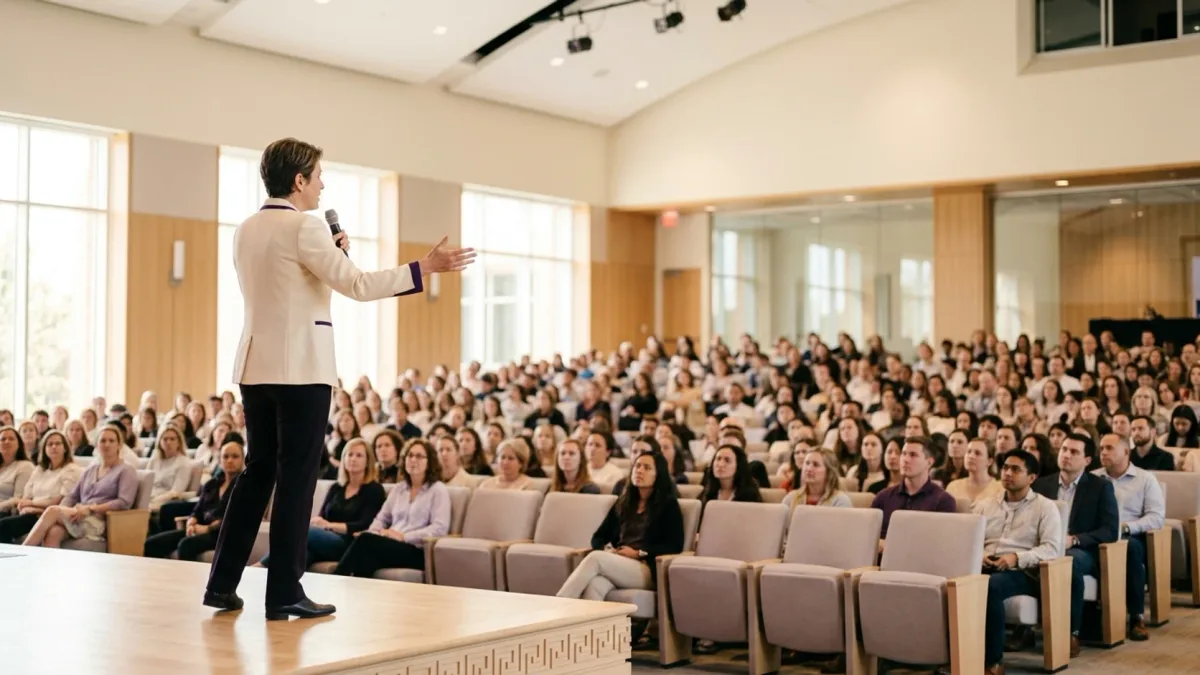
There is a piece of advice you will find on nearly every article about speaking to a big crowd: a large audience is really just a lot of small conversations, so behave exactly as you would with six people. It is comforting, and as a way to manage nerves it is genuinely useful.
As delivery advice it is wrong, and it is why competent speakers who are fine in a meeting room fall flat on a stage. A room holding four hundred people is not a meeting room scaled up. The acoustics are different, the sightlines are different, the feedback you get from the audience arrives differently, and there is a microphone between your mouth and everyone's ears. Those are physical facts, and they demand physical adjustments.
This guide covers those adjustments. The nerves are a separate problem with a separate fix — if that is your main blocker, start with how to overcome fear of public speaking, and come back here for the mechanics.
What to change when the room gets big:
- Cut your pace and over-articulate your consonants.
- Roughly double the length of every pause.
- Raise gestures to chest height and hold them longer.
- Work the room in quadrants rather than person by person.
- Learn the microphone before you need it.
- Move deliberately, or not at all.
- Rehearse standing, out loud, at performance volume.
Why does a large audience feel so different?
Partly because it genuinely is more stressful, and partly because of an anticipation gap that catches almost everyone.
The stress is measurable. In a 2023 study published in the International Journal of Virtual Reality, researchers put 140 participants through a speech-and-maths stress task in front of either a two-person audience or a 200-person virtual one. The large-audience condition produced higher salivary cortisol and more negative affect than the small one (Byron, Strahm, Bagne & Hilmert, Using virtual reality to study the impact of audience size on cortisol responses to the Trier Social Stress Test, 2023). Audience size is not just in your head — your endocrine system is responding to it too.
But the more useful finding is older, and stranger. In Basic and Applied Social Psychology, Paulus and colleagues measured high- and low-speech-anxious people speaking to audiences of different sizes. Highly anxious speakers were more anxious after facing a larger audience — the expected result. Low-anxiety speakers were less anxious in front of the bigger audience, and when given a choice, actually preferred having more people present (Paulus et al., The Effects of Audience Size on High and Low Speech-Anxious Subjects During an Actual Speaking Task, 1983).
That split matters because of what it implies: audience size is not inherently frightening. It amplifies whatever you already bring to the room. If speaking is already uncomfortable, scale makes it worse; if it is not, scale is closer to fuel. Which is a strong argument for fixing your baseline in small rooms first rather than waiting for the big one to somehow go well.
There is also a gap between dreading a large audience and actually standing in front of one. Most people find the anticipation considerably worse than the event — once you are talking, the individual faces stop registering and the crowd flattens into a single presence you are addressing. Bank that. The worst part is usually the ninety seconds before you start.
What changes when you speak in front of a large audience
Here is the part almost nobody writes about, because it is unglamorous. Six things change, and all six are mechanical.
Slow down, because the room is working against you
This is the adjustment with an actual physical cause. Large halls reverberate: each syllable keeps bouncing around the space after you have moved on to the next one. Acoustic designers target a reverberation time of roughly 1.2 to 1.6 seconds for a large auditorium — meaning sound is still audibly decaying more than a second after you produced it.
Think about what that does to fast speech. Your consonants are arriving on top of the tail of the previous word. In a small room this is a non-issue; in a hall it turns "the second point is" into mush somewhere around row fifteen. The people at the back are not straining because you are too quiet. They are straining because the sounds are overlapping.
The fix is pace plus precision. Speak slower than you would in a meeting, and give consonants — particularly the ones at the ends of words — a little more effort than feels natural. It will feel overdone to you and normal to them. If rushing is a habit rather than a one-off, how to stop talking too fast works through the underlying causes.
Double your pauses
Reactions take time to move through a crowd. In a room of eight, a laugh happens all at once. In a room of four hundred, it starts near the front, spreads, peaks, and then decays — and if you talk over it, you have both buried your next sentence and taught the room that reacting is unwelcome.
The rule: whatever pause length feels correct, roughly double it. After a punchline, after a hard number, after your thesis sentence. The silence that feels agonising on stage reads to the audience as a speaker who is entirely in control. This is the single easiest upgrade available to you, and the one most people cannot make themselves do.
Make your gestures bigger and slower
Below about the third row, small hand movements are invisible — they are lost against your body and the distance. A gesture that reads clearly in a meeting simply does not exist in a hall.
Raise the working area to somewhere between your waist and your shoulders, keep your hands out from your torso rather than tucked in, and let each gesture land and stay for a moment instead of fluttering. Fewer, larger, held. The same logic applies to your face — expressions have to be more definite to be legible at distance. If your hands are the part you find hardest to manage, what to do with your hands when public speaking covers the default positions to fall back on.
Work the room in quadrants
You cannot make eye contact with four hundred people, and trying produces the scanning-for-an-exit look that undermines everything else you are doing.
Divide the room into four to six zones — front left, front centre, front right, and the same again at the back. Pick one real person in each and deliver a complete thought to them before moving to another zone. Everyone sitting near your chosen person experiences it as being looked at, which is the whole trick: at distance, nobody can tell the difference between eye contact with them and eye contact with someone two seats along.
Do not forget the back and the far edges. Speakers under pressure gravitate to the friendly faces in the centre-front, and the effect on everyone else is a speaker who appears to be presenting to a small group they happen to be sitting behind. Deliberately give a full thought to the back row early — it also makes you project properly.
For the mechanics of holding a gaze without staring, see how to make eye contact when public speaking.
Learn the microphone before you need it
A microphone is not a volume knob; it is an instrument with a technique, and mishandling it will cost you more than any amount of stagecraft will gain.
- Distance. Hold a handheld mic roughly four to six inches from your mouth, angled up toward it from below rather than straight-on. Too close and you get the boomy proximity effect plus popped Ps; too far and you vanish under the room noise.
- Keep it with you. The single most common failure is turning your head to address one side of the room while the mic stays pointing where your mouth used to be. Move the mic with your face — treat your hand and your chin as a single unit.
- Lavalier and headset mics. These are simpler but not free. Clip a lavalier high on the centre of your chest, and keep long hair, lanyards and jewellery away from it — the rustle is amplified as loudly as your voice.
- Do not stop supporting your voice. Amplification handles loudness. It does not handle a thin, unsupported, trailing-off delivery — it just makes a weak voice loudly weak. The breath support in how to project your voice still applies with a mic in your hand.
Ask for two minutes with the mic before the room fills. Say a few sentences at your real volume, listen to what comes back, and adjust. That two minutes is worth more than an extra rehearsal.
Move deliberately, or not at all
On a stage you have space, and nerves will turn that space into pacing. Drifting back and forth burns the audience's attention and reads as agitation.
Pick two or three positions and use them as punctuation: a home position centre-stage for your main argument, a step toward the audience for a direct address, a move to one side to mark a transition to a new section. Walk while you are between thoughts, then plant and stay still while you deliver one. Stillness during a point is what makes the point look important.
How do you prepare for a room you have never spoken in?
By removing every variable you can before the day, and rehearsing under conditions closer to the real thing than a silent read-through.
Get into the room early. Walk the stage. Stand where you will stand and look at the seats from there — the view from the stage is the thing that surprises people, and having already seen it once takes most of the surprise out of it. Find where the lights are, whether you can see faces past them, where the clock is, where you walk on and off.
Test the technology yourself. Your deck on their screen, your clicker, the mic, and where your notes will be. Ask what the aspect ratio is. Ask whether there is a confidence monitor and where it sits, because if there is not, you need your structure in your head rather than on a screen behind you.
Rehearse standing, out loud, at performance volume. Mumbling through your slides at a desk is not rehearsal. Stand up, use your real voice, make the actual gestures, and take the actual pauses. Your body needs the reps, not just your memory — and delivery habits you have only practised sitting down quietly do not survive contact with a stage. How to practice public speaking covers how to build those reps when you do not have a room or an audience to hand.
Record one full run and watch it. You will find things you cannot feel: gestures that never leave your waist, a pace that creeps up in the third minute, sentences that trail off. Watching yourself once is worth several more run-throughs done blind.
Time it, and cut. Large events run on schedules and someone will hold you to yours. A talk that fits comfortably is a talk you can slow down and pause inside; a talk that is slightly too long forces you to rush, which undoes half of this guide.
What if something goes wrong on stage?
Something usually does, and audiences are far more forgiving than speakers assume — as long as you do not make the problem the subject.
- The slides fail. Keep talking. This is the argument for knowing your structure rather than your slides: if you can say what your next three points are without looking, a projector failure is an inconvenience rather than an ending.
- You lose your place. Stop, close your mouth, and look at your notes. Two seconds of silence reads as a deliberate pause. A panicked apology tells four hundred people that something has gone wrong when they had not noticed.
- A question derails you. In a big room, repeat the question into the mic before answering — most of the audience did not hear it, and the repetition buys you a few seconds to think. How to handle questions after a presentation covers the harder cases.
- The room is flat. A large audience is a quiet audience. People laugh less and nod less in a crowd than they do in a small group, because being one of many suppresses individual reaction. This is not a verdict on your talk. Do not chase the room by speeding up or pushing harder — it reads as desperation. Hold your pace and finish the thought.
Do the small-room habits still matter?
Yes — everything in this guide is a layer on top of a delivery that already works, not a replacement for one. Scale amplifies what is already there. A rushed, filler-heavy delivery does not become authoritative because there is a microphone attached to it; it becomes a rushed, filler-heavy delivery that four hundred people can hear clearly.
So the sequencing matters. Get the underlying habits steady in low-stakes rooms first — pace, pauses instead of filler, finished sentences, level inflection — and treat the large-audience adjustments as a set of dials you turn up on top of them. The guides on how to speak with confidence and how to improve public speaking cover that base layer in full.
This is also the practical version of what the Paulus research implies. If large audiences amplify your existing state, the way to make a big room go well is not to steel yourself for the big room. It is to arrive at it with a baseline that scale can safely magnify.
Key takeaways
- A large room is not a small room with more people — the acoustics, sightlines and feedback all change, and your delivery has to change with them.
- Reverberation in a big hall runs around 1.2 to 1.6 seconds, which is why fast speech turns to mush at the back. Slow down and sharpen your consonants.
- Double your pauses. Reactions take time to travel through a crowd, and silence reads as control.
- Gestures need to be bigger, higher and held; below the third row, small movements are invisible.
- Make eye contact by quadrant, not by person — at distance nobody can tell the difference.
- Hold a handheld mic four to six inches away and move it with your head; amplification does not fix an unsupported voice.
- Audience size amplifies your existing state rather than creating fear from nothing, so fix your baseline in small rooms first.
- A quiet crowd is normal, not a verdict — large audiences react less per person than small ones do.
Frequently asked questions
How do I make eye contact with a large audience?
Work in zones rather than individuals. Divide the room into four to six areas — front left, centre, right, and the same at the back — pick one real person in each, and give them a complete thought before moving on. Everyone sitting near that person experiences it as eye contact, because at distance nobody can tell whether you are looking at them or at someone two seats away. Deliberately include the back row and the far edges early, since speakers under pressure drift toward the friendly faces in the centre-front and unintentionally ignore most of the room.
How should I use a microphone when speaking to a big crowd?
Hold a handheld microphone about four to six inches from your mouth, angled up toward it from below, and move it with your head so it stays in front of your mouth when you turn to address a different part of the room. Closer than that produces a boomy tone and popped consonants; further away and the room noise swallows you. For a clip-on lavalier, fix it high on the centre of your chest and keep hair, lanyards and necklaces clear of it. Ask for two minutes to test it before the audience arrives.
Should I speak faster or slower in front of a large audience?
Slower, and with crisper consonants. Large halls have a reverberation time of roughly 1.2 to 1.6 seconds, so each syllable is still decaying while you produce the next one — at conversational speed the sounds overlap and become unintelligible for anyone past the middle rows. Dropping your pace and putting extra effort into word endings will feel exaggerated to you and simply clear to the audience. The people at the back who look like they are straining usually cannot separate your words, not hear you.
Why does a large audience feel so much scarier than a small one?
Because it genuinely produces a stronger stress response, and because anticipation inflates it further. A 2023 virtual-reality study found that a 200-person audience produced higher cortisol and more negative affect than a two-person one. But audience size mainly amplifies your existing baseline rather than creating fear from nothing — the same research literature found that people who are not especially speech-anxious feel less anxious in front of a bigger crowd and often prefer it. Most speakers also find the ninety seconds before starting far worse than the talk itself.
What do I do if the audience seems unresponsive?
Treat it as normal rather than as feedback. Individual people react far less in a crowd than they do in a small group — laughter is quieter per person, nodding is rarer, and from the stage a perfectly engaged audience of four hundred can look completely blank. The mistake is chasing the room: speeding up, pushing your energy harder, or adding material to win a reaction. That reads as desperation and makes things worse. Hold your pace, keep your pauses long, and finish the thought you are on.
How much should I move around the stage?
Move deliberately or not at all. Pick two or three fixed positions and use them as punctuation — a home position for your main argument, a step forward for direct address, a shift to one side to mark a new section — and walk only between thoughts, not during them. Standing still while you deliver a point is what signals that the point matters. Undirected pacing, which is what nerves produce if you let them, drains the audience's attention and reads as agitation.
Conclusion
A big room asks for the same delivery you already have, turned up: slower pace, longer pauses, larger gestures, eye contact by zone, and a microphone you have actually tested. Get the base habits steady in small rooms first, because scale amplifies whatever you bring to it. Then rehearse the real talk standing up and out loud, at the volume you will actually use.